What Microsoft showed on October 7
The announcement came at a San Francisco event where Microsoft presented a revamped Windows, new Surface devices, and a set of developer tools aimed at software that acts on its own. Copilot and Windows Search are wired into system tasks and local file operations, so the assistant sits on the taskbar as a command point rather than a separate window. Fortune reported that the pitch is "agentic AI" as an operating-system feature, not an app category.
Microsoft also said hybrid intelligence features will reach tools such as GitHub Copilot during October 2026, which puts the routing logic in front of developers sooner than the consumer hardware refresh.
Hybrid intelligence and where the tokens run
The idea behind hybrid intelligence is that the machine decides whether a request is handled on the local GPU or sent to a cloud model. Microsoft says the Surface Laptop Ultra can run a 120-billion-parameter model on-device at petaflop-level AI performance. That is a real number, and it matters because the economics of cloud inference are no longer the barrier they were. Anthropic's Claude Haiku 5.5 lists at $0.10 per million input tokens and $0.50 per million output tokens, Mistral Large 4 at $0.68 and $2.09, and DeepSeek-V4.1-Flash at $0.15 and $0.60 off-peak. At those rates a laptop does not pay for itself by saving tokens.
What local execution buys is different: latency that does not depend on a connection, files that never leave the device, and a fixed cost instead of a metered one. For a document assistant working over a folder of client contracts, that distinction is usually the deciding factor. Our own measurements on a 16 GB consumer card in AI Arena show the ceiling clearly enough: a 120B model in that memory class is not a comfortable fit, which is why Microsoft is pairing the feature with 128 GB-class hardware in the first place.
Microsoft Execution Containers
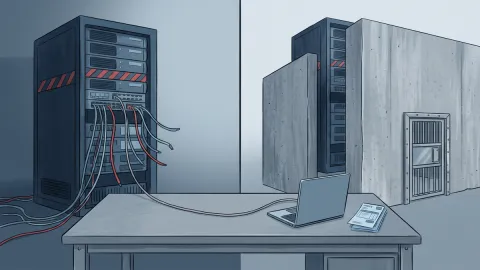
MXC is the part worth watching. It is a containment layer that restricts what an autonomous agent can read, write, and call, so a misbehaving agent cannot walk through the user's file system or reach the network without permission. That is a shift from the current pattern, where agent frameworks run with whatever rights the host process has.
The list of companies willing to implement it is the strongest signal in the announcement: Anthropic, OpenAI and Nvidia. Format adoption across vendors is rare, and it has historically been what turns a vendor-specific API into something that survives the next product cycle. Whether the implementations arrive on schedule is a separate question that the event did not answer.
What the sandbox means for EU compliance
European teams have a specific reason to look at MXC. Under the EU AI Act, general-purpose AI obligations have been mandatory since August 2025, and transparency duties plus deepfake labelling became enforceable on August 2, 2026. The 2026 Digital Omnibus amendment pushed strict high-risk compliance deadlines to 2027 and 2028, but record-keeping, logging and human-oversight duties for high-risk systems remain in force. An execution container that produces a bounded, inspectable record of what an agent touched is closer to that paperwork than an agent that simply runs as a user process.
There is a data-protection side too. Processing inside the container on local hardware keeps personal data on the device, which changes the analysis under GDPR if the alternative is a cloud endpoint in another jurisdiction. That argument only works when the routing actually keeps data local, and Microsoft has not published a full breakdown of which tasks default to which side. The European Commission's AI Act pages remain the reference for what has to be documented.
Prices in dollars and euros
The Nvidia RTX Spark-powered Surface Laptop Ultra opens at $2,599, with top configurations reaching $5,900, and ships from October 16. The Surface RTX Spark Dev Box workstation starts at $6,000.
Converted at roughly 1.08 USD per euro, the laptop starts near €2,400 and tops out around €5,460, while the dev box lands around €5,550. Those figures are indicative. US list prices generally exclude sales tax, while EU retail prices include VAT, which is 21% in Czechia and 19% in Germany, so the gap between a US sticker and an EU receipt is wider than the exchange rate suggests. Microsoft has not published European pricing or a country-by-country availability list for the new devices.
What a developer can do now
The hybrid intelligence rollout to GitHub Copilot during October is available before the hardware is. Wait for the European pricing sheet before budgeting for hardware, and treat the local-model claim as something to verify against your own workload rather than a spec line. For anyone building agents that touch files or customer records, MXC is worth a look on the documentation alone, both as a security boundary and as the beginning of a compliance trail. The container format has three large vendors behind it; that is more than most agent security proposals have managed.
Will the new Surface devices be sold in the EU on October 16?
Microsoft announced an October 16 release date and US pricing but has not published European availability or euro pricing for the Surface Laptop Ultra or the RTX Spark Dev Box. Until that list appears, EU buyers cannot assume a simultaneous launch.
Do I need 128 GB of memory to run a 120B model locally?
To run one of that size at usable speed, yes, more or less. Quantised weights for a 120B model consume far more than the 16 GB on a typical consumer card, which is why Microsoft pairs the feature with workstation-class hardware.
Does MXC make an AI agent compliant with the AI Act by itself?
No. A sandbox limits what an agent can access, and it can help produce logs, but obligations depend on the system's risk classification and on what the provider documents. Technical controls are one input into that, not a substitute for it.