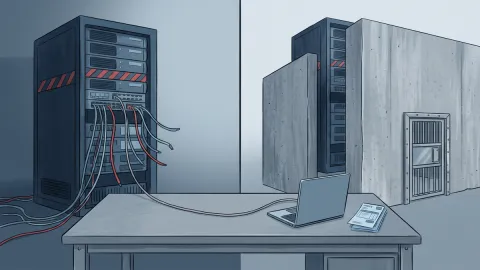
What Fulcra actually shipped
Fulcra Dynamics, led by co-founder and CEO Michael Tiffany, sells a user-owned context backend for AI agents. That phrase hides a fairly concrete architecture decision: the context (your calendar, your notes, your history with the assistant) lives in an account you control, and the model you point at it is replaceable. The company says the platform supports direct cross-communication between agents running on Claude, ChatGPT, Hermes and OpenClaw.
The multiplayer feature, announced on 22 September and first reported a few days earlier, extends that from one person to several. Two agents belonging to two different people can exchange the context they need to agree on a meeting, split a task list, or keep a shared project moving. The Trend Hunter write-up frames this as part of a broader "shared AI apps" trend, and that framing is fair: the unit of deployment stops being an assistant and becomes a small multi-user service.
What the coverage does not contain is a benchmark, a latency figure, or a reliability number. So treat the announcement as a capability claim, not a measured result. Anyone who has run an agent loop in production knows the failure modes live in the retries, not in the happy path.
From one workflow to a shared app
The deployment step matters more than it sounds. Fulcra's flow lets a user take a personal, single-owner agent workflow and publish it as a web app that other people can join. That is a different product category from a chat window. It means identity, permissions and per-user context separation have to exist before the first invite goes out.
The reason this is technically interesting is that most personal-agent setups today are glued to one vendor. Your assistant is a GPT, or a Claude, or a local Ollama model behind a custom front end, and sharing it with your partner means sharing your login. Fulcra's pitch is that the context layer is neutral, so the shared app does not care which model each participant runs. If that holds up in practice, it removes a real lock-in barrier. If it does not, the shared app quietly becomes a lowest-common-denominator chat room.
The token bill depends on whose model you attach
Model neutrality has a price consequence that gets very little attention in launch posts. Once the context layer is shared and the model is a choice, the monthly cost of the same coordination workload can vary by a factor of twenty depending on what each participant points at it. I ran the numbers on current API list prices for a modest workload: 50 million input tokens and 5 million output tokens per month, roughly what an active household or a five-person team could burn once agents start summarising threads for each other. Euro figures assume $1.15 per euro.
| Model | Input $/1M | Output $/1M | Monthly cost | Monthly cost (EUR) |
|---|---|---|---|---|
| Claude Haiku 5.5 | 0.10 | 0.50 | $7.50 | ≈ €6.52 |
| GLM-5.3-Flash | 0.15 | 0.50 | $10.00 | ≈ €8.70 |
| DeepSeek V4.1 Flash (peak) | 0.30 | 1.20 | $21.00 | ≈ €18.26 |
| Mistral Large 4 (launch price) | 0.68 | 2.09 | $44.45 | ≈ €38.65 |
| Meta Muse Spark Open (hosted) | 1.25 | 4.25 | $83.75 | ≈ €72.83 |
| Grok 4.7 | 2.00 | 6.00 | $130.00 | ≈ €113.04 |
| GPT-6.1 Sol | 2.00 | 10.00 | $150.00 | ≈ €130.43 |
The spread between a Haiku-class model and a frontier model is the whole argument for keeping the context layer separate from the inference layer. A shared scheduling agent does not need a frontier model to compare three calendars. A shared research agent might. Fulcra's architecture lets each participant make that call per agent, which is more flexibility than most competing setups offer, and also more room to get the bill wrong. Off-peak discounts, like DeepSeek's 50% cut, push the low end even lower.
Coordination raises questions the launch did not answer
Agent-to-agent messaging is not new as a research idea, but it is new as a consumer product. The hard problems are unglamorous. How does a receiving agent tell the difference between data and instructions when both arrive in the same context window? What stops a compromised agent in one household from issuing a plausible-sounding instruction to an agent in another? How is consent recorded when your agent shares a fragment of your calendar with a stranger's agent?
Those are questions to ask of any platform in this category, and the published material around the September rollout does not address them. It may well be handled in the product. It is not visible in the announcement.
The European side: who is the controller
For EU users the deployment question comes before the technical one. A context backend that stores personal notes, calendars and message history is processing personal data under the GDPR, full stop. Once two households' agents exchange context, you have a joint processing arrangement that needs a legal basis and, in most readings, a written agreement between the parties. Fulcra's user-owned model suggests the user is the controller and the platform is a processor, which is the cleaner setup, but it also means the user carries the obligation.
Data residency is the second issue. The platform is web-based and reachable from the EU, so availability is not in question. Whether context is stored on European infrastructure is a separate matter, and for a product whose selling point is that you own your data, it is the question worth asking first. EU businesses under the sovereign-AI procurement pressure of 2026 will ask it immediately.
Third, the EU AI Act is now in its enforcement phase for general-purpose AI, with Article 50 transparency obligations supervised by the EU AI Office and the high-risk timetable pushed to 2027 and 2028 under the Digital Omnibus. A shared app that visibly acts as an AI system has to disclose that it is one. That applies to whoever deploys the app, not to Fulcra.
What to test before you invite anyone
If you want to try this on a real household or a small team, four things are worth checking in the first hour. Whether context separation genuinely holds when two users ask overlapping questions. Whether the shared app keeps working when one participant switches models mid-project. Whether you can export the whole context store and walk away. And whether the audit trail lets you see which agent told which other agent to do what. None of these are exotic requirements. They are the minimum for letting software act on your behalf in front of other people.
Our own AI Arena rig exists for exactly this kind of question: run the same task through several models and look at the numbers instead of the marketing. A shared agent app deserves the same treatment before it gets your family's calendar.
Do I need a paid AI subscription to use a shared Fulcra app?
Not necessarily for the context layer, but the agents still need a model behind them. Depending on how the app is configured, that cost lands either on the person who deployed it or on each participant's own API account. Fulcra has not published a public price list in the material covered here, so treat per-user cost as something to confirm before inviting people.
Can an agent built on a local model join a shared app?
The company lists support for several external agent frameworks rather than a fixed model list, which suggests the model itself is not the constraint. A local model running through a compatible framework would still need to reach the context backend over the network, so check that the interface is exposed in a way your setup can call.
Does a shared agent app change my GDPR obligations?
Yes. If you deploy an app that other people join and their personal data flows through it, you are no longer just a user. You may be a controller for that data, with the documentation, retention limits and access rights that follow from it.