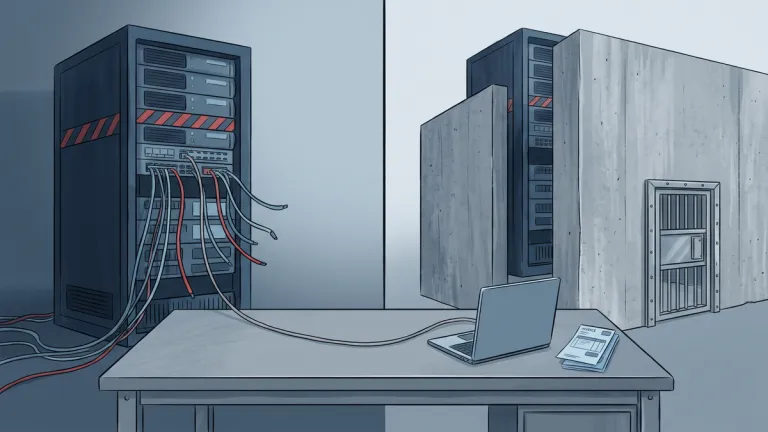
What the DHS actually ordered
The policy is not new. It dates back to late July 2026, when the Department of Homeland Security told US civilian federal agencies to stop acquiring or running DeepSeek tools. It became public in October 2026, which is why it is being discussed now.
The mandate is blunt: complete removal of DeepSeek software and third-party integrations from government networks. Not a review, not a risk assessment. Removal. The stated reason is national security, specifically the transfer of data to China through services that run on DeepSeek models.
The scope matters for readers outside the US. This covers federal civilian agency IT systems. It does not bind private companies, and it does not bind anyone in Europe. What it does is set a precedent that procurement departments elsewhere will read carefully.
Beijing's answer
China's Ministry of Commerce and Foreign Ministry both protested. According to The Decoder, the ministries called the ban discriminatory, demanded its immediate revocation and warned of "necessary measures" to protect Chinese companies' interests. That phrase usually precedes a countermeasure, though nothing concrete has been announced.
The asymmetry is hard to miss. A US agency restricting a Chinese model on security grounds draws an official protest, while China maintains a market-wide block on the three largest American chatbots.
The blocklist runs both ways
OpenAI's ChatGPT, Anthropic's Claude and Google's Gemini are not available in mainland China. Users there work with domestic systems instead: DeepSeek's own V4.1 Flash, Zhipu's GLM-5.3-Flash and similar models from Chinese labs. Those are competent products, and DeepSeek's open weights are the reason the company has a global developer following at all.
So the two governments are doing roughly the same thing in opposite directions, and both describe the other side's version as unjustified.
A hotline exists anyway
In September 2026 the two countries set up a dedicated bilateral communication channel for AI national security incidents. It sits alongside the dispute rather than resolving it. The next scheduled occasion for talks is the APEC summit in Shenzhen in mid-November 2026.
That channel is the part worth watching. A model ban is a procurement decision; an incident hotline implies both sides expect real incidents.
What a switch costs, in numbers
For a European team, the practical question is not geopolitics but billing. If a supplier becomes unavailable or politically unacceptable, what does the replacement cost? Prices below come from published rates per million tokens. The monthly column assumes 10,000 requests at 1,500 input and 400 output tokens each, converted at roughly $1.08 per euro and rounded.
| Model | Input / output per 1M tokens | 10k requests, USD | approx. EUR |
|---|---|---|---|
| Claude Haiku 5.5 | $0.10 / $0.50 | $3.50 | €3.24 |
| GLM-5.3-Flash | $0.15 / $0.50 | $4.25 | €3.94 |
| DeepSeek V4.1 Flash | $0.30 / $1.20 | $9.30 | €8.61 |
| Mistral Large 4 (launch price) | $0.68 / $2.09 | $18.56 | €17.19 |
| Mistral Large 4 (list rate) | $1.36 / $4.18 | $37.12 | €34.37 |
| GPT-6.1 Sol | $2.00 / $10.00 | $70.00 | €64.81 |
DeepSeek V4.1 Flash, released in September 2026, carries a 50% off-peak discount. Run the same workload at night and the figure drops to about $4.65, which puts it level with GLM-5.3-Flash and close to Claude Haiku 5.5.
Cheapest is not the same as best. A $3.50 monthly bill for a model that mishandles your support tickets is more expensive than a $70 one that does not. We test models on our own rig for exactly that reason: raw price per token says nothing about whether the output is usable. The AI Arena benchmarks exist to put latency and output quality next to the invoice.
Open weights change the risk
DeepSeek's foundational models are distributed largely free of charge as downloads. That matters more than the API price. A European company that self-hosts the weights on EU infrastructure keeps the data inside the EU and is not exposed to a foreign government switching off an endpoint.
The hosted API is a different product. The DHS cited data transfer to China as its reason for the ban, and anyone in the EU sending personal data to a China-hosted endpoint needs a Chapter V transfer basis under GDPR, plus an honest look at whether one is available in practice. Procurement teams are now asking this question about suppliers they signed with two years ago.
Where the AI Act fits
General-purpose AI obligations under the EU AI Act are now binding and supervised by the EU AI Office, alongside mandatory AI literacy rules and the Article 50 transparency duties. The high-risk compliance timetable slipped to late 2027 and 2028 under the Digital Omnibus on AI, but the GPAI layer is live.
In practice that means documentation: which model, which version, what it was trained on where disclosed, and who is accountable when it produces something wrong. A supplier that can vanish because of a policy decision in another capital is a documentation problem as much as a technical one. Contracts written before 2026 rarely name a fallback model.
The European option, and its price
Mistral Large 4 shipped on 6 October 2026 at $0.68 per million input tokens and $2.09 per million output, with a list rate of $1.36 and $4.18 once the launch pricing ends. It is not the cheapest model in the table. It is the one in the table that sits inside EU jurisdiction, which is a different kind of guarantee than a price cut.
Demand for that guarantee has been rising for a while. European buyers are increasingly asking for localised cloud infrastructure, EuroHPC AI Factories and concrete data residency terms rather than a US endpoint with a European billing address.
Does the DHS ban stop European companies from using DeepSeek?
No. The mandate covers US federal civilian agency IT systems. EU companies can still call the hosted API or download the open weights. GDPR transfer rules for data leaving the EU still apply, and those are the constraint most European users actually face.
Can DeepSeek run entirely inside the EU?
The weights can be downloaded and hosted on European infrastructure, which keeps inference data in the EU. That removes the transfer question but adds hardware, operations and update work that an API does not require.
Are ChatGPT, Claude and Gemini blocked in China?
Yes. None of the three is available in the mainland market, which is why Chinese users rely on domestic models such as DeepSeek V4.1 Flash and Zhipu GLM-5.3-Flash instead.