The money comes from the Innovation Fund, which is filled by revenues from the EU Emissions Trading System. The call behind this round was launched in December 2025, and the winners have now been invited to start preparing grant agreements, according to the Commission's Innovation Fund selection announcement of 19 October.
What was selected
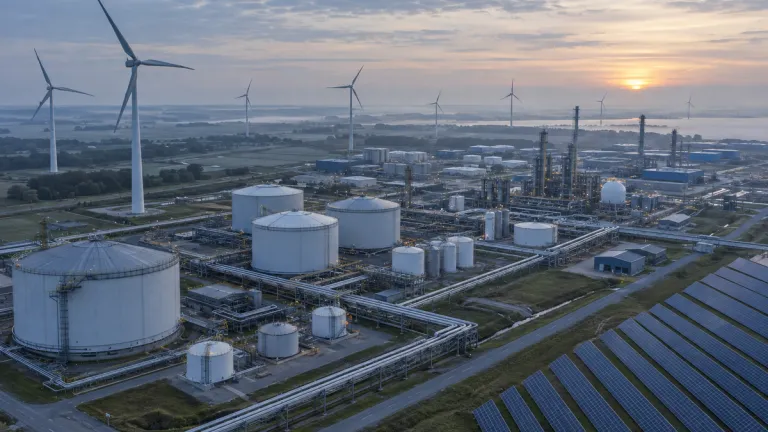
The portfolio covers clean technology manufacturing, industrial decarbonisation, renewable energy, energy storage, critical raw materials, sustainable mobility and carbon management. Six of the projects deal with strategic raw materials – permanent magnets and battery material recycling among them.
The geography stretches beyond the 27 member states. Norway, Iceland and Liechtenstein take part through the EEA, and one of the two headline firsts sits in Norway.
Where the money goes
The Commission published totals by category rather than per-project amounts:
– about €1.58 billion for 12 large-scale decarbonisation projects
– €895 million for 12 clean technology manufacturing projects
– €458 million for 17 medium-scale decarbonisation projects
– €124 million for 20 small-scale projects
Those four lines add up to roughly €3.06 billion and cover 61 of the 77 projects. The remaining share of the €3.4 billion headline figure is not broken down in the published summary.
Two firsts
NetZeroHeat in France is the first small modular reactor to appear in an Innovation Fund selection. It is a heat-only module with roughly 30 MW of thermal output (MWth), designed to deliver about 131 GWh of low-carbon heat a year to the district heating network. Heat-only units do not generate electricity; they replace gas or coal boilers in municipal networks.
Furu in Norway is the first direct air capture and storage project in the portfolio. Its design target is roughly 4,000 tonnes of CO₂ pulled from the atmosphere annually and stored permanently.
What 4,000 tonnes means
Four thousand tonnes a year is small next to the programme's overall claim. Ten years of operation at that rate gives 40,000 tonnes, or 0.04 million tonnes. The 290 million tonne figure for the whole portfolio is more than 7,000 times larger.
The comparison is not an argument against the plant. Direct air capture is expensive per tonne and early plants are built to prove the technology and bring costs down. It does show how much of the 290 million tonnes rests on conventional industrial projects: cement, steel, chemicals, heat.
The same arithmetic applies to the headline emissions figure. Divide 290 million tonnes by ten years and you get 29 million tonnes a year. Over 31.5 million seconds in a year, that works out at a little under one tonne of CO₂ equivalent per second — the magazine's own arithmetic from the published totals.
Who pays
The Innovation Fund does not draw on national budgets. It is financed from the revenues of the Emissions Trading System, meaning companies covered by the carbon market pay for allowances, and part of that money returns as grants to low-carbon projects.
That structure explains the mix of winners. Projects that cut emissions in sectors already under the trading system have a direct link to the fund's income. Manufacturing of batteries, heat pumps or electrolysers is included because the fund also supports the industrial base that produces low-carbon equipment.
For readers who follow European regulation, the pattern is familiar: the EU sets a price on emissions through the trading system and uses the proceeds to fund the transition. Our magazine section tracks how those rules reach households and small firms in practice.
What the announcement does not say
There is no signing date for the grant agreements, and the selection does not by itself guarantee that every project reaches construction.
Individual award sizes are also missing from the published summary, which gives only category totals. Anyone wanting the per-project figures will have to wait for the grant agreements.
Does the fund cover countries outside the EU?
Yes, within the European Economic Area. Norway, Iceland and Liechtenstein are eligible alongside the 27 member states, and this round includes a Norwegian project. The United Kingdom and Switzerland are not EEA members.
What is a small modular reactor?
A nuclear reactor built from factory-made modules rather than assembled entirely on site, which is meant to make units cheaper and faster to build than large conventional plants. The French NetZeroHeat unit on this list produces heat for district networks, not electricity.
Can a project apply for money for operating costs?
The Innovation Fund is designed around investment support for capital costs of low-carbon installations. The published summary for this round does not break down how each grant is split between construction and other costs.
The 77 developers now move into preparation of grant agreements with the Commission. No timetable for signing them has been published.