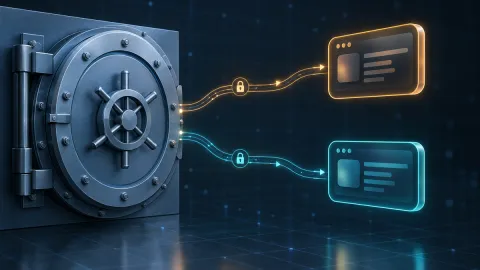
Sweden's Government Offices will block direct web access to ChatGPT and Claude on staff computers from Monday, 26 October 2026. Microsoft Copilot keeps its approval. Employees who still need OpenAI or Anthropic models will reach them through an internal government platform, not a browser tab.
The decision and its date
Sveriges Radio's Ekot reported the block on 23 October, three days before it takes effect. Mikael Wettercrantz, the Government Offices' digitaliseringsdirektör (digitalisation director), informed staff through the internal intranet that AI platforms without formal agreements create information security risks when sensitive public-sector data is involved. Two details separate this from a plain ban. The restriction covers direct web access from work machines. It does not cover the underlying models, which stay reachable through a government-built assistant for staff with authorisation.What is blocked and what stays
| Service | Status from 26 October | Note |
|---|---|---|
| ChatGPT (consumer web) | Blocked on work computers | Direct access removed |
| Claude (consumer web) | Blocked on work computers | Direct access removed |
| DeepSeek | Already restricted | Earlier decision |
| Microsoft Copilot | Approved | Security and data governance tightened after internal review |
| ChatGPT and Claude via the internal platform | Allowed | Authorised staff only |
Copilot sits inside an existing agreement
Technically, Copilot is not a different category of software. Microsoft's assistant runs on OpenAI models, delivered under Microsoft's own agreement with the authority. Data handling, retention and audit terms sit in a contract the organisation already holds, rather than in a click-through acceptance screen. That is the practical distinction the Swedish review worked from, and Wettercrantz's intranet message points the same way: formal agreements, not model quality.Other Swedish agencies moved first
The Government Offices are not leading here. The Swedish Tax Agency (Skatteverket) and the National Board of Institutional Care (SiS) put comparable blocks in place. The Swedish Enforcement Authority (Kronofogden) has started formal proceedings to weigh a similar policy. An internal audit at the Swedish Transport Administration (Trafikverket) found staff actively using around ten different open AI services. That number is the strongest argument for the policy. Ten services means ten sets of terms, ten retention rules and nobody counting.The GDPR reason behind "formal agreements"
Article 28 of the GDPR requires a written contract between a controller and a processor before personal data changes hands. A civil servant pasting case notes into a personal-tier chatbot account has no such contract, and the retention settings live in whichever account was used, not in the authority's IT department. Consumer tiers are built for personal use. The paperwork public bodies need, meaning a processing agreement, defined retention, audit rights and breach notification, ships with enterprise products and public-sector terms. That is the whole of the argument, and it applies to any vendor.Where the AI Act fits
This is a procurement and information-security decision, not an enforcement action under the EU AI Act. Chapter V obligations for general-purpose AI providers are now handled by the EU AI Office, and Article 50 transparency duties for synthetic content have applied since August 2026. Neither of those rules required Sweden to close a browser tab. What the regulation does change is the paperwork on the other side of the table. Providers selling into the EU publish training-data summaries and mark synthetic output machine-readably. A procurement department asking for a data processing agreement today is asking a question the regulation has made easier to answer than it was two years ago.Alternatives a European buyer can procure
For an authority that wants a general model without a US consumer account, the EU market has options with published prices. Mistral Large 4, in API preview, is listed at $1.36 per million input tokens and $4.18 per million output tokens. Those figures are quoted in USD, and EU buyers add VAT on top. The contract is what makes the invoice usable in the first place. Open-weight models sidestep the direct-access question completely. Meta's Muse Spark Open ships under Meta's own Muse Model License, while DeepSeek-V4.1-Flash uses a permissive licence; check the terms before internal deployment. Running them on your own hardware replaces a vendor relationship with an operations budget. That is a different project with different costs; our AI Arena measurements on an RTX 5060 Ti 16 GB show what that looks like at the small end.What the block does not settle
Personal phones, private accounts and staff who paste work documents into a browser at home are outside the scope of a work-computer block. Trafikverket's audit of ten separate services suggests how quickly tools spread beyond IT's view. Restricting one channel answers one part of the problem, and the Government Offices have not published anything about the others. The Government Offices have not published the cost of the Copilot rollout. So the Copilot deployment has an approval, a set of tightened controls and no public price tag.