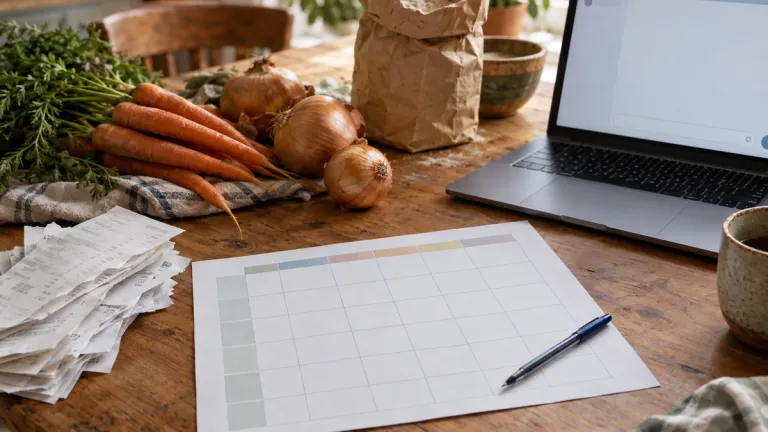
I use AI at work every day. In the kitchen I have always been sceptical. Recipe sites are free, my mother's notebook is reliable, and I can count onions without help. But the weekly question, what do we eat and what do I have to buy, takes me about forty minutes every Sunday, and I resent every one of them.
So this was the test. Seven days, no cheat sheets. ChatGPT did the planning, I did the shopping and the cooking, and I wrote down every place where the plan and the kitchen disagreed.
The brief I gave ChatGPT
Vague prompts get vague plans. On the first Sunday I typed a short brief instead of a request:
- Four people: two adults, children aged 9 and 13.
- Weekday dinners in 30 minutes or less, one pot if possible.
- No mushrooms. One adult does not eat pork.
- Breakfasts and packed snacks for the children; lunches happen at school and at work.
- Budget around €130 for the week, one ordinary supermarket, normal shelf prices.
- Output: a table with day, dish, ingredients and quantities, then a shopping list sorted by store section.
The answer came back in about fifteen seconds. It looked professional: a table, a list, a line about seasonal vegetables. I copied the list into my phone and went shopping. The whole planning session, including my typing, took 20 minutes. Normally it takes 40.
The week, day by day
| Day | What the plan said | What actually happened |
|---|---|---|
| Monday | Chicken traybake with potatoes and carrots | Cooked as written. It fed six, not four, so Tuesday's lunches were solved. |
| Tuesday | Pasta with tomato and courgette | The 13-year-old refused the courgette. I swapped in frozen peas and said nothing. |
| Wednesday | Lentil soup with bread | The best meal of the week. About €1.20 per portion by my own arithmetic. |
| Thursday | Salmon with bulgur and cucumber salad | No salmon on the counter that day. Cod instead. The bulgur quantity was double what four people eat. |
| Friday | "Use up the fridge" frittata | Worked only after I listed what was actually in the fridge. It cannot see inside. |
| Saturday | Pork roast with dumplings | It forgot the no-pork rule from Sunday. Chicken went in the oven instead. |
| Sunday | Leftovers plus next week's list | The leftovers plan was genuinely useful. Almost nothing was thrown away. |
Where the plan held up
Three things worked better than I expected. The first was structure: having seven dinners decided on Sunday removed the 5 p.m. negotiation entirely. The second was the soup and the frittata, two cheap dishes I make badly and rarely, which the plan pushed back into rotation with quantities that made sense.
The third was the leftovers logic. Because the plan knew Monday would produce extra chicken, Tuesday's lunch was already accounted for. That single decision saved money in a way I usually only manage by accident.
Where it fell apart
Portions were the biggest problem. The model cooked for an abstract family, not for my family. A 9-year-old eats roughly half of what an adult eats, and the plan assumed four adults at every sitting. Two dinners produced a second full meal. That is not a disaster, but it is not a plan either.
Prices were the second gap. The plan estimated my basket at about €95. The till said €117. It had used generic European averages, not the price of anything in the shop I actually walk to. A supermarket's weekly offers are invisible to a chatbot unless you paste them in.
Then there were the small, human mistakes. It put pork on Saturday after I had said no pork on Sunday, which suggests the constraint got lost in a long conversation. It invented a "seasonal" vegetable that was not on the shelf in usable condition. And when I asked for the plan in Czech, it translated hladká mouka as "smooth flour" – plain flour, in other words. A Czech cook would never write that.
None of these are reasons to abandon the idea. They are reasons to check the output before you leave the house.
The shopping list did most of the work
If I keep one thing from the test, it is the list. Sorted by store section, with quantities next to each item, it cut my shopping trip from about 50 minutes to 30. I stopped doubling back for forgotten garlic. I bought fewer things I did not need, because every item had a dish attached to it.
The quantities needed correcting by hand: it asked for two onions across four recipes, and I bought six. But the shape of the list, grouped by produce, dairy, dry goods and frozen, was better than anything I write myself.
What the week cost
The receipt came to €117 for four people, about €8 less than the previous week. One week proves very little. The saving came mostly from fewer discarded vegetables and one fewer emergency takeaway, not from the AI finding cheaper food.
On the tool side: OpenAI lists ChatGPT Plus at $20 a month in the United States, and EU customers see a VAT-inclusive price of roughly €23 at the time of writing. The free tier handled every planning request in this test without hitting a limit, so a subscription is not required for this use. Compared with a €117 weekly food bill, €23 a month is small, but it buys almost nothing that the free version could not do here.
Privacy: what to keep out of the chat
A meal plan is not sensitive data, but the conversation around it can be. If you tell ChatGPT about a child's allergy, a medical diet or your address for a delivery suggestion, that goes to OpenAI's servers. Italy's privacy regulator fined the company €15 million in December 2024 over how ChatGPT handled personal data, which is a useful reminder that the rules apply here too.
Under the GDPR you can ask for a copy of your data and for deletion, and you can complain to your national data protection authority. In practice, three settings do most of the work:
- Temporary chat keeps a conversation out of your history and out of model training. Use it for anything you would not want in an archive.
- Data controls in settings let you switch off "improve the model for everyone", which is the option that allows your chats to be used for training.
- Do not paste receipts. They carry card fragments and loyalty numbers. Type the totals instead.
On regulation: since 2 August 2025, providers of general-purpose AI models in the EU have transparency duties under the EU AI Act, including a public summary of training data. Meal planning is nowhere near the Act's high-risk category, so for a home cook the practical effect is close to zero. For allergies it matters more: the model cannot know about cross-contamination in your shop, and EU rules on the 14 declared allergens are on the label, not in the chat window.
Other options available in Europe
ChatGPT is not the only tool that can do this, and all the main ones work across the EU in Czech, German, French or Polish.
- Google Gemini has a free tier, a generous context window and decent recipe knowledge. It reads photos of a fridge well.
- Mistral's Le Chat is French, free at the basic level and available across the EU. If you prefer a European provider, this is the obvious place to start.
- Claude from Anthropic handles long conversations with many constraints well, which matters when you keep adding rules.
Feature rollouts in the EU sometimes arrive later than in the US, usually for regulatory review. For plain text planning, that has not affected anything I tested.
A prompt that works better
The second week I changed four things, and the plan improved noticeably. It took 12 minutes instead of 20.
- Give portions as people, not numbers. "Two adults and two children who eat half an adult portion" beats "four portions".
- Paste the shop's offers. Two lines of text from the leaflet changed three dinners.
- List what is already in the fridge and cupboard before asking for the plan.
- Ask for the constraints again at the end of the conversation, so they sit next to the answer rather than buried in the first message.
I also asked for a short "what could go wrong" note per dish – the model flagged that Thursday's fish would not keep if I shopped on Sunday, which was correct.
What I kept after the test
I still plan on Sunday evening, and I still use ChatGPT for the first draft. I no longer trust it with quantities or prices, and I always read the list against my own kitchen before leaving. The time saving is real, roughly half an hour a week. The savings on the food bill are modest and not proven by seven days.
What changed most is that the decision is already made when I come home tired. That is worth more to me than the €8. More of our hands-on AI tests are collected in the magazine.
Does ChatGPT remember my family's dislikes between conversations?
On paid plans it can store preferences in memory, and you can review and delete those entries in the settings. On the free tier it usually starts fresh, so paste the brief again each week. In this test the no-pork rule was forgotten within a single long conversation, so repeat the constraints near the end of the chat.
How do I stop it suggesting the same five dinners?
Give it a list of what you cooked in the last two weeks and ask for no repeats, then add a constraint such as "one fish dish, one meat-free dish, one soup". Without that, the model drifts towards the safest, most common recipes in its training data.
What if a recipe gives unsafe cooking advice?
Treat any generated recipe as a draft from a stranger. Check that poultry is cooked through, cool leftovers within two hours, keep the fridge at about 4 °C and reheat to piping hot. For allergies, rely on the declared allergens on the packaging, not on the chat.