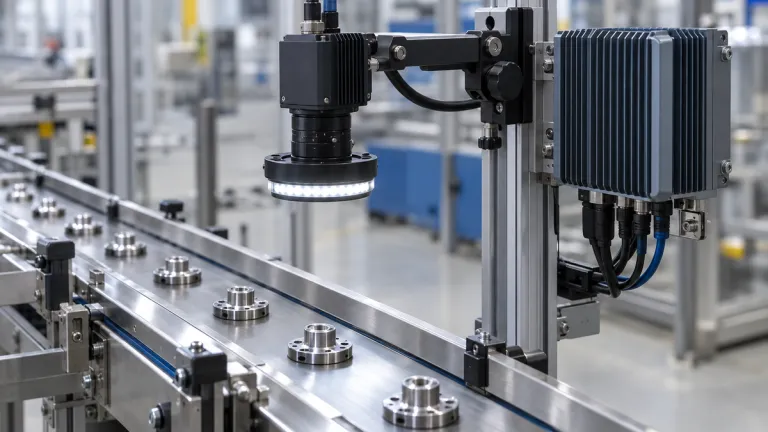
A booth built as a production line
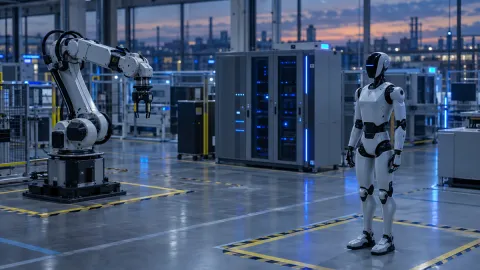
Opto Engineering has organised its exhibition space as a sequence of stations instead of a catalogue of parts. Visitors walk through the same problems a plant faces when it automates inspection: how to light an awkward part, how to capture it while it moves, and how to keep the result repeatable on the second shift.
The company describes the setup as a practical journey through factory challenges, which is not the usual format at a trade fair. Most booths show a demo with ideal lighting and a stationary target. Whether these stations survive contact with a visitor's own part is the test nobody can run in advance. The VISION 2026 programme overview lists the stand among the show's application-focused exhibits.
The OEVIS platform and its three steps
OEVIS is the software side of the pitch. It uses a three-step workflow the company labels dataset, train, evaluate, and it is built so that an engineer on the line can produce a working inspection model without writing code.
That claim deserves a closer look, because no-code tools remove the scripting, not the work. Someone still has to collect images that contain the defects the line really produces, including the rare ones. Labelling remains manual labour, and the evaluate step is where a project either passes or quietly stops. What changes with a guided workflow is the number of people involved: a plant that would otherwise hire an integrator for a first prototype can test an idea internally. Opto Engineering is running those tests on the stand rather than describing them in a brochure.
Hardware: IP67, PoE and the SKAO job
Opto Engineering says the ITALA G.EL.IP camera series won a Vision Systems Design Innovators Award in July 2026. It carries IP67 dust and water protection, GigE Vision Power over Ethernet, and liquid lens control. On a food or beverage line, where washdown is routine, that rating decides whether a camera can be mounted near the product at all.
Opto Engineering says it has also been shipping automated inspection for real-time, high-speed inline quality control, including 100 percent inspection on food processing lines. That means dimensional checks and defect detection on every unit rather than on a sample. The company additionally names the Square Kilometre Array Observatory among its reference projects, describing antenna inspection work there at a scale where sampling would have been impossible, not merely expensive.
The hardware catalogue lives at opto-engineering.com, and the range is the argument behind the "full-service" wording in the company's own description of itself. Lighting, optics, camera and software from one supplier means one party to call when a station refuses to repeat.
What EU rules say about inspection AI
The compliance picture for European buyers is moving. The Digital Omnibus simplification regulation, as tracked on the European Commission's AI Act pages, moves the deadlines for high-risk AI systems to December 2027, and to August 2028 where the system is embedded in a product covered by existing EU safety legislation. Adoption and entry into force are separate steps there: the Commission's page records each one rather than a single date. Transparency obligations under Article 50 have applied since 2 August 2026. The governance rules for general-purpose AI models have applied since 2 August 2025, and the Commission's enforcement powers for those models take effect from 2 August 2026, according to the Commission's implementation timeline.
For a camera that measures a machined bracket, none of that is high-risk territory. The classification depends on the role the system plays. If the same model acts as a safety component under the Machinery Regulation, it falls into Annex I and the high-risk obligations apply, which brings documentation, risk management and post-market monitoring that a quality-check deployment does not need. That distinction is the practical question to put to a vendor at the show, and it is cheaper to answer before an integration than after one.
Cloud pricing versus line inspection
Cloud vendors sell general-purpose language models by the token. An inline inspection system is sold per camera and per integration. The two price lists describe different kinds of work, and a buyer cannot read one against the other.
The mismatch is not only about units. An inline inspection system returns a decision per part in milliseconds, processes every frame rather than a sampled one, and cannot depend on a connection to a data centre. Support comes on the same invoice as the hardware, not as a separate subscription. A plant comparing a vision quote with an API bill is comparing two different things.
The hardware argument is also weaker than it sounds. Inspection networks are small next to general-purpose language models. On our own AI Arena rig, mid-size open-weight models run on a single 16 GB consumer GPU, and a defect classifier needs far less. The difficult parts are the images, the lighting and the labelling, which is where the money goes.
What is not being shown
The next-generation system appears only in private previews for selected customers, and Opto Engineering has not described it publicly. Anyone hoping for a specification sheet at the booth will leave without one.
Do I need programming skills to use OEVIS?
The vendor describes a three-step workflow (dataset, train, evaluate) that does not require coding. Collecting and labelling images for the defect classes you care about still takes engineering time, and that part is not automated away.
Does the EU AI Act treat a vision inspection system as high-risk?
Not by default. A system becomes high-risk when it falls under Annex I, for example when it acts as a safety component of machinery covered by the Machinery Regulation. The Digital Omnibus moved those deadlines to December 2027, and to August 2028 for AI embedded in regulated products.
Where can I see Opto Engineering at the show?
Hall 8, Booth D48. The booth runs through inline inspection stations drawn from factory applications. The unreleased product is limited to invited customers.