What the two companies actually put together
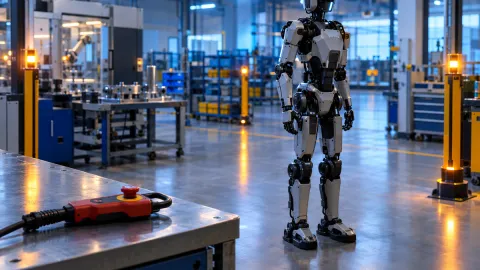
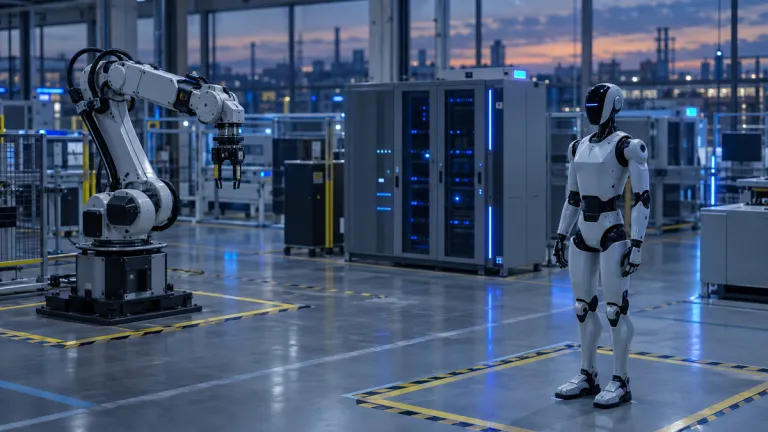
Hitachi contributes three things: its physical AI models, its systems integration organisation, and low-power edge AI semiconductors. Agile Robots contributes AgileCore, the software platform that coordinates its hardware portfolio, which includes robotic arms, mobile robots and the Agile ONE humanoid. Commercialisation is planned through Hitachi's HMAX Industry portfolio and through Agile Robots' own customer network.
The scope is narrower than the phrase "autonomous manufacturing" suggests. Hitachi and Agile Robots list tasks where the workplace varies: picking parts that arrive in different positions, loading a machine, feeding assembly stations, moving material inside a plant, and changing over a line. These are the places where a fixed program stops working and a person still makes the call.
The one hard number in the announcement is Hitachi's: more than 110 years of manufacturing and operational technology experience feeding into the initiative. Everything else about scale is missing. The original report comes from AI Insider, which covered the Agile Robots news item of 29 September 2026, and both partners maintain their own product pages on hitachi.com and agile-robots.com.
A German software stack inside a Japanese industrial group
Agile Robots SE is headquartered in Munich. That detail changes the procurement conversation for European manufacturers. The layer that decides how a robot arm approaches a part, and what it does when the part is not where it expected, would be maintained by a German legal entity and integrated by a Japanese industrial group. For a plant manager in Bavaria, Poland or Slovakia, that is a different support and spare-parts geography than buying a platform from a US or Chinese vendor.
It also matters for data. Robot telemetry, vision feeds and process logs are industrial data, and where they are processed determines which contracts and safeguards apply. The announcement does not say how data will be handled, which is a question worth putting to both companies before any pilot.
No European factory has been named as a pilot site.
Cost transparency stops at the factory gate
Model pricing in the LLM market is public to the cent. OpenAI lists GPT-6.1 Sol at $2.00 per million input tokens and $10.00 per million output tokens on its own pricing page, and the other major providers publish a comparable table for their own models. Anyone can compare those numbers in a spreadsheet.
Industrial robotics does not work that way. A system that picks a part and loads a machine is sold as a project, with integration hours, safety engineering, fixtures and support contracts baked into a quote. There is no published cost per pick, per hour or per shift for the Hitachi and Agile Robots combination, and the announcement does not hint at one.
Physical AI as a marketing term deserves the same scepticism as any other. Recorded demonstrations in this field often rely on teleoperation, fixed lighting or a limited set of parts. The tasks named in this agreement are more constrained than a general-purpose factory robot, which is also what makes them plausible.
The European rulebook a buyer inherits
Two layers apply to anything installed in an EU plant.
The first is machine safety. The EU's machinery rules govern the physical device and its guarding, and they exist independently of whatever model runs on top.
The second is the AI Act. Since 2 August 2026, the transparency and labelling obligations under Article 50 have been enforced by the EU AI Office and national market surveillance authorities. Those rules mostly concern generated content, so a welding cell is not the primary target. Classification as a high-risk system is use-dependent rather than product-dependent: a robot doing machine loading is not automatically in Annex III, while a system that allocates tasks to workers or monitors their performance can be. Under the Digital Omnibus on AI, Regulation (EU) 2026/1744, the compliance deadline for Annex III high-risk obligations moved to December 2027.
For a manufacturer, that means the integration contract and the technical documentation matter as much as the robot. Whoever signs the conformity paperwork carries the obligation.
Who else is building this
Hitachi is not entering an empty field. Figure AI and Tesla Optimus are working on US humanoids, Agility Robotics has focused on warehouse material handling, and Boston Dynamics has pursued factory applications with Toyota Research Institute. In Germany, Neura Robotics in Metzingen has raised money on a cognitive-robot pitch. Chinese vendors including UBTech and Unitree press on price.
Most of these programs sit on top of the same simulation and training tooling, largely supplied by NVIDIA. The differentiator is rarely the model. It is access to real process data, integration capacity and service networks, which is exactly what a 110-year-old industrial group brings to a Munich software company.
What a European plant can do with this today
Nothing is purchasable yet. There is no price list, no order form and no pilot reference to call. What an operations team can do now is prepare the substrate these systems need: log the variation in the tasks you would want automated, capture images of parts in the poses they actually arrive in, and document the safety assessment for that station early. Projects like this tend to stall on that data, not on the model.
The announcement names no pilot plant, no unit price and no delivery date. HMAX Industry and Agile Robots' customer network are the two stated routes to market, and both remain without published schedules.
Is the Agile ONE humanoid available to buy in Europe?
The announcement does not say. Agile ONE is named as part of the hardware portfolio entering the partnership, but no product availability, price or delivery window was given for it or for any other unit.
Does a factory robot fall under the EU AI Act's high-risk category?
It depends on what the system does. Annex III covers areas such as worker management and task allocation rather than manufacturing hardware as a category. High-risk obligations under that annex now apply from December 2027 following Regulation (EU) 2026/1744.
What is HMAX Industry?
It is Hitachi's industrial AI portfolio, and the stated channel through which solutions from this partnership are meant to reach customers worldwide. Hitachi has not published a list of products or services added under it as a result of the Agile Robots agreement.