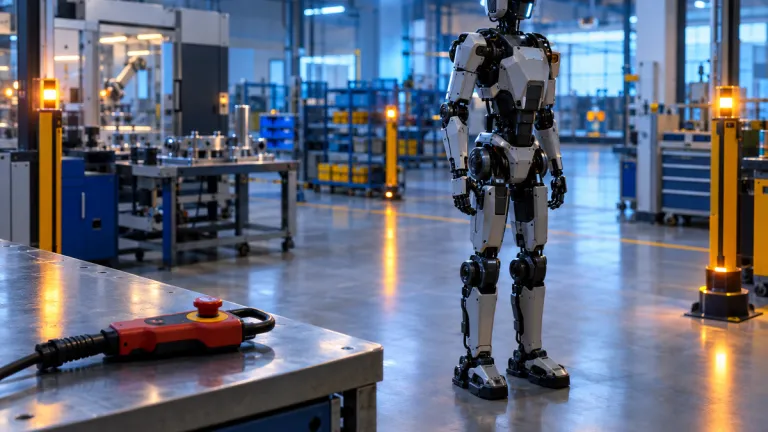
Agility Robotics and FORT Robotics formalised a relationship both companies describe as multi-year. The document covers a three-part safety architecture: a pendant an operator can carry, communications hardware mounted on the robot, and interfaces that sit in the workspace around it. FORT supplies the Offboard Safety Bridge and the manual emergency overrides. Agility supplies the onboard cooperative safety layer built into Digit 5. The announcement was reported by Trend Hunter.
The word fleet matters. A single robot in a cage needs a stop button wired to that one machine. Twenty robots on the same floor, with forklifts and people moving between them, need a stop path that works across the whole installation. That is what the offboard bridge is for.
Digit 5 was unveiled in September 2026 with redesigned legs, swappable end-effectors and a new battery pack. Agility is selling it as a robot that can operate near people without a cage, which is where the FORT agreement becomes more than a press release.
Digit 5 by the numbers
Payload: 50 lbs, about 23 kg, lifted repeatedly.
Battery: roughly 90 minutes of runtime, then a rapid recharge of about 9 minutes. Agility says that supports more than 20 operational hours in a 24-hour day.
Run the arithmetic yourself and the duty cycle comes out at 91 percent, meaning 90 minutes of work inside a 99-minute cycle. That caps a 24-hour day at about 21.8 hours if nothing else intervenes. Field reality eats into that number, so the claim of 20+ hours sits just below the theoretical ceiling rather than above it.
Track record: predecessor Digit 4 units have logged more than 65,000 cumulative hours at customer sites.
Timeline: early access in H1 2027, general commercial availability in late 2027.
Order book: more than $300 million in multi-year orders for Digit 5.
Orders against revenue
Agility reported $1.8 million in net sales for fiscal 2025. Against the $300 million-plus order figure, that is roughly 167 times booked revenue. The company plans to go public through a SPAC merger with Churchill Capital Corp. XI at a $2.5 billion valuation, about €2.2 billion at recent exchange rates, or roughly 1,390 times its 2025 revenue.
Those numbers do not contradict each other. Order value is spread over years and revenue is recognised on delivery, so the ratio mainly shows how early the commercial stage is. It is still a reminder that the $300 million headline describes future deliveries, not money already earned.
Where EU rules apply
For a European buyer, the question is which rulebook covers a humanoid whose AI layer decides how it moves among people.
The AI Act treats a system as high risk when AI acts as a safety component of a product covered by Annex I harmonisation legislation, and machinery is on that list. If the onboard AI shares responsibility for speed, force limits or stopping behaviour, the provider inherits the obligations: risk management, technical documentation, logging, and human oversight under Article 14. The kill switch itself is machinery safety, not AI regulation, and the two systems have to work together.
The EU's new Machinery Regulation, 2023/1230, starts applying on 20 January 2027, a few months before Agility's early-access window opens. Since 2 August 2026 the European AI Office and national authorities also hold binding supervision and fine powers, and the Article 50 transparency duties are already in force. Paper-only compliance on the EU market is no longer an option for anyone selling AI into it.
There is a data-protection side as well. A robot walking a shared floor with cameras and depth sensors collects information about the people around it. In an employment setting that falls under GDPR, with a data protection impact assessment and, in several member states, works council consultation.
Safety-critical inference also tends to run on the machine itself, because a stop decision cannot wait for a round trip to a cloud API. That is the same reason we benchmark local models on our own hardware in AI Arena instead of routing every task through hosted endpoints.
No European availability yet
Agility has published no unit price for Digit 5, no European distribution partner and no CE marking statement. Those gaps are practical, not cosmetic. Machinery cannot be placed on the EU market without CE marking, and without a unit price a European logistics operator cannot put a line in a budget. The $300 million order figure is an aggregate, not a price list.
What exists right now is a safety architecture, a delivery timeline that lands just after the EU's new machinery rules take effect, and a company heading for public markets. What does not exist is a Digit 5 a European company can order.
Can I buy a Digit 5 today?
No. Agility's published plan is early access in H1 2027 and general commercial availability in late 2027. No unit price has been announced.
Does the memorandum of understanding guarantee delivery of anything?
No. An MOU records intent and describes how two companies will work together. It is not a purchase order and not a binding supply commitment. The $300 million-plus order figure comes from separate customer agreements, not from the FORT deal.
Would a Digit 5 deployed in the EU be regulated as high-risk AI?
It depends on what the onboard AI actually controls. Under Article 6(1) of the AI Act, AI that acts as a safety component of a product covered by Annex I legislation, including machinery, is classified as high risk. A robot whose AI influences movement and stopping decisions on a shared workplace is the kind of case that falls into that discussion. The classification is made by the provider, while the machinery side is assessed separately under the Machinery Regulation.