
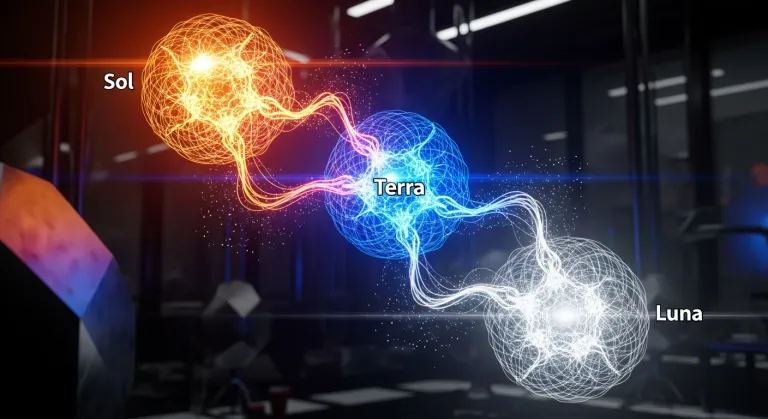
The race for technological dominance in artificial intelligence has just crossed another frontier. OpenAI announced the launch of GPT-5.6 models, which come with a diverse range of performance and cost requirements. However, this novelty is not just about technical parameters; it is also about geopolitics and the question of control over the world's most powerful algorithms. While some models will be generally available, the best ones are currently "locked" in the hands of selected entities under the supervision of the American state.
Three Pillars of the New Generation: Sol, Terra, and Luna
Instead of a single universal model, OpenAI has chosen a segmentation strategy. This means that developers and companies can choose a model precisely according to their needs — from extreme performance to maximum speed.
1. Sol: Peak Performance and Autonomous Reasoning
The Sol model is designed for the most demanding tasks. OpenAI presents it as a tool for advanced programming, scientific research, and cybersecurity. What distinguishes Sol from previous versions are two new reasoning modes:
- "Max" mode: The model dedicates more computational time to deeper analysis of the task and minimizing logical errors.
- "Ultra" mode: This involves the use of sub-agents. In practice, this means that the model does not compute the task all at once, but divides it among several of its virtual instances (sub-agents) that cooperate, check each other, and solve individual parts of the problem in parallel.
2. Terra: Balanced Standard
The Terra model is designed as a "workhorse". It is intended to be an optimal choice for typical corporate deployment where high intellect is required, but not necessarily the extreme capabilities of Sol. According to official OpenAI data, Terra offers performance comparable to the earlier GPT-5.5, while its operating costs are roughly half.
3. Luna: Speed and Efficiency
Luna is the lightest and fastest model in the family. It is ideal for applications requiring immediate response, such as real-time chat assistants or simple text automation, where deep philosophical reasoning is not needed.
Benchmarks: How Does GPT-5.6 Stack Up Against the Competition?
In the field of AI, the only valid measure of performance is comparison in tests. OpenAI attempts transparency, although complete data for some standard tests like SWE-bench Pro are still missing for the most powerful Sol model.
The published Terminal-Bench 2.1 test, which measures the model's ability to work in the command line (CLI), shows fascinating results. The Sol model achieved a score of 88.8%, significantly outperforming the publicly available Claude Opus 4.8, which scored 78.9% in this test. Sol thus operates at the level of the latest models from Anthropic, such as Mythos 5, which are currently unavailable to ordinary users.
For comparison with other players: While Google Gemini 2.0 excels in integration into the Workspace ecosystem, GPT-5.6 appears to be stronger in pure logic and programming thanks to the aforementioned sub-agents.
Pricing Policy: How Much Will Working with AI Cost You?
For Czech companies and developers, the price per token (units of text) is key. Prices are quoted in USD, which is standard for API services. For a better idea, we also provide an indicative conversion to Czech crowns (at an exchange rate of 23 CZK/USD).
| Model | Input Price (per 1M tokens) | Output Price (per 1M tokens) |
|---|---|---|
| Sol | $5 (~115 CZK) | $30 (~690 CZK) |
| Terra | $2.50 (~58 CZK) | $15 (~345 CZK) |
| Luna | $1 (~23 CZK) | $6 (~138 CZK) |
Geopolitics and Restrictions: Why Won't You Get the Best Models Right Away?
Here comes an unexpected twist. Although OpenAI has released the models, their most powerful part is currently under strict supervision. According to information from TechCrunch, the distribution of Sol was limited at the request of the US government. Currently, only about two dozen selected companies that have passed government vetting have access to the API.
This step is part of a broader trend where the US administration requires advanced models to be reviewed up to 30 days before their full release. This creates constant tension between technological progress and national security. For European and Czech companies, this means that if they want to use the highest possible Sol performance for critical systems, they will have to wait for the approval of these processes within the framework of the EU AI Act regulations.
Impact on the Czech Market and Availability
What does this mean for you in the Czech Republic? Luna and Terra models should be available via ChatGPT and API within a few weeks. In terms of language support, OpenAI confirms that all GPT-5.6 series models fully support Czech, which is crucial for local application developers.
If you are a Czech company and need the highest possible intelligence (Sol), you must wait for the release of the limited preview. For most common applications — from customer chatbots to document analysis — the Terra model will likely be the ideal choice due to its balance between price and performance.
Will I be able to use GPT-5.6 in Czech?
Yes, OpenAI confirms that all new 5.6 series models have full support for Czech and other European languages, which includes grammatical correctness and contextual understanding.
How can I access the most powerful Sol model as a company in the Czech Republic?
Currently, Sol is in a limited preview for selected American companies. For Czech developers, API access will likely be available only after government review periods have passed, which OpenAI estimates to be several weeks.
Is the Luna model suitable for simple chatbots?
Absolutely yes. Thanks to its lowest price and high speed, Luna is ideal for interactions where immediate response and low operating costs are important.




