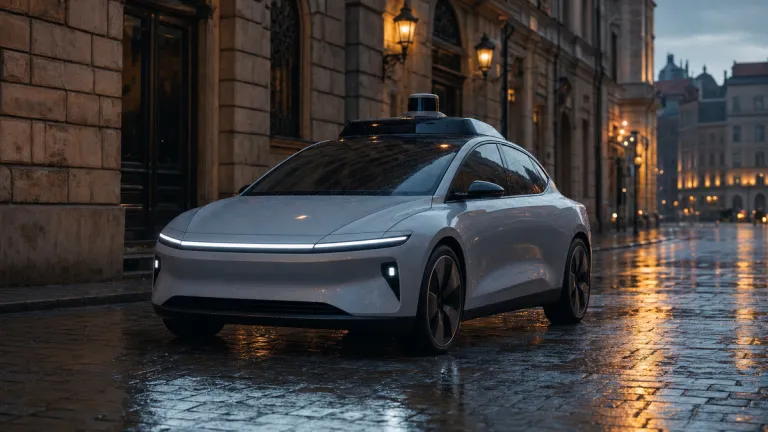
CNBC reports that Uber and Chinese autonomous-driving firm Pony.ai are expanding their existing partnership with a 2,000-vehicle robotaxi fleet aimed at Europe. Pony.ai's cars already operate inside the Uber app in Dallas and Houston, so this is not a tech demo — it's a scaling play into a new continent.
What we actually know
The number that matters is 2,000 vehicles, but the operational details matter more. Pony.ai is a serious player, not a startup sketch: founded in 2016, dually headquartered in Beijing and Fremont, California, and listed on the Nasdaq under the ticker PONY. It has operated public robotaxi services across Chinese cities — Beijing, Shanghai, Shenzhen, Guangzhou — for years and holds autonomous-driving permits in both China and the US.
What the CNBC report doesn't yet specify is the timeline and the exact launch cities. Pony.ai has already planted a European flag in Luxembourg, where it bases its EU operations, and has previously signaled Germany as a key target market, with Frankfurt often named as a candidate first city. If you want to know where robotaxis will actually appear, watch for city-level regulatory approvals — not marketing announcements.
Why Europe, and why now
Europe has traditionally been a hard market for autonomous vehicles: fragmented national rules, dense historic city layouts, and cautious authorities. But the regulatory ground has shifted. As of August 2026, the EU AI Act rules for AI systems are in active enforcement, with national authorities and the EU AI Office applying binding transparency, governance, and risk-mitigation obligations for high-risk systems under the 2026 AI Omnibus framework. Autonomous vehicles fall squarely into the high-risk category.
That is good news for Pony.ai in an unexpected way: instead of navigating a grey zone, the company now has a concrete compliance pathway. A clearer rulebook, a wealthy market with high taxi fares, and Uber's ready-made distribution channel make Europe harder to ignore. Uber, for its part, gets to offer driverless rides without owning the cars or carrying the full liability of the autonomous stack — Pony.ai carries that weight.
The European questions nobody is answering yet
Two issues will decide the success of this rollout: data residency and safety acceptance.
A robotaxi is a rolling sensor platform. Cameras, lidar, GPS, and telemetry continuously collect location and imagery data from public space. Under GDPR, much of that is personal data. A company with deep roots in China operating a fleet on EU roads will face hard questions from European data protection authorities: Where is the data processed? Who internally can access it? What happens when a foreign authority requests it? The workable answer for any serious operator is on-shore processing with EU-based infrastructure and strict access controls. Whether Pony.ai's architecture delivers that transparently will be the first real test of this deal.
Safety acceptance is the second hurdle. European type approval for autonomous vehicles runs through UNECE regulations — including R157 for automated lane-keeping and the broader vehicle safety framework — and then through national road-traffic rules. A committed fleet of 2,000 cars means Pony.ai must prove its operational design domain (the precise conditions under which its cars can drive themselves) multiple times to multiple authorities. That is why the rollout will be geofenced and gradual, not a continental wave.
How the fleet compares
For context, 2,000 vehicles puts this commitment in the same league as the largest robotaxi fleets operating today. Waymo, the US market leader, has scaled across American cities and begun international tests in Tokyo, but has not announced a comparable European deployment. Tesla's promised robotaxi network has not reached Europe in any verifiable, approved form. European players — Germany's Vay with tele-operated driving, Einride in autonomous freight, and OEM programs at Mercedes-Benz and BMW — remain at earlier commercial stages. If Pony.ai's 2,000 cars materialize, the company would leapfrog every announced European passenger-robotaxi program.
What this means for riders
Practically, a robotaxi ride will look unremarkable: open the Uber app, pick your destination, and a driverless car arrives. The first corridors will likely connect airports, business districts, and well-mapped main roads — not narrow medieval lanes. Expect pricing to be set in euros per city, aligned with Uber's existing fare structure: competitive with human-driven rides, at least while operators are still building rider trust.
The deeper question is trust, not technology. Pony.ai's fleet has logged millions of autonomous kilometres in China and the US, but European signage, roundabout etiquette, and pedestrian behaviour differ. The company's own interest is in a cautious launch — in this industry, one high-profile crash can set a market back by years. Slow, geofenced deployment is not a sign of failure; it's the only credible way to win over European regulators and riders alike.
Will the Pony.ai robotaxis drive everywhere in Europe?
No. The first phase will be geofenced urban areas in specific cities, where the company has high-definition maps and validated road conditions. Expect airports, business districts, and main corridors first.
Is my ride data protected under GDPR?
GDPR applies to all personal data collected in the EU, regardless of where a company is headquartered. The critical open question is data residency: whether location and camera data will be processed and stored inside the EU, and whether access is restricted to EU-based staff.
When will the first robotaxis arrive in Europe?
No firm launch date has been confirmed. Watch for national regulatory approvals and city-level announcements, which will happen before any public service starts.