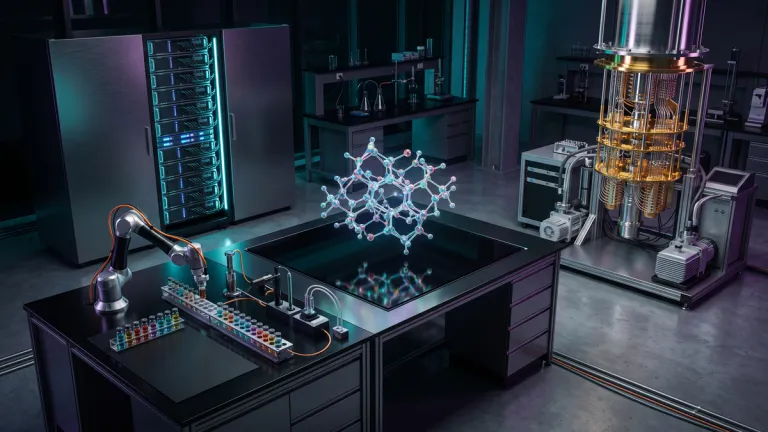
Chemistry research has never lacked instruments that generate data. What it lacks is a nervous system connecting the data to decisions: spectra, simulation logs, literature PDFs and quantum-chemistry calculations still live in separate silos. The new arXiv preprint argues that the bottleneck has shifted from producing measurements to integrating multimodal knowledge — and that the lab of the near future is best understood as five technology layers working as one system.
Five pillars, one orchestration layer
The paper formalizes what many of us in applied AI have been assembling piece by piece:
- Scientific reasoning LLMs form hypotheses, read papers and plan experiments;
- Self-driving laboratories (SDLs) and cloud labs execute those plans with robots and automated instruments;
- Machine-learned interatomic potentials (MLIPs) screen candidates far faster than brute-force simulation;
- Fault-tolerant quantum computing (FTQC) is reserved for the electronic-structure calculations where classical methods hit a wall;
- Agentic AI frameworks orchestrate the other four layers.
None of these pillars is new on its own. What is new is treating them as a single, multiplicative pipeline — and being explicit about the interface between each layer. That interface problem is where the open-weight result matters.
The benchmark that should make proprietary API vendors nervous
Autonomous laboratories need models that understand more than text. A reaction spectrum or a figure in a PDF is not a token stream; it is visual information that must be retrieved, compared and reasoned about. The paper evaluates models on LabBench, a benchmark for visual scientific question-answering and literature retrieval, using an oracle retrieval score that measures whether the right scientific evidence is found at all.
The open-weight Nemotron 3 Nano Omni model reached 89%, ahead of the proprietary GPT-4o-mini baseline at 87%. This is precisely the pattern we care about at our AI Arena benchmark rig: on narrow, technical tasks, a small, specialized open model can beat a much larger general-purpose one. For European chemists and pharma teams, the implications go beyond the two-point lead.
Why open weights matter more in Europe than in Silicon Valley
An open-weight model does not force proprietary chemical structures, synthesis routes or patient-adjacent data to cross the Atlantic. You can fine-tune Nemotron-class models with NVIDIA NeMo Gym and run them on your own HPC infrastructure, on European cloud providers, or on a local workstation. That is a GDPR and data-residency advantage that no API pricing sheet can compensate for.
The EU regulatory context makes this even more relevant. Since August 2, 2026, the EU AI Office and national authorities can enforce Article 50 transparency obligations for general-purpose AI models — including disclosure of AI interactions and labelling of synthetic content. Open weights do not automatically equal compliance, but they make the crucial part easier: you can inspect what the model does, document its training and outputs, and answer regulator questions with evidence instead of a vendor's reassurance. For European research organisations, that auditability is now a procurement requirement in practice, not just a nice-to-have.
One nuance deserves attention: under the EU's Digital Omnibus on AI, which entered into force in July 2026, standalone high-risk AI systems listed in Annex III — including those used in HR, education or critical infrastructure — have until December 2, 2027 to meet full compliance obligations. Prohibited practices, meanwhile, are already strictly banned since February 2025, with fines up to €35 million or 7% of global turnover. The window for getting AI governance right in European labs is real, but it is not infinite.
Where quantum actually fits — and where it does not
The most hyped part of the paper is also the most honest one. Classical Full Configuration Interaction (FCI) calculations scale combinatorially with system size, which is why accurate electronic-structure calculations for molecules of practical interest remain out of reach. Fault-tolerant quantum algorithms would achieve FCI-quality energy estimates with polynomial resource scaling — a theoretical advantage that is now well understood.
In the meantime, tools such as PsiQuantum's RLEASE are already deployed to make quantum workflows practical: RLEASE uses reinforcement learning and orbital descriptors to automate low-cost active-space selection, which is normally a manual and error-prone step. This is the classic pattern of quantum-adjacent software: it prepares the workflow so that when fault-tolerant hardware matures, chemistry is ready for it.
What an autonomous chemistry agent actually costs in tokens
Since this magazine runs real model evaluation, we did the pricing math for a hypothetical agentic lab assistant that reads papers all day and proposes synthesis routes at night. These are the September 2026 list prices per 1 million tokens, with approximate EUR conversion at €1 ≈ $1.08:
- OpenAI GPT-6 Astra (Sept 3): $10 / $50 per 1M input/output tokens — roughly €9.3 / €46.5
- Anthropic Claude Fable 5.1 (Sept 1): $10 / $50 per 1M tokens — €9.3 / €46.5
- xAI Grok 4.6 (Aug 12): $2 / $6 per 1M tokens — €1.9 / €5.6
- Google Gemini 3.8 Flash (Sept 2): $0.75 / $3.75 per 1M tokens — €0.7 / €3.5 (promotional through December 31, 2026)
- DeepSeek-V4-Flash-Vision-Exp (Aug 21): $0.22–$0.44 input / $0.66–$1.32 output depending on peak hours
- Open-weight Nemotron 3 Nano Omni: $0 — you bring your own GPU and your own electricity
For a workflow that retrieves thousands of documents per day, the difference between a $10-per-million flagship and a $0.75-per-million flash model is not a rounding error. It is the difference between a lab assistant that runs constantly and one you switch on only for important questions. And the open-weight option removes the per-token economics entirely — at the cost of hardware and maintenance, which European research institutions often already have.
The convergent laboratory is not a single product and it will not arrive as a grand release. It will arrive as integrations: an open model that reads spectra, an SDL that executes the proposed experiment, an MLIP that screens the candidates, and a quantum-classical workflow that computes the final answer. The preprint is a map of that integration. For once, the map is worth reading — because the first models on it are already outperforming closed competitors.
Does this mean GPT-4o-mini is obsolete for chemistry?
No. The 89% vs 87% LabBench difference is specific to visual scientific literature retrieval and oracle scoring. General-purpose proprietary models remain strong on broad reasoning. What the result shows is that a small, specialized open-weight model can be competitive on narrow scientific tasks — which changes deployment economics, not the overall model hierarchy.
Can European labs run these open-weight models on their existing infrastructure?
The paper describes fine-tuning and running workflows with NVIDIA NeMo Gym and NeMo-RL, which are designed for local and HPC deployment. The key requirement is GPU capacity and the ability to handle multimodal scientific data. No cloud API is required, and no data needs to leave the institution.
Is the quantum part of the convergent laboratory available today?
Not as a full fault-tolerant pipeline. The FTQC pillar is a design with clear algorithmic advantages in theory, while classical approximations such as PsiQuantum's RLEASE are already used for automated active-space selection. Treat the quantum layer as the part of the stack that is being prepared now, not the part that runs today.