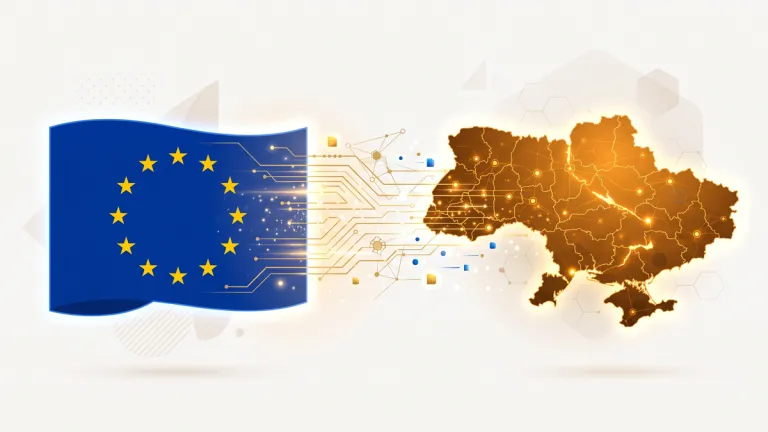
A milestone that no longer depends on Kyiv
Ukraine applied for EU membership in February 2022, days after the full-scale invasion began. More than four years later, that application has moved from diplomatic symbolism to concrete negotiating tables. Accession talks formally opened in the summer of 2024. In June 2026, the first thematic cluster — Cluster 1, “Fundamentals” — was officially opened at an intergovernmental conference in Luxembourg. In July, the EU and Ukraine opened Cluster 6, covering external relations and trade policy.
Now, according to the Commission’s assessment, Ukraine has met the technical conditions to begin talks on the remaining trade and internal-market blocks — the most consequential part of the whole process for businesses on both sides. As LIGA.net reports, the European Commission has called on its member states to “move forward” with the official decision.
What the “highest rating” actually means
The numbers behind Svyrydenko’s statement are unusual for a country at war. Ukraine’s foreign policy and international alignment with the EU now sits at an estimated 98–99 percent — the highest level since the accession path began. Two of the six negotiation clusters are already open, covering the judiciary, anti-corruption, fundamental rights and external relations.
After passing the required integration and market reforms, Ukraine also secured €2.7 billion in disbursements under the EU’s Ukraine Facility — money tied to concrete legislative change rather than simple budget support.
The full negotiation framework consists of six clusters and roughly 33 policy chapters. The block now in the spotlight — the Internal Market cluster — includes the free movement of goods, services, capital and workers, plus company law, competition and financial services. The Commission argues that the Deep and Comprehensive Free Trade Area (DCFTA), in place since 2016, has already aligned much of Ukraine’s market legislation with EU standards, positioning this cluster for rapid opening once member states agree.
Why the internal market matters beyond trade
For many European readers, this can sound like diplomatic procedure. It is not. The Internal Market cluster is the part of the negotiation that changes everyday economic life: a Ukrainian engineering firm could bid for public contracts in Prague or Lisbon, a Slovak bakery could hire bakers from Kyiv under EU labour rules, and a German insurer could sell policies in Odesa without a separate licensing scheme.
For the digital economy, the stakes are just as concrete. Ukraine has one of the largest IT workforces in Europe — more than 300,000 specialists, with software exports exceeding six billion dollars a year before the full-scale invasion. Many of those companies now operate from Warsaw, Berlin, Lisbon and Prague. Opening the internal market would mean their services fall under the same EU rules as any European supplier, which is exactly what both smaller Ukrainian studios and larger outsourcing firms have been preparing for.
The digital chapter: GDPR, DSA and the AI Act
This is where Ukraine’s path intersects with the EU’s technology agenda. To complete the internal market cluster, Kyiv must align with the EU’s digital rulebook: the GDPR on data protection, the Digital Services Act, the Data Act — and, significantly, the EU AI Act. Compliance work of this scale usually takes candidates years; the Commission believes the DCFTA framework has already carried Ukraine a large part of the way.
For Ukrainian AI companies, this is a double-edged sword. Many already build on EU cloud infrastructure and sell to European clients, but they operate under a patchwork of national rules and contractual workarounds. Formal alignment would remove the cost of maintaining parallel compliance regimes and give them a clear legal status across all 27 member states. At the same time, the AI Act’s binding transparency rules — enforced since August 2026, including the EU’s enlargement framework for Ukraine — will apply to them just as they apply to any other company placing AI products on the European market.
Individual users may hardly notice the change. But the practical effect is real: a wider market means more competition in digital services and AI tools, which in principle means more choice and more pressure on prices. And because Ukraine is integrating through the EU’s rules rather than a separate trade deal, the standards stay identical for everyone — for a studio in Lviv and a startup in Berlin alike.
What happens next
The European Commission has done what it can: it has publicly confirmed Ukraine’s readiness and urged the member states to move forward. The formal opening of the remaining clusters requires unanimity in the Council. That is not a formality — every national government holds a veto, and the “Fundamentals” cluster already proved to be a sensitive topic for some members before the June decision.
If the member states agree, Ukraine would begin negotiating chapter by chapter — a process that still takes years and that will continue under the shadow of war. The direction, however, has changed. The question is no longer whether Ukraine can meet the EU’s standards. It is whether Europe’s governments are ready to say so publicly, together.
What is a negotiation cluster in EU enlargement?
EU accession talks are divided into six thematic clusters covering roughly 33 policy chapters. Each cluster groups related policy areas — for example the internal market, competition and financial services — and must be opened and closed as a single unit during negotiations.
Does opening trade clusters mean Ukraine will join the EU soon?
No. Opening a cluster is the starting point for chapter-by-chapter negotiations, which normally take years and require closing every chapter one by one. But it does give Ukrainian businesses a clearer European perspective and signals a concrete political commitment from both sides.
How would EU accession affect Ukrainian AI companies and European users?
Ukrainian AI firms would need to follow the EU AI Act, GDPR and related digital rules once the internal market chapter is implemented. In exchange, they would gain unrestricted access to the 27-country market on the same legal basis as EU-based competitors — while European users get a broader range of products and services under consistent, enforceable rules.