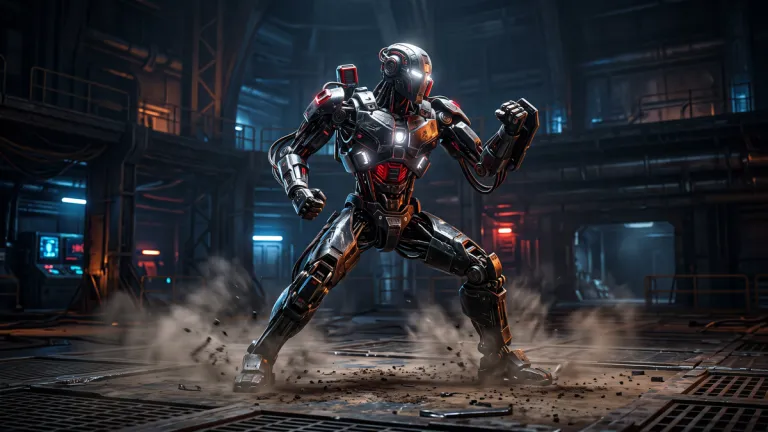
It sounds like the setup for a sci-fi sports drama: 200 teams from around the world enter a humanoid robot fighting tournament, and the highest-scoring European squad turns out to be seven Polish engineers and students going by Brave Mind Fighters. According to the Polish Press Agency's Science in Poland, the team finished 4th in the URKL 2026 qualification, the results of which were announced in late July — the best score posted by any European team in the competition.
Put that number in perspective: 4th out of 200 is the top 2 percent of the field. Three teams scored higher; 196 scored lower. For a seven-member squad rather than a corporate robotics division, that is a serious result before the robots have even touched each other.
Why the qualifiers were fought in simulation
The decisive detail of this tournament is that the qualification rounds were virtual. Teams' embodied AI models were evaluated in simulation — no physical robots, no travel, no arena damage. Only after qualifying did the Polish team shift to preparing its model for real-time combat in Shenzhen, China, scheduled for August 2026, with the final championship stage to follow in December 2026.
That structure is a sensible reflection of reality: shipping full-size humanoid fighters halfway around the world is enormously expensive, and one overheated actuator in a qualifying match would send a team home because of hardware luck rather than AI skill. Simulation filters for the model. The in-ring stage filters for everything else.
And "everything else" is where a fighting robot separates from the benchmark culture most AI people live in. At our AI Arena, we measure LLMs on an Nvidia RTX 5060 Ti under fixed conditions and report repeatable tokens-per-second numbers. A fighter has none of that luxury.
The sim-to-real gap, measured in bruises
In robotics, the difference between simulated and real behavior has a name: the sim-to-real gap. In a combat scenario it is brutal. A simulator gives perfect sensors and exact dynamics; a real robot in a fight has cameras knocked askew, joint actuators pushing against an opponent, radio latency that shifts mid-exchange and battery voltage sagging exactly when the action peaks.
The Polish team's model has to handle problems that never appear in standard model benchmarks:
- keeping track of an opponent that is also moving on two legs;
- committing to a strike or grapple inside a control loop fast enough to matter;
- falling in a way that limits damage; and
- getting back up — because a humanoid that stays down loses the same way a boxer who cannot beat the count does.
None of that shows up in tokens per second. In our own production experience, even ordinary real-world AI deployments fail in ways the lab never predicts; in a fighting humanoid, every one of those failures is physical.
What the result says about European robotics
The European humanoid conversation usually oscillates between two poles: cautious EU regulation and startup announcements from companies such as 1X (Norway) or Neura Robotics (Germany). Competitive robotics, meanwhile, has been dominated by Asian and North American squads with long-running league experience. A Polish team of engineers and students entering the global top four suggests European embodied AI talent can compete where it matters — on the leaderboard, not only in the policy debate.
There is a less glamorous side of the same coin. A humanoid with an AI control system that later ships in the EU will have to satisfy the EU AI Act's high-risk obligations — audited risk-management and quality-management systems, technical documentation, human oversight and registration in the EU database — alongside the revised Machinery Regulation. For a seven-person team, that compliance path is a real budget line, not paperwork theater. Whether the Shenzhen results turn into a European product roadmap is nearly as interesting as the fights themselves.
What to watch in Shenzhen and beyond
The in-ring group fights in Shenzhen are scheduled for August 2026, with the final championship in December 2026. Brave Mind Fighters enters as the 4th seed and the top European seed. Hardware will matter: commercial humanoid platforms start in the tens of thousands of euros (Unitree's G1 was introduced around $16,000, roughly €15,000, in 2024), and a bracket-ready fighter with reinforced joints costs considerably more. Software is this team's main weapon — and the qualification shows it is sharp.
The encouraging part for everyone outside the mega-labs: in a field where big companies pour hundreds of engineers into factory automation, a seven-person European team reached the global top four with a well-trained model and a smart simulation strategy. The ring in Shenzhen will reveal whether that advantage survives first contact.
Why did the tournament run virtual qualifiers instead of live fights?
Shipping full-size humanoid fighters to one venue is expensive, and hardware failures would decide qualification before the AI gets a chance. Virtual qualification evaluates the embodied AI model itself; the in-ring stage in Shenzhen then tests how the model survives real physics, sensor noise and damage.
How is humanoid robot combat different from RoboMaster or BattleBots?
Those leagues use wheeled or tracked vehicles, so the challenge is driving, aiming and durability. A humanoid must keep two-legged balance while being hit, use its arms for grappling or strikes, fall without destroying itself and stand back up — a much harder problem for perception and control.
When do the URKL 2026 finals take place?
The in-ring group fights are scheduled in Shenzhen for August 2026, followed by the final championship stage in December 2026. Brave Mind Fighters enters those fights as the 4th seed.