
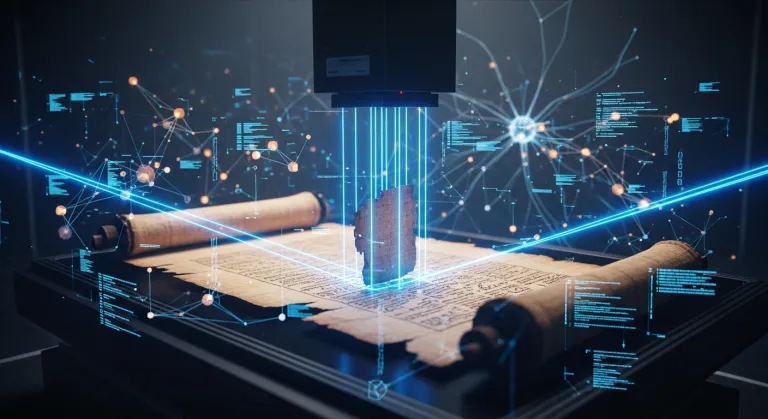
Imagine a material so fragile that it crumbles to dust at any attempt to touch it. Imagine text that is completely invisible to the human eye because it is on the surface of blackened, burnt matter. For archaeologists, the scrolls found in Herculaneum were for centuries just "black pieces of charcoal". Today, however, thanks to artificial intelligence and advanced computer vision, we are gaining the opportunity to glimpse into the thoughts of people who lived in the ancient world.
Technology Behind Invisible Text
The key to this success is not just the AI model itself, but a combination of cutting-edge hardware and specific algorithms. The process begins with the use of micro-CT scanning (X-ray tomography), which creates an extremely detailed 3D map of the scroll. For humans, this map is still just an unreadable cluster of densities, but for specialized neural networks, it is a treasure trove of data.
In this case, it is not classic text processing as we know it from ChatGPT or Claude. While these models (LLM – Large Language Models) work with already existing text, here it is about computer vision. Algorithms are trained to recognize microscopic differences in material density. Ink, even when burnt, contains tiny particles of metals or carbon, which have a different density than the papyrus itself. AI can identify these differences and "extract" letter shapes from the data noise.
This approach uses techniques known as image segmentation. The algorithm divides the image into individual parts and determines which part belongs to the background and which represents the ink trace. It is a process that requires enormous computational power and precision that the human eye simply cannot maintain.
Comparison: LLM vs. Specialized Vision
It is important to understand the difference between the tools we commonly use and the technologies employed for this research. If you were to take a state-of-the-art model like GPT-4o or Gemini 1.5 Pro and try to show them an X-ray image of a burnt scroll, they would likely fail. These models are optimized for human language comprehension and general understanding of the world.
| Feature | General LLM (GPT/Gemini) | Specialized Vision AI |
|---|---|---|
| Primary Task | Text generation, logic, conversation | Pattern detection in unconventional data |
| Input Data | Text, common photographs | 3D X-ray maps, microscopic scans |
| Accuracy | High in language tasks | Extremely high in texture detection |
Practical Impact: What Does This Mean for Science and the Future?
This breakthrough has a profound impact not only on archaeology but also on the broader technology market. The first significant aspect is the democratization of science. Thanks to projects like Vesuvius Challenge, data is made accessible to a wide community of developers and students worldwide. What previously required decades of work by expert archaeologists can now be accomplished by a group of talented programmers in months, thanks to collaboration with the AI community.
For the Czech and European technology sector, this represents a huge opportunity. The European Union, through programs like Horizon Europe, is massively investing in research in digital transformation and AI. Companies specializing in computer vision, data analysis, or the production of advanced laboratory equipment can play a key role in these projects. In the Czech context, we can see similar applications in medicine (analysis of X-ray images or MRI) or in industrial automation (quality control of materials).
What does this mean for the average user? Even if it seems to you that reading ancient scrolls has nothing to do with your daily life, the technologies developed for this purpose are gradually spilling over into the civilian sector. Better image analysis algorithms mean more accurate diagnostics in hospitals, more efficient food control in the food industry, and better security systems that can distinguish a real threat from ordinary movement.
Conclusion
The success in deciphering the Herculaneum scrolls confirms that artificial intelligence is not just a tool for writing emails or generating images. It is a powerful tool for discovering truth hidden in data that is invisible to our human eyes. We are witnessing an era where technology allows humanity to reclaim lost history without the risk of damaging it.
Do the scrolls have to be physically unrolled to read the texts?
No. Thanks to virtual unrolling technology, AI can analyze 3D data obtained from scans and "unroll" the papyrus layers digitally, without ever touching the original object.
Is this technology available to ordinary companies?
The research software itself is often open-source or academic, but the principles of computer vision and segmentation are widely available through libraries like TensorFlow or PyTorch. Companies can train these models on their own data for specific purposes (e.g., in medicine).
What is the cost of using such technologies?
In an academic environment, costs are primarily associated with computational power and scanning equipment. For commercial use in industry, the price depends on the complexity of the solution, but an "AI as a service" model is often used, where you pay for data analysis.




