From One Thousand to Fifteen Thousand: Numbers That Make Sense
When AGIBOT announced its 10,000th robot produced in March 2026, it took roughly a year to go from one thousand to five thousand units. The next leap — from five to ten thousand — however, took only three months. Production speed increased more than fourfold. And now, at the end of June 2026, the company added another five thousand robots in less than a quarter.
This growth trend is not just a number on paper. It shows that AGIBOT has not only production capacities, but also a supply chain, standardized production, and the ability to actually deploy robots into operation. The fifteen-thousandth unit, model AGIBOT G2, is a wheeled mobile manipulator with a humanoid torso and arms designed for industrial tasks — and it went straight to the factory.
What is AGIBOT G2 and Why It Matters
The G2 is not a full-fledged bipedal humanoid, but a so-called semi-humanoid robot (wheeled mobile manipulator). It combines a wheeled chassis for stable and fast movement with a torso and arms that can handle delicate manipulation. This is often more advantageous for industrial deployment than walking robots — it is faster, more stable, and cheaper to manufacture.
Key parameters of AGIBOT G2:
- Automotive components — 100% of parts meet automotive industry standards
- IP42 rating — resistance to dust and splashing water
- Sub-millimeter precision — thanks to force-controlled manipulation and reinforcement learning (Genie RL)
- Interactive capabilities — expressive facial mimicry, gaze tracking, conversation with multiple people simultaneously
The G2 is part of a broader architecture that AGIBOT calls "Three Intelligences in One" — it integrates intelligence for locomotion, interaction with the environment, and object manipulation into a single system. This is the principle that distinguishes embodied AI from "headless" industrial robots that merely repeat pre-programmed movements.
Live Stream from the Factory: 100 Hours of Uninterrupted Work
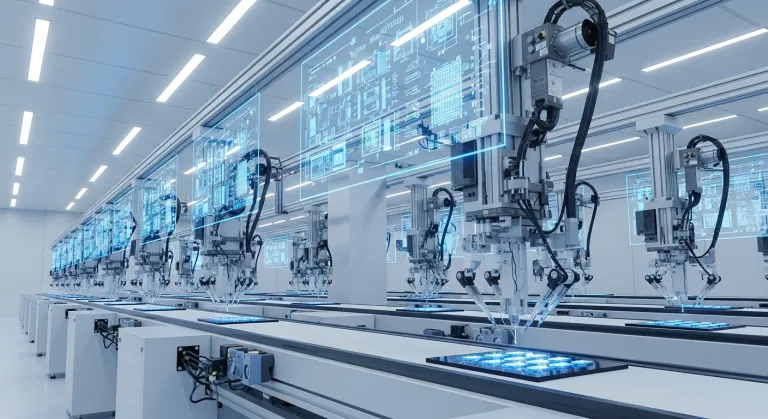
AGIBOT does not rely solely on press releases. From June 23 to 28, 2026, the company broadcast a six-day global livestream directly from the production line of Longcheer Technology in Nanchang. The footage showed several G2 robots continuously performing visual quality control of tablets — in a real production rhythm, side by side with human workers.
During approximately 100 hours of cumulative operation, the robots performed quality inspection tasks at the pace of live production. This is a fundamental difference from demonstrations at trade fairs — the live stream showed that AGIBOT robots can handle the consistency, repeatability, and reliability that a factory truly needs.
"The rolling off of our 15,000th robot from the line is not only an important milestone in AGIBOT's mass production and technical deliveries, but also a reflection of a broader industry shift towards large-scale deployment in real-world environments," said Dr. Yao Maoqing, Partner and Senior Vice President of AGIBOT, responsible for the embodied AI division.
World Leader in Humanoid Robots
According to a January report by the analytical firm Omdia, AGIBOT was the global leader in humanoid robot shipments in 2025 — with 5,168 units, it gained a 39% share of the global market. For comparison: the entire global humanoid robot market then totaled approximately 13,000 units. Omdia further predicts that by 2035, annual worldwide humanoid shipments will reach 2.6 million units.
AGIBOT is not competing alone. Agility Robotics (with the Digit model), Boston Dynamics (Atlas), Figure AI, and Tesla (Optimus) are also entering commercial trials with humanoid robots. While Western companies are often in the role of pioneers, China's AGIBOT is in the position of one who scales — and does so faster than anyone else.
What This Means for Europe and the Czech Republic
AGIBOT is actively expanding into the European market. It has previously showcased its product line at VivaTech in Paris and at Hannover Messe, where its robots garnered attention. The company is also building a global service network and openly discusses leasing humanoids abroad — including to Europe.
For Czech manufacturing companies, this means that the cost of deploying advanced robotics is sharply decreasing. When AGIBOT produces robots in the thousands per month, the unit price logically falls. While an industrial humanoid was previously a rarity costing hundreds of thousands of dollars, mass production opens the way for even medium-sized European companies. The question remains how European regulation will approach Chinese robots — especially in the context of the EU AI Act and rising geopolitical tensions.
From Proof-of-Concept to Real-World Deployment
The most interesting thing about the entire AGIBOT story is not the number 15,000 itself. It's the trajectory. In robotics, we are used to slow progress: years of research, then the first prototype, then years of testing, then — maybe — a small series. AGIBOT rewrote this scenario. From its founding in 2023, it went from zero to mass production in three years.
The company itself summarizes it by saying: "Industrial competition is shifting from standalone robotic demonstrations and proof-of-concept projects towards mass production, batch deliveries, and real-world deployment. The ability to sustain large-scale manufacturing and deployment will become an important measure of industrial maturity."
And that's precisely the point. Embodied AI is no longer a question of "if," but "how fast." And AGIBOT answers this question with a pace that sets a new standard for the entire industry.
What is the difference between a humanoid robot and a semi-humanoid like AGIBOT G2?
A humanoid robot has two legs and mimics human walking — typical examples are Tesla Optimus or Boston Dynamics Atlas. A semi-humanoid (wheeled mobile manipulator) like AGIBOT G2 has a wheeled chassis instead of legs, but retains a humanoid torso, arms, and head. For most industrial tasks, this design is more practical — the robot is faster, more stable, and cheaper to manufacture than a walking humanoid.
Are AGIBOT robots available in the Czech Republic?
AGIBOT has not yet announced an official presence in the Czech Republic, but is actively building a distribution and service network in Europe. It has showcased its products at VivaTech in Paris and at Hannover Messe, indicating serious interest in the European market. Czech companies considering deploying these robots should particularly monitor the development of European regulation — the EU AI Act may affect how quickly Chinese embodied AI systems reach the local market.
How much does such a robot cost?
AGIBOT does not publicly state the final prices of its robots — these are handled individually based on order volume and specific configuration. However, with increasing production volume (15,000+ units), it can be assumed that the unit price is decreasing. For orientation: competing robots of a similar category range from 50,000 to 150,000 USD, but the exact price of the G2 model is not yet publicly available.