What actually won in Berlin
According to AgiBot's own announcement, the full-size AGIBOT A3 took the top prize in the "Best in IFA Next & Emerging Technologies" category at the official IFA Innovation Awards 2026, while the smaller AGIBOT X2 was named an Honoree. The trade press followed suit: TechRadar called the A3 "Best in Show", Techlicious gave it an IFA Editor's Choice award, and BGR placed it among the five best humanoid robots at the show. Gadget Flow singled out the X2 for its navigation and human-robot interaction. The live demonstrations matter here, because a humanoid's "brain" is only half the product. AGIBOT showed dynamic mobility, multi-robot swarm coordination, and traditional calligraphy written with its OmniHand dexterous gripper. A robot writing brush strokes on a show carpet is precisely the kind of demo that used to end with a hidden human operator. What made it credible this time was the swarm system: a UWB-based coordination layer — the same radio technology family as Apple's AirTag — that AGIBOT says can manage more than 100 robots simultaneously. Coordinating a hundred mobile manipulators is an engineering problem, not a scripted demo problem.The numbers behind the booth
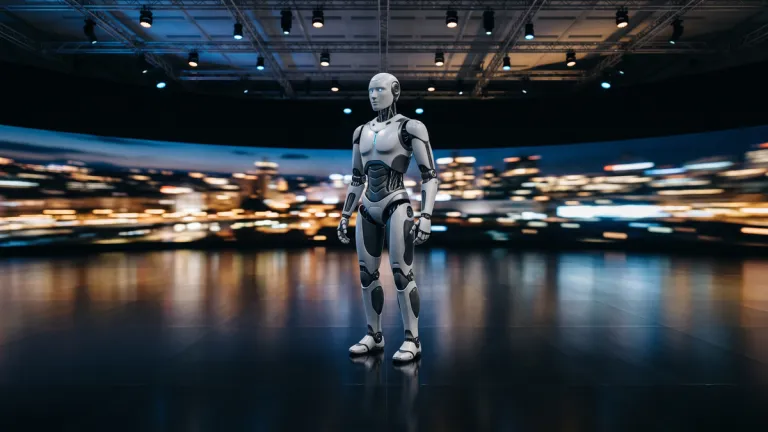
AGIBOT's 2025 claim of 5,100 units shipped and a 39% global market share in humanoid robotics deserves context: the overall market is still small, and that figure is the company's own. Still, it puts AGIBOT in a different category from the countless startups that show one polished prototype and disappear. The robot specs are worth writing down:- AGIBOT A3 — full-size humanoid, 173 cm tall, 55 kg. That is roughly the size and weight of an adult, which matters in workplaces designed for humans.
- AGIBOT X2 — compact robot, ~1.31 m tall, ~35 kg, 25 degrees of freedom, walking speed up to 1.8 m/s, joint torque up to 120 Nm, and a 500 Wh battery rated for about two hours of runtime.
The European reality check
For European readers, the most important part of the announcement is not the award. It is AGIBOT's European market entry strategy. First, the company has established a regional commercial distribution alliance with European partner Tekpoint. That is a pragmatic move: humanoid robots need local integration, spare parts, training and maintenance, and no Chinese manufacturer can build that network from a trade-fair booth alone. Second, AGIBOT has secured certifications from TÜV Rheinland, the German testing and certification body, for the A3 Ultra and its wider lineup (A2, X2, G2, D1 Max Pro, C5), covering radio approvals and safety requirements (RED DA, RED NB and Safety AK). In practical terms, this shortens the path to placing these products on the EU market with CE marking — and it signals that the company understands European compliance is a precondition, not an afterthought. Third, and this is where the timing gets interesting: the EU AI Act moved into its general application phase on 2 August 2026. Mandatory risk-management systems, conformity assessments and EU database registration for high-risk AI systems are now the legal floor, not voluntary guidance. A humanoid robot in a retail or industrial setting does not automatically fall under the AI Act's high-risk annexes — but the AI software driving navigation, perception or worker interaction can trigger obligations depending on the use case. Add GDPR to the equation, because a mobile robot with cameras and LiDAR in a shop or warehouse is processing personal data by default. European integrators will need to ask hard questions about data flows, retention and transparency before they sign.What does a robot like this actually cost?
AGIBOT's humanoid series, including A2 variants, is priced between $100,000 and $190,000 depending on configuration. At an assumed exchange rate of 1 EUR ≈ 1.08 USD, that is roughly €93,000 to €176,000 — before integration, training, maintenance and the inevitable software updates. That price point tells you the target customer. This is not a consumer gadget; it is capital equipment. European businesses comparing AGIBOT with US or European alternatives — Figure, Tesla's Optimus, or Norway's 1X — should treat the headline price as the starting point of a total-cost-of-ownership calculation, not the end of it. Two-hour runtime batteries, spare end-effectors and certification documentation all have line items.The takeaway from IFA 2026
The AGIBOT A3's award haul is real, and the company deserves credit for demonstrating physical AI in front of thousands of visitors. But awards do not survive contact with a procurement department. What matters for Europe is that AGIBOT has done the unglamorous work: production volume, third-party safety certification, a local distribution partner, and a price list rather than a vague "contact us". If I were a European system integrator, I would not ask whether the A3 can write calligraphy. I would ask Tekpoint for the EU declaration of conformity, a GDPR data-flow description for the perception stack, and a service-level agreement for the two-hour batteries. The answers to those questions will determine whether the humanoid era in Europe starts with a purchase order — or stays on the show floor.Is 1.8 m/s actually fast for a humanoid robot?
It is a brisk human walking pace — roughly 6.5 km/h — which is faster than most service robots and comfortable for working alongside people in warehouses or retail spaces. The bigger limitation is the ~2-hour runtime of the X2's 500 Wh battery, which makes battery swapping and charging logistics a real deployment topic.
Who is actually buying six-figure humanoid robots today?
AGIBOT's claimed 5,100-unit shipment milestone and 39% market share point to enterprise buyers — retail assistance, commercial cleaning and industrial operations — rather than consumers. The C5 cleaning robot is a concrete example of a single-purpose deployment that is easier to justify economically than a general-purpose humanoid.
Does the EU AI Act apply to a Chinese robot sold in Europe?
Yes, if the AI system is placed on the EU market or affects people in the EU. The AI Act has extraterritorial reach, and since 2 August 2026 the general application phase requires conformity assessments and registration for high-risk AI systems. A robot's hardware falls under machinery safety rules, but the navigation and perception software can trigger AI Act obligations depending on the use case — one more reason AGIBOT's TÜV Rheinland certifications matter.