What LM Link connects
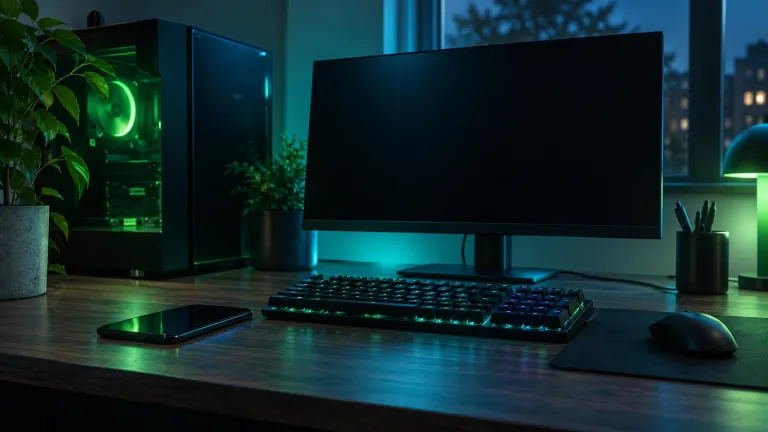
LM Studio is a desktop application for downloading and running open-weight models on your own hardware. LM Link is its pairing feature: the PC hosts the model, a companion app called Locally sends the prompts from the phone. XDA's hands-on piece walks through replacing the ChatGPT and Gemini apps on an iPhone with exactly this arrangement.
The connection runs over Wi-Fi and over cellular data. No open router ports, no port forwarding, no VPN. Anyone who has tried to reach a home machine from outside their local network knows that this was the part that ate the evening.
The phone is a thin client. Generation happens on the desktop GPU, and tokens stream back to the screen as they are produced. That means the model you get on mobile is limited by the desktop, not by what fits in a phone's memory.
The model in the test
XDA used Gemma 4 26B A4B, a Mixture-of-Experts model from Google DeepMind's Gemma family. It holds 26 billion parameters and activates about 4 billion of them per token. The split explains the appeal: arithmetic per token stays close to a dense 4B model, while the memory footprint stays at 26B.
| Precision | Memory needed |
|---|---|
| 4-bit quantization | ~14.4 GB |
| 8-bit quantization | 28.8 GB |
| BF16 | 57.7 GB |
Those figures include static weights plus roughly a tenth for loading overhead. Only the 4-bit row fits a 16 GB consumer card, which is what the XDA setup used in the form of an RTX 4070 Ti Super.
Headroom on a 16 GB card
Subtract 14.4 GB from 16 GB and you have roughly 1.6 GB left. That remainder has to absorb the KV cache, which grows with context length, plus whatever the desktop compositor and browser are already using. Short questions against an idle machine are fine. A pasted contract or a long debugging session is where the margin starts to matter.
We have not published a Gemma 4 26B run on our own RTX 5060 Ti 16 GB yet, so the honest version of this paragraph is arithmetic, not measurement. Our AI Arena page is where local-model numbers go once we actually run them.
Electricity versus API tokens
Keeping a gaming PC available all day is the real subscription. Assume the machine averages 150 W while it waits and serves. That is 3.6 kWh per day, about 108 kWh per month. At roughly €0.20/kWh, near the Czech household level in 2026, the bill lands around €22 a month. A PC that sleeps when unused costs less. A rig idling at 250 W with a large GPU costs more.
Cloud prices per million tokens, input and output, converted at €1 = $1.16:
| Model | USD | EUR (approx.) |
|---|---|---|
| DeepSeek V4.1 Flash, off-peak | $0.15 / $0.60 | €0.13 / €0.52 |
| Mistral Large 4, promotional | $0.68 / $2.09 | €0.59 / €1.80 |
| Gemini 4 Argon, intro until Nov 30 | $2.00 / $10.00 | €1.72 / €8.62 |
Push a few million tokens a month through the cheap end of that table and you spend less than the electricity. The local setup starts to pay off when volume is high, when prompts cannot leave the building, or when a flat cost is worth more than a marginal one.
iOS only, and other limits
The Locally client is an iOS app, 116 MB to 124.6 MB depending on the build, requiring iOS 18.1 or newer. Android users have no official equivalent in this setup and fall back on manual work with tools such as llama.cpp.
The host machine has to stay powered and awake. A desktop that sleeps breaks the link, which turns a gaming PC into something closer to a small server with a graphics card. LM Link is free while it sits in LM Studio's preview programme; paid tiers are planned for later releases, according to the report.
What the EU rules say about local output
For GDPR purposes, running inference on your own hardware takes the model provider out of the processing chain for those prompts. Nothing is transmitted to a third party. The weights are still covered by Google's Gemma licence, and any account or telemetry inside LM Studio or Locally is a separate question from where the inference happens.
Transparency duties under Article 50 of the EU AI Act have applied since 2 August 2026. People have to be told when they are interacting with an AI system, and synthetic content must carry detectable markings. Running the model in your own house does not move you outside those duties once you publish the output somewhere.
Enforcement against general-purpose AI providers also began on 2 August 2026, with the European AI Office able to issue fines up to €15 million or 3% of worldwide annual turnover. That applies to the companies shipping the models, not to someone running Gemma on a card in a spare room.
Can I use a model other than Gemma 4 26B?
LM Studio is not tied to one model. The memory table above scales with parameter count and precision, so a smaller model leaves more room for context on a 16 GB card, and a larger one will not load at all.
Does the host PC need a dedicated GPU?
It can run on CPU and system RAM, but a 4-bit 26B model still needs around 14 GB of memory before context, and generation is slower. A 16 GB graphics card is the practical minimum for this particular setup.
Do both devices have to be on the same network?
No. The link works over cellular data as well, which is the point of not requiring port forwarding or a VPN on the router.
With no date attached to the paid tiers, the current arrangement is a free preview that requires iOS 18.1 or newer on the phone and a desktop that never goes to sleep.