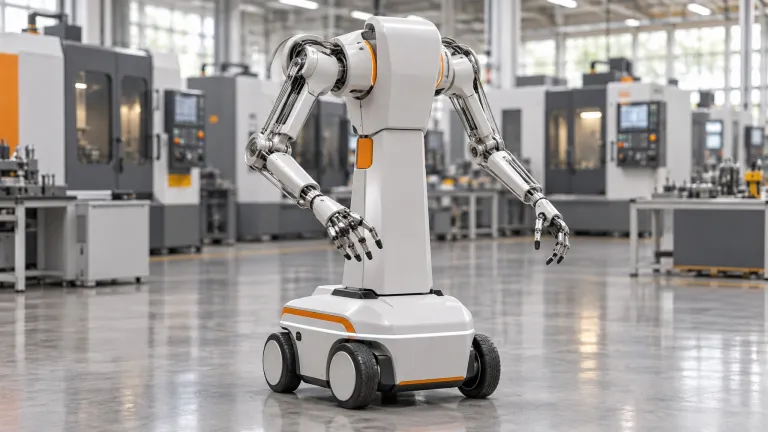
Industrial arms usually live behind mesh. The reason is energy: a heavy arm moving fast carries enough momentum to break bone, so the cheapest way to make it safe is to keep people out. Collaborative robots changed that trade-off by shrinking payload and capping speed. Embodied AI is trying a third route, putting the mass where it cannot swing.
Light arms, heavy torso
On AIR, motors, gearboxes and electronics sit in the torso. The arms carry little more than structure and a tendon drive, so contact with a person ends with the arm yielding instead of the person absorbing the load. The company says the design follows ISO/TS 15066:2016, the technical specification that sets out how collaborative operation is validated, including limits on contact force and pressure for different body regions.
The base is a wheeled platform. Legs are harder to stabilise, cost energy to keep upright, and bring a fall risk into a workspace full of people and cables. Flat factory floors are exactly where wheels work.
Nine months to a prototype
Embodied AI says AIR went from first research to a working physical prototype in nine months. That figure describes hardware iteration, not autonomy. The robot does not start on its own. It begins under remote teleoperation while AI models train on recordings of the operator. Once a task is learned, the company says independent execution typically arrives within about one month.
A human stays on standby for edge cases. That is the standard shape of industrial robot learning in 2026, and it has a staffing consequence: teleoperation is a job, and someone has to do it, from somewhere.
What the pilot numbers cover
The published figures are cell-level, not robot-level. Across paid pilots with automotive and industrial partners and with consumer electronics customers, Embodied AI reports an average 95% task success rate for its industrial cell software. In a cable-handling proof of concept, the system reached 98% reliability against a customer benchmark of 90%.
Both numbers come from the company and describe supervised deployments. A 95% success rate over a pilot is not the same as 95% across a three-shift week, and the cable trial is one task with one customer. Interesting Engineering reported the debut without independent measurements, and none have been published elsewhere so far.
No price, no payload
Three numbers a plant manager needs before a purchase order are missing: commercial price, payload capacity and delivery dates. Without a payload figure, comparing AIR with an established cobot such as the UR20 or the KUKA LBR iisy is guesswork on the only axis that matters at line level, which is what the machine lifts and how fast. Embodied AI has opened commercial orders anyway.
CE marking and the 2027 machinery rules
CE marking is planned for 2027. That year is not arbitrary. Regulation (EU) 2023/1230, the new Machinery Regulation, applies from 20 January 2027 and replaces the Machinery Directive. A collaborative robot placed on the EU market after that date is assessed against the new text, including its provisions on autonomous machinery and digital instructions.
A second deadline sits in the same window. Under the AI Act, machinery that includes an AI system acting as a safety component falls into the high-risk category through Annex I, with conformity assessment involving a notified body. Article 113 of the AI Act sets 2 August 2027 for that route to start applying. A robot whose learned policy influences how hard it pushes is a plausible candidate for that classification, and the provider would have to record it in the technical documentation.
For a European buyer, the practical question is what happens when the model is updated. A learned policy that changes behaviour after deployment is not the product the original risk assessment covered. Ask who re-validates the cell after a model update, and how often.
Recorded demonstrations are personal data
Learning from teleoperation means recording video of a working cell, and of the people in it. In an EU plant those recordings are personal data under GDPR, whatever the training purpose. Before a pilot, clarify where the footage is stored, how long it is kept, whether it leaves the EU, and who inside the vendor organisation can view it. Works councils in Germany and Czechia will ask, and the answer belongs in the pilot contract rather than in a blog post.
Questions before an order
A short list that the current public material does not answer:
- Documented force and pressure limits per body region, and the test method used to establish them.
- Payload and repeatability, so the cell can be compared with a conventional cobot.
- Which integrator in the EU can take responsibility for the risk assessment.
- Spare parts and service response times, given that tendon drives wear.
- Update policy for the learned policy, including re-validation triggers.
- Where demonstration recordings are processed and stored.
The company has not published payload capacity, commercial price or delivery dates. CE marking is targeted for 2027, the year the new Machinery Regulation applies.
Is AIR a humanoid robot?
No. It has a wheeled base and two arms mounted on a torso, built for flat factory floors rather than stairs or outdoor terrain.
Can it run without a person nearby?
Not at the start. Deployments begin under remote teleoperation, with models trained on operator demonstrations, and a human stays on standby for edge cases. Embodied AI reports that independent task execution usually arrives within about a month.
When can a European factory buy one?
Commercial orders are open, but no price, payload figure or delivery date has been published. CE marking is planned for 2027, when the EU Machinery Regulation takes effect.