What ST actually showed
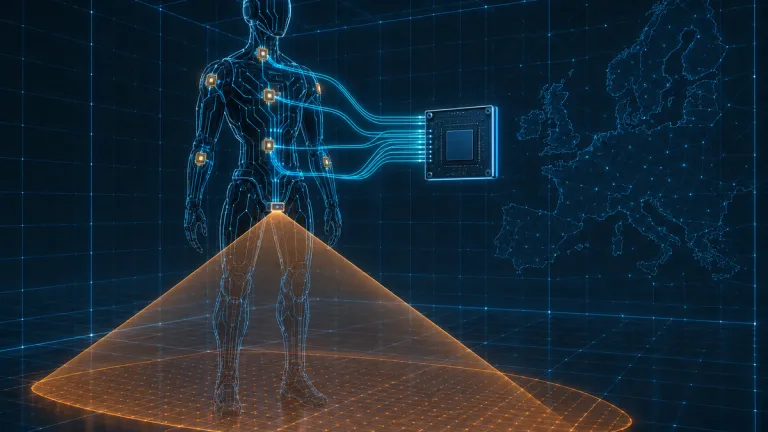
The update on ST's blog distinguishes physical hardware demonstrations from a virtual humanoid walking-gait simulator, rather than presenting all four as running on real hardware. The physical part includes the balance setup with an ASM330LHHX inertial measurement unit mounted on a robot torso, streaming over Ethernet into an NVIDIA Jetson Thor compute unit, and separate camera and depth-sensor modules. The humanoid walking-gait demo is shown as a virtual simulation inside Isaac Sim/Isaac Lab, not as a physical robot walking on the show floor.
That distinction matters. In a closed-loop balance task, latency, noise and drift can all degrade control performance. ST frames the physical balance setup as evidence that the sensor-to-compute path is short and clean enough to matter; a sensor that is slow or noisy at that first hop makes stability harder before the policy even starts.
The sim-to-real gap is a sensor-model problem
This is the part that will interest anyone who has trained anything. Robot policies are trained in simulation because breaking a simulated robot costs nothing. The problem: simulated IMUs are polite. Real IMUs have noise density, bias instability, offset drift across temperature, and mechanical vibration from the motors sitting next to them. A policy trained on clean simulation data walks confidently into a real robot and immediately develops a wobble.
ST's answer is a Sim2Real IMU model inside Isaac Lab that models that noise, bias and drift explicitly, so policies for tasks like stable hand manipulation can be trained against something closer to the physical device. ST claims to be the first IMU vendor to publish high-fidelity device models inside Isaac Sim and Isaac Lab. I have not independently verified the "first" claim — vendor-first claims usually survive until someone checks the fine print — but the direction is correct and the gap it addresses is real.
The hardware, in one place
| Role | Component | Notable figure |
|---|---|---|
| Edge compute | NVIDIA Jetson Thor | — |
| Balance IMU | ASM330LHHX | Ethernet link to Jetson |
| Module IMU | LSM6DSV16X | 1 per camera module |
| 3D depth | VL53L9 dToF LiDAR | 2,300 zones |
| Vision | 2× VB1940 RGB/IR | Depth + colour fusion |
| Sensor bridge IP | STM32H7 MCU | Runs Holoscan Sensor Bridge IP |
| Camera module | Leopard Imaging LI-ASTRO-VB1940-VCL-DTOF | 10 GbE uplink |
The detail worth pausing on is the STM32H7 running the Holoscan Sensor Bridge software IP. That means the low-latency, hardware-accelerated sensor-to-compute bridge does not need a Linux host — it sits on a microcontroller. For anyone who has tried to bolt a real-time control loop onto a general-purpose OS, that is a meaningful architectural step; ST positions it as moving the bridge closer to a product than a research demo, but the update does not demonstrate production readiness or certification.
Why a European chipmaker is the interesting part
STMicroelectronics is one of Europe's largest semiconductor companies, with a Franco-Italian industrial footprint and manufacturing sites in France and Italy. Hype cycles around Physical AI tend to centre on American model labs and Chinese humanoid startups. The unglamorous layer — the IMU that keeps the robot upright, the ToF sensor that stops it walking into a person — is where European suppliers still have leverage.
That matters for two regulatory reasons. First, the EU Machinery Regulation 2023/1230 replaces the old Machinery Directive and applies from 20 January 2027. Robot safety functions, including the sensing chain, move under a stricter regime. Second, under Article 6(1) of Regulation (EU) 2024/1689 (the AI Act), an AI system is high-risk if it is a safety component of a product covered by Annex I to the AI Act — machinery being the obvious case — and the product or the safety component is required to undergo third-party conformity assessment under that Annex I legislation. That is narrower than a blanket “safety-critical sensing = high-risk” reading. For those high-risk systems that fall under Annex I product rules, the AI Act’s compliance obligations apply from 2 August 2027, not from the Machinery Regulation’s 20 January 2027 application date. For most other high-risk AI systems, obligations apply from 2 August 2026. Systems already placed on the market before the relevant date generally do not need to comply retroactively unless they undergo significant changes; teams should verify their specific transitional status.
Read that combination and ST's emphasis on device models with modelled noise and drift stops looking like a developer convenience. It looks like groundwork for a world where you have to justify, in writing, how your robot behaves when the IMU misbehaves.
What is missing: numbers a buyer can use
ST publishes no public unit pricing for these parts. The ASM330LHHX, LSM6DSV16X, VL53L9 and VB1940 move through distribution, and quotes depend on volume — so I am not going to invent a EUR figure for you. What is visible today is the integration shape: the demo hardware list is Jetson Thor plus ST sensors plus an STM32H7 running the bridge IP. On paper, that looks like a bill of materials a small EU robotics team could plausibly source for evaluation; I have not verified low-volume availability or cost, and it is not evidence of a production-ready kit. That is still a meaningful change from five years ago, when humanoid-grade sensing was far less accessible.
Our own rig in AI Arena is tuned for LLM inference, not robot physics — different GPU workload, different bottlenecks — so I will not pretend a desktop benchmark tells you anything about Isaac Sim throughput. Local LLM numbers and robot simulation numbers are not comparable, and anyone claiming otherwise is selling something.
The other honest gap: ST describes "functional safety" in the framing, but the update does not spell out which certification levels the new models or the bridge IP reach. A simulated sensor model supports engineering validation, but it does not establish functional-safety certification or regulatory compliance. Until that is on paper, treat it as a design direction rather than a certified safety claim.
What a developer should take from this
If you are building anything that moves — an AGV, a service robot, a lab automation arm — the practical change is that the sensor vendor now hands you a model of the sensor, not just a datasheet. That shortens the loop between "our policy works in sim" and "our policy works on the bench". ST argues it should also make simulation results more comparable across teams, because teams can train against the same published noise model instead of a home-made guess. That comparability is useful for engineering validation, but it does not guarantee identical real-world behaviour or certify a system.
The strategic point is that Physical AI is being assembled from layers, and the layer Europe still owns is sensing. That is a better position than it sounds. Models commoditise fast. A sensor that survives a factory floor does not.
Do I need NVIDIA hardware to use ST's IMU models?
The sensors themselves are vendor-neutral and talk standard SPI and I²C. But the high-fidelity device models ship inside Isaac Sim and Isaac Lab, which are NVIDIA platforms, and the reference demo runs on Jetson Thor. If you use a different simulator or a different edge compute module, you can still use the silicon — you just do not get the ready-made model.
Is this only relevant for humanoid robots?
No. ST lists industrial, service and healthcare robotics alongside humanoid platforms, and the Embedded World demos include an edge machine-learning smart rear-view camera and a multi-sensor Leopard Imaging module. The sensor bridging problem — getting depth, colour and motion data into a compute unit with minimal latency — is identical for a warehouse robot and a hospital delivery cart.
What is the European deadline I should be watching?
20 January 2027, when Regulation (EU) 2023/1230 becomes applicable and supersedes the Machinery Directive. Under Article 6(1) of Regulation (EU) 2024/1689, AI safety components of products covered by Annex I are high-risk only where the product or safety component is subject to third-party conformity assessment; for that group, the AI Act’s obligations apply from 2 August 2027. A published sensor model with modelled drift can support engineering validation and documentation, but it is not certification or proof of compliance.