The round and valuation
Agile Robots announced the round on November 12, according to AI Insider. SoftBank Group led the $500m Series F. Nvidia, Hitachi Group, through Hitachi and Hitachi Ventures, and T.Capital participated.
The valuation is $8.5bn. Agile Robots says it has raised $2bn in total since launch. At $8.5bn, the valuation is the headline number; the $500m round equals 25% of the $2bn cumulative capital the company cites. That is a useful scale check: the Series F is a major top-up, but not the majority of the company's capital history.
What Agile Robots sells
The company groups its work under "physical AI": AI models, control software, humanoid robots, robotic arms and dexterous hands. That is a broad product surface. For buyers, the category label is less useful than the specification sheet.
Agile Robots says it has deployed 20,000 industrial robotic solutions globally across logistics, consumer electronics and automotive manufacturing. That number covers industrial solutions, not humanoid units. Shipments are not broken down by product line in the release.
The concrete hardware includes arms, hands, mobile robots and control software. The humanoid line is the part tied to the new German capacity. Unit prices for these systems are not disclosed.
Agile Robots was founded in 2018 as a spin-off from the German Aerospace Center (DLR). The company says it has more than 2,000 research and development specialists and over 650 patents. Its portfolio includes Franka Robotics and Krause Automation, an industrial deployment specialist recently acquired from thyssenkrupp. Its customers include companies in automotive, consumer electronics, healthcare and service industries.
German capacity
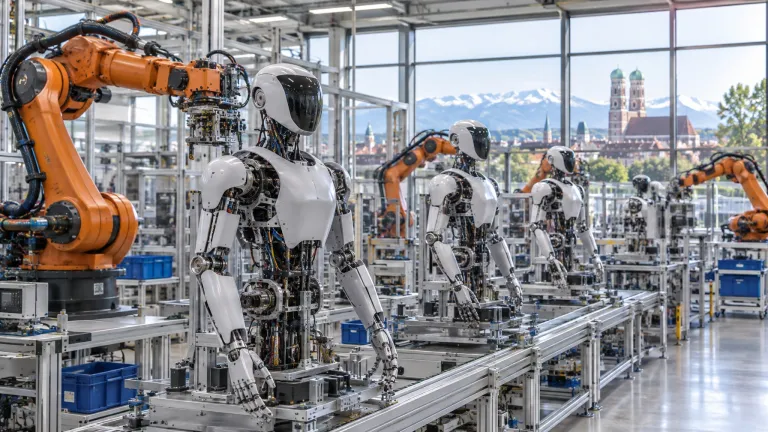
The manufacturing facility in Fürstenfeldbruck near Munich, opened earlier this year, is described as having annual production capacity of 10,000 legged and wheeled humanoid robots. How much of that capacity is currently in use, how many humanoid units have shipped, and what a unit costs are all undisclosed.
This is the part with direct European relevance. A German plant, German engineering jobs and a local supply chain can matter to European manufacturers that want shorter logistics and closer service. Agile Robots is also expanding in the U.S. market, so the German capacity is not the whole story.
For European buyers, local capacity may reduce lead times compared with suppliers based in Asia or the U.S. It does not guarantee lower prices. The release lists capacity and expansion plans, not allocation by region.
Investors and partners
Hitachi Group participated through Hitachi and Hitachi Ventures. Nvidia is an investor in this round. The announcement names the investors but gives no detail on joint product plans.
Nvidia's involvement is notable because robot training and simulation depend on compute. Investment is not the same as product integration; no specific Nvidia hardware or software is named for production.
Google DeepMind released Gemini Robotics 2.5 on November 11, 2026, though its robotics pricing is not public. That is a reminder that robot software is a separate market from robot hardware. Agile Robots is raising money on the hardware and deployment side, where capital costs are higher and sales cycles are longer.
Arithmetic check
At $8.5bn and 10,000 units a year, the valuation works out to $850,000 per unit of annual humanoid capacity. The $500m round works out to $50,000 per unit of annual capacity. These are rough ratios, not prices. They help compare the scale of the funding with the stated manufacturing plan.
The $500m is 25% of the $2bn cumulatively raised. The remaining $1.5bn came earlier. The Series F is therefore a large top-up, but not the majority of the company's capital history.
European rules
For European deployers, the AI Act is now active in stages. Since August 2, 2026, Article 50 transparency obligations apply. Users must be told when they interact with an AI system, and synthetic content must be detectable and labelled. A factory robot that only performs pre-programmed welding may not trigger those rules. A robot that interacts with workers or generates synthetic media may.
The Annex III high-risk deadline was postponed to December 2, 2027, under the 2026 Digital Omnibus. That is later than the original August 2, 2026 date, but it is still a deadline. If a physical AI system is classified as high-risk, conformity assessment and documentation will be required.
GPAI supervisory powers also activated on August 2, 2026. Fines can reach €15m or 3% of worldwide annual turnover. If Agile Robots supplies a general-purpose model in the EU, that regime may apply. Whether it does is not stated.
What to watch
The useful signals are not the valuation. They are whether the Fürstenfeldbruck line reaches 10,000 units a year, what a humanoid unit costs, and which European manufacturers sign deployments. Those three data points are not in the release.
The company has 20,000 industrial solutions deployed, but the humanoid capacity is new. The gap between the installed industrial base and the humanoid output is the story. The release gives the capacity, the round and the investors; unit prices, current production and customer names for the humanoid line are missing.
Is the 10,000-unit capacity already active?
The company describes the Fürstenfeldbruck facility as having that annual capacity. How much is in use, and how many humanoid units have shipped, are not disclosed.
Can European companies buy Agile's humanoid robots now?
Agile Robots sells industrial robotic solutions globally. Retail pricing and a public ordering process for humanoid units are not in the release.
Does the AI Act apply to humanoid robots in factories?
It depends on the system and use. Article 50 transparency rules apply from August 2, 2026. High-risk Annex III obligations were postponed to December 2, 2027. A factory robot may fall under machinery safety rules instead, or in addition, depending on its function.