The reformer who gave Estonia its own money
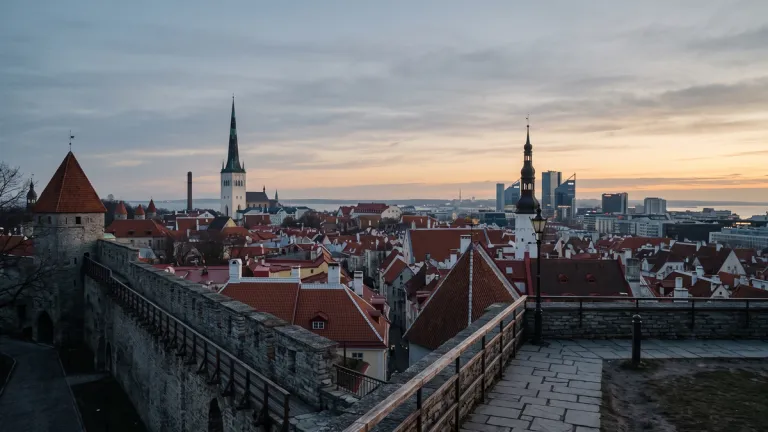
Siim Kallas was born in Tallinn in October 1948, when Estonia was still under Soviet occupation. He trained as an economist and spent his early career inside the Soviet financial system, but when independence returned in 1991 he became one of the people who turned paper plans into functioning institutions.
As president of the Bank of Estonia, he led the 1992 currency reform that phased out the Soviet rouble and introduced the Estonian kroon. For a country that had just regained independence, this was not a technical exercise but a statement of sovereignty — a sign that Estonia's economy would be anchored in the West, not Moscow.
He went on to serve as foreign minister, finance minister and, from 2002 to 2003, as prime minister. Under his government, Estonia concluded EU accession negotiations at the Copenhagen summit in December 2002, clearing the road to membership in 2004. Across his life, Estonians elected him to parliament five times — in the eighth, ninth, tenth, fourteenth and fifteenth Riigikogu — a rarity in a profession that usually burns through its people.
Ten years in Brussels
Between 2004 and 2014, Kallas served on the European Commission, first as commissioner for administrative affairs, audit and anti-fraud, then as vice-president responsible for transport. For a decade he was part of the small group of Baltic politicians who proved that post-Soviet states could not only join the EU but help run it.
The transport portfolio mattered more than it sounds. It put him in charge of the infrastructure that physically connects Europe's east and west — railway corridors, ports, motorways — and it gave him a front-row seat for every debate about where EU money should build links first. He also became one of the more persistent voices for transparency in EU administration, a theme that ran through his entire career.
The digital state he belonged to
For readers of a magazine about AI and society, the most important part of Kallas' legacy is not the currency or the ministries. It is the digital state Estonia built while he was in government.
In the late 1990s and early 2000s, Estonia's reformers made a series of decisions that looked eccentric at the time and look prescient now: a digital ID card for every citizen, online tax filing, digital health records, and a data exchange layer called X-Road that lets public agencies share information securely without centralising it. Estonians vote online, sign contracts online and file taxes in minutes.
Kallas was never the single "father of e-Estonia" — that achievement belongs to a generation, not an individual. But as finance minister and prime minister in the exact window when those systems were being built, he funded the bet and defended it politically. That bet is why Estonia is now able to experiment with artificial intelligence in public services, from automated tax checks to the national "Kratt" AI programme, on top of digital infrastructure that most EU countries still do not have.
What this has to do with the EU AI Act
The connection between an Estonian statesman and a Brussels regulation may not be obvious, so let us spell it out. On August 2, 2026, the grace periods for general-purpose AI models ended. The European Commission and the EU AI Office now have statutory powers to audit models, demand technical documentation, run evaluations and impose fines of up to €35 million or 7% of annual global turnover. Article 50 of the AI Act is also being enforced, which means AI-generated text, audio, images and deepfakes must carry clear labels and machine-readable watermarks across the EU. We have followed the transition in our magazine coverage of EU digital policy.
These powers only work if citizens trust the institutions using them. Estonia built that trust the hard way, in the 1990s, with digital services that saved people time and protected their data. Kallas' generation understood something that AI regulators are re-learning today: a digital state is a fragile construction, and it survives only if citizens believe it belongs to them.
A last public bow
Kallas stayed in public view until the very end. On June 19, 2026, he appeared in Tallinn to launch Torupill ja nuga (The Bagpipe and the Knife), a book whose title — folk tradition meets sharp-edged politics — captured the man well.
His daughter Kaja Kallas, the EU's high representative for foreign affairs and security policy, announced his death on social media. Estonian officials, European politicians and political institutions responded with tributes, recognising his place at the centre of Estonia's post-Soviet state-building and European integration, as reported by Demócrata.
What his passing says about Europe's digital decade
Siim Kallas died at a moment when Europe is deciding whether it can be sovereign in the digital age. The AI Act is being enforced, the Commission is demanding transparency from model makers, and European companies are being pushed to build alternatives to American and Chinese platforms.
His life is a reminder that none of this was inevitable. Estonia's digital infrastructure was built on a small budget, in a small country, under a genuine geopolitical threat on its border. The same persistence that created the kroon and the digital ID is now the example the EU cites when it talks about digital sovereignty. Kallas' generation did not wait for a master plan — they started building, and the plan followed.
For Europeans who fear the EU is too slow, too regulated or too fragmented for the AI age, his career offers a quiet correction. The continent's most digitalised society was built within a single political generation by a handful of determined people in a country of about 1.3 million. That is not a promise that Europe will succeed in the AI era. It is evidence that it can.
What was Siim Kallas best known for?
He led Estonia's 1992 currency reform as president of the Bank of Estonia, served as prime minister from 2002 to 2003, and spent ten years on the European Commission, finishing as vice-president responsible for transport.
How does his legacy connect to AI in Europe?
The digital state Estonia built during his political era — e-government, digital IDs, the X-Road data layer — is the infrastructure its AI services run on today, and it has become the EU's reference point for what digital sovereignty can look like.
What changed in EU AI enforcement on August 2, 2026?
General-purpose AI models became subject to active enforcement. The EU AI Office can audit models, demand technical documentation, apply Article 50 transparency rules requiring labels and watermarks on AI content, and fine companies up to €35 million or 7% of global annual turnover.