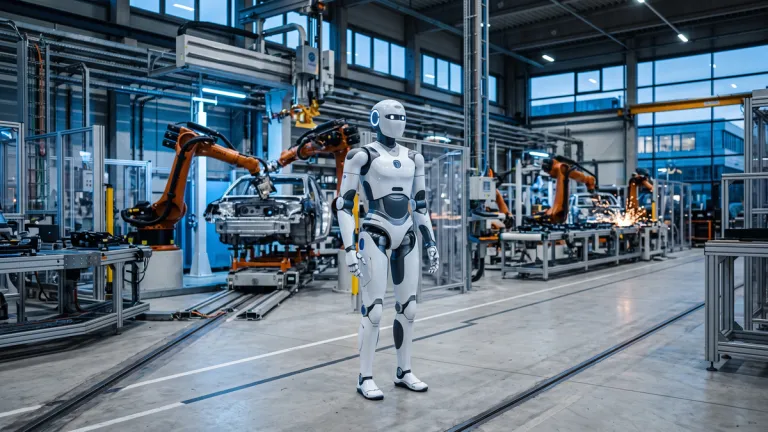
The state-of-humanoid-robotics report from AI Insider, published this week, confirms a shift that has been building all year: humanoids now work industrial trials, factory floors and warehouses — not as waving mascots, but as machines expected to move, sort and assemble. The 2026 partnership map reads like an industry who's who: BMW, Hyundai, GXO and Schaeffler on the demand side; Google DeepMind and Nvidia on the AI side. And yet the gap between money and measurable deployment has never been wider. That gap is the real story of 2026.
The money story, by the numbers
According to Dealroom data cited in the report, humanoid startups raised $8.7 billion through July 2026 — nearly double the total for all of 2025. A few numbers put that in perspective:
- Unitree Robotics raised $905 million in its August 2026 Shanghai IPO. First-day market cap: $53 billion (358 billion yuan, roughly €45.5 billion) — approximately 210× its 2025 revenue of 1.7 billion yuan ($252 million).
- Neura Robotics (Germany) closed a Series C of up to $1.4 billion (≈ €1.2 billion) in June 2026 — the largest European round in the category so far.
- Humanoid (UK) raised $152 million in Series A at a $1.35 billion valuation in July 2026.
- Apptronik pushed its extended Series A past $935 million after an additional $520 million in February 2026.
- Morgan Stanley projects 930 million humanoid units deployed by 2050, led by China (302.3 million) and the US (77.7 million).
210× revenue is a multiple you associate with hyper-growth software, not a hardware maker that still has to prove its machines can run a full shift without human supervision. The Unitree IPO is a statement about expectations, not about production maturity.
From demo to pilot line
The centre of gravity shifted in 2026 from "look what the robot can do" to "can it do this 10,000 times without stopping?" The report lists the known production partners — BMW, Hyundai, GXO, Schaeffler — and the AI side is now a first-class partner, not a bolt-on. In June, Nvidia and LG Group established a strategic physical AI partnership covering humanoid, logistics and factory automation platforms.
That is the right architecture. A humanoid is effectively a multimodal AI model wearing a body — which is why the mid-2026 model landscape matters here too: OpenAI's GPT-5.6 family, Google's Gemini 3.7 Flash, Anthropic's Claude Opus 5, Meta's open-weight Llama 4, and in Europe, Mistral's Apache-2.0 Leanstral 1.5 and DeepSeek's V4 line. The rapid cheapening of capable models is one reason the AI side of humanoid development is moving fastest; mechanics, reliability and unit economics are not.
The geopolitical twist: a US ban and a Shanghai IPO
July 2026 brought something the industry had not seriously modelled: the United States enacted a ban on sales of new foreign-made robotics. The report flags this as a significant shift in international trade dynamics. Combined with Unitree's Shanghai IPO weeks later, the signal is clear — the two biggest markets are building separate supply chains.
Europe sits in between. The EU has not adopted an equivalent blanket ban, so European buyers can still source humanoids from China and from US vendors. But procurement is becoming a compliance exercise: export rules, software provenance and data location all now affect the decision. That is a new line in the risk register for every European logistics or manufacturing pilot.
Europe's homegrown option is no longer hypothetical. Germany's Neura Robotics raised up to $1.4 billion in June; the UK's Humanoid is a freshly minted unicorn. Neither has proven mass deployment yet — but they give European enterprises an alternative that sidesteps US-China export politics entirely.
What the EU AI Act actually means for robots
Much of the regulatory talk in 2025 assumed strict high-risk AI obligations would land on 2 August 2026. That deadline no longer holds. The Digital Omnibus on AI (Regulation (EU) 2026/1744) postponed Annex III high-risk obligations to 2 December 2027, and Annex I product-embedded systems — where most robots sit — to August 2028.
In practice, for a European company deploying humanoids:
- Today: general-purpose AI models in the robot's stack are already under active EU AI Office enforcement, with mandatory transparency disclosures under Article 50 and a binding GPAI Code of Practice. If the robot runs a foundation model, those obligations apply now.
- By 2027–2028: the full high-risk regime for the machine itself (Annex III applications and Annex I product safety) kicks in.
- Under GDPR: a humanoid in a warehouse is a mobile sensor array. Workplace cameras and biometric sensors typically require a data protection impact assessment, and any training data containing EU personal data stays under EU data-residency rules.
The postponement is a window for pilots, not a loophole — but it means European robotics pilots now run under a clearer, more predictable regulatory timeline than they did a year ago.
The problem nobody has solved: the business case
The report is candid about the central hurdle: venture funding continues to outpace actual deployment, and manufacturers must prove two-legged robots can operate reliably, safely and cost-effectively compared with humans or simpler automated systems. Notice what is missing from the 2026 public record: an industry-standard cost-per-task benchmark. Nobody has published a credible, comparable figure for "euros per pallet moved by a humanoid." Until that exists, the 210× revenue valuation stays a bet, not a verdict.
For a European operations manager, the practical takeaway is deliberately boring: run a pilot with measured metrics — uptime, cycle time, cost per task — compare against an autonomous mobile robot and against a human team, then add the compliance costs above. If humanoids win on those terms, they win for real.
When do the EU AI Act's high-risk rules actually apply to humanoid robots?
Under the Digital Omnibus on AI (Regulation (EU) 2026/1744), Annex III high-risk obligations apply from 2 December 2027 and Annex I product-embedded systems from August 2028. Obligations for general-purpose AI models — including Article 50 transparency — are already being enforced by the EU AI Office.
Can European companies still buy Chinese humanoids such as Unitree's?
Yes, in principle. The July 2026 US ban restricts sales of new foreign-made robotics in the US market; the EU has not introduced an equivalent import ban. However, export rules, software dependencies and the coming high-risk regime turn procurement into a compliance decision, not just a price decision.
Is the humanoid sector overvalued?
The evidence is mixed. Unitree's first-day valuation was roughly 210× its 2025 revenue, which is extreme by any standard. But $8.7 billion in sector-wide venture funding through July 2026 is still small next to, say, the automotive industry. The honest verdict: funding clearly runs ahead of measurable deployment.