Three years, 40+ sites, three states
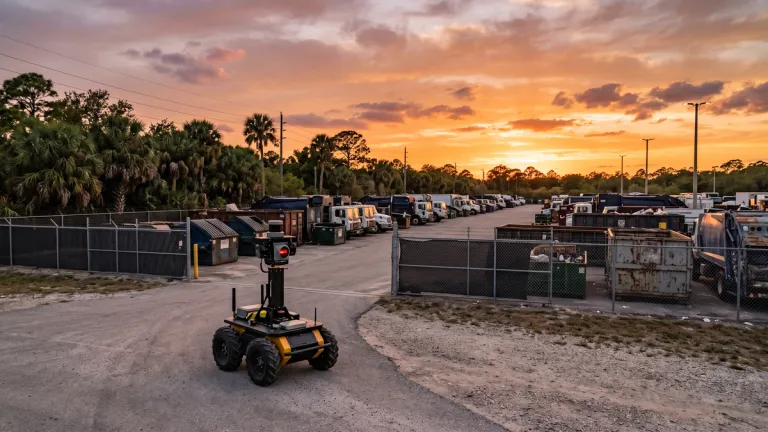
Tekcapital, the London-listed IP investment group, reported this week that its portfolio company Guident Corp. has signed a three-year deal with Coastal Waste & Recycling. The agreement covers Guident's WatchBot autonomous inspection robots, its AI software platform and operational support, deployed across more than 40 Coastal Waste sites in Florida, Georgia and South Carolina.
Tekcapital holds roughly 70% of Guident, so this is not a passive portfolio story — it is a bet on one company's ability to ship and service hardware, not just demo software.
What WatchBot actually does all day
WatchBot is an autonomous patrol and inspection robot. According to the announcement, its job description includes:
- facility patrols with continuous monitoring;
- thermal scanning and early fire detection on loaded trucks;
- identification of asset damage;
- PPE compliance checks.
On paper, none of this is headline-grabbing AI. In practice, it is the kind of task where the economics work. Waste haulers have a chronic and expensive problem with fires — especially fires started by discarded lithium-ion batteries in trucks and storage piles. A robot that thermally scans a loaded truck before it reaches the tipping floor can catch a battery fire while it is still a single smoking bin, not a facility shutdown.
PPE compliance is the less glamorous cousin of the same story. Instead of a human supervisor walking a facility, the robot does continuous, documented checks. For safety managers, that is not a gadget; it is an insurance and compliance layer that produces records.
From pilot to production contract
The relationship between Guident and Coastal Waste is not new. The two companies began a pilot in July 2025, and on 20–21 August 2026 that arrangement was formally converted into a three-year commercial contract. Between those dates, Guident also completed a $2 million funding round in May 2026.
This is the part of the story that deserves attention. The AI industry is full of pilots that go nowhere. A contract that says "36 months, 40+ sites" is a different category of commitment — it means the customer is budgeting for the system, not just testing it. Tekcapital explicitly frames the deal as Guident's progression from pilot projects to long-term multi-year contracts.
The numbers, converted
Contract value was not disclosed, which is itself worth noting. We get scope, duration and geography, but not per-site pricing. Still, the public financial figures around the deal are useful context:
- 36 months — duration of the agreement.
- 40+ sites — the number of Coastal Waste locations covered.
- ~70% — Tekcapital's equity stake in Guident.
- $2 million — Guident's May 2026 funding round (roughly €1.8 million at an assumed $1.09/EUR).
- $201.7 million — Tekcapital's net assets as of 30 June 2026 (about €185 million), up from $55.1 million at the end of 2025.
- $145.5 million — Tekcapital's portfolio returns and revenue for H1 2026 (about €133.5 million), versus $6.1 million a year earlier.
- 3.57p–3.6p — Tekcapital's share price after the announcement, up roughly 2.0% to 2.86% on the news.
Let me be blunt: net assets jumping from $55.1 million to $201.7 million in six months reflects investment returns and portfolio marks more than it reflects cash flow from operating contracts. Treat the asset figures as valuation marks, not recurring revenue. The actual revenue from this specific contract is a much smaller number, and we simply don't know it.
The European angle
For European readers, the most direct access point is the stock itself. Tekcapital trades on London's AIM under the ticker TEK, so investors in EU countries can buy exposure to a US robotics services contract through a European-listed holding. The share price in pence is a reminder that this is a GBP liquidity story, not a US mega-cap one.
It is also useful to compare how Europe plays in this segment. The best-known European AI-waste companies — London's Recycleye, Helsinki's ZenRobotics — concentrate on sorting robots that pick recyclables from conveyor belts. Guident's WatchBot targets a different job: patrolling facilities, monitoring thermal risk and enforcing safety rules. Both are real work; the difference is that patrol robots carry more liability and service weight.
Anyone planning a similar deployment inside the EU should factor in the EU AI Act. Since 2 August 2026, EU authorities have moved from transition mode to active enforcement: the AI Office and national regulators can audit models, request technical documentation and issue statutory penalties, and Article 50 transparency obligations require clear disclosure of AI use in user-facing applications. A robot documenting workers for PPE compliance will also raise data protection questions under GDPR — a US customer's "PPE check" is, in EU terms, employee monitoring that requires a legal basis, a data protection impact assessment and potentially works council involvement.
What this deal does — and doesn't — prove
What it proves: autonomous inspection robots can win multi-year contracts in a conservative industry like waste management. What it does not prove: that the technology is profitable on a per-site basis. There is no contract value, no margin data, and no guidance on how much of the deployment is hardware sold to the customer versus robots-as-a-service.
From our production experience at ai-jarvis.eu, that distinction matters. We run AI systems in daily production work — article pipelines, transcription, TTS — and the honest lesson is that operational AI wins by being boring: reliable schedules, clean data, predictable costs. WatchBot's pitch is precisely that: a robot doing a dull job with thermal cameras, consistent patrols, and a record of every check. It is not the most sophisticated use of AI on the planet. It may well be more durable commercially than most demos we get pitched.
For European waste operators and utilities, the transferable lesson is simple: look for the dull, high-liability task, automate it with measurable output, and build a contract around it. Guident just showed how that looks on paper.
How much is the Guident–Coastal Waste deal worth?
Not disclosed. The announcement covers duration (36 months) and scope (40+ sites across Florida, Georgia and South Carolina), but not contract value or per-site pricing. Guident's May 2026 funding round of $2 million is the only recent cash figure on the record.
What exactly is WatchBot?
WatchBot is Guident's autonomous inspection robot. It performs facility patrols, thermal monitoring, early fire detection on loaded trucks, asset damage identification and PPE compliance checks, backed by an AI software platform and operational support services.
How can European investors get exposure to this deal?
Indirectly, through Tekcapital, which holds about 70% of Guident. Tekcapital trades on London's AIM under the ticker TEK in pounds sterling. The share price moved to 3.57p–3.6p after the announcement, up roughly 2.0% to 2.86%.