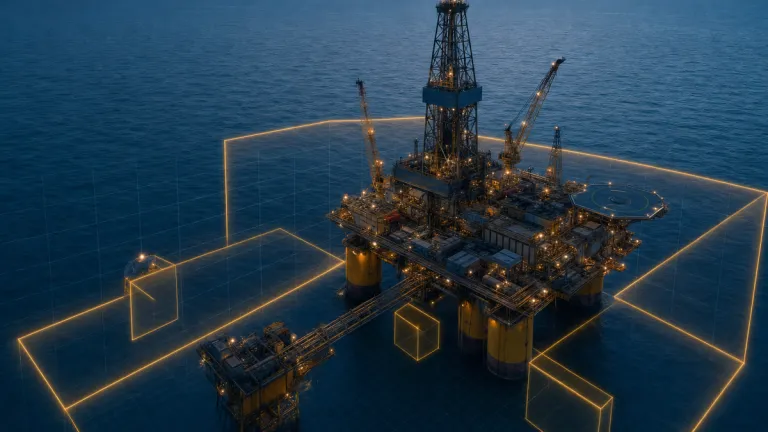
Computer vision has been promising safer workplaces for years. The interesting part of the latest AWS-backed reporting, covered by Imaging and Machine Vision Europe, is that the conversation has moved from "can cameras detect hazards?" to "how do you get supervisors to act on the alerts?" That shift from feasibility to operations is exactly where most industrial AI projects quietly die.
What the deployed systems actually do
The systems in question run continuous computer vision on offshore drilling rigs — including installations in the North Sea and sites in the Middle East. They watch for the usual suspects: missing PPE, unauthorized entry into red zones, line-of-fire exposures, and unsafe behaviors that safety rounds only catch by chance.
Three figures dominate the AWS-linked coverage:
- 80% reduction in safety violations at an offshore site in Abu Dhabi, after safety supervisors used AI zone-by-zone tracking data to resolve repeat shift and boundary incursions. The available AWS material does not state the measurement period or the baseline violation denominator.
- 30% to 60% fewer unplanned safety incidents on platforms that implemented AI monitoring, with measurable HSE metrics improving within the first eight weeks. No independent multi-site denominator or validation detail is specified.
- Visual inspection processing time cut from 210 days to 45 days in a separate deployment that combined reality capture with AI computer vision. That is a 78.6% reduction in processing time and a 4.67-times shorter cycle; the available material does not specify the inspection volume or measurement period behind that baseline.
None of these figures is presented as an independent multi-site validation. The last one is still worth doing the math on: 210 days down to 45 is a 78.6% reduction in processing time and a 4.67-times shorter cycle. Even without an independently audited denominator, the workflow compression alone is a strong business case for offshore operators, where every inspection day means helicopter hours, crew time and production downtime.
The injury data that defines the problem
The reason these systems target specific behaviors comes from industry-wide baseline data. The International Association of Oil & Gas Producers (IOGP) records safety data across 87 countries. The most recent IOGP figures cited in the reporting state that 946 lost-time injury cases were reported in 2024; slips and trips accounted for 206 cases, or 21.8% of cases where the cause was given.
Slips and trips are exactly what continuous camera monitoring can influence. A camera cannot stop a falling pipe, but it can stop a worker from walking into the fall zone a second early. The AI does not replace the safety officer; it multiplies their field of view from one location to the entire deck.
Why 80% deserves a skeptical look
Now the uncomfortable part. AWS sells computer vision infrastructure, and the 80% headline comes from a single site reported through vendor-adjacent channels. That does not make it false — it makes it unverified. A one-site result, however impressive, is not a controlled study. The 30–60% range across other platforms is wide enough to suggest that results depend heavily on site conditions.
The reporting itself confirms the hard part: lighting, camera angles and shift patterns all require site-specific model calibration, and alerts only generate value if they are integrated into existing HSE workflows. In other words, the technology works when the process around it works. Impressive demo, yes — but production value depends on supervision culture, which no model fixes.
The European angle: AI Act and the camera on the rig
For European operators — including the North Sea platforms in these deployments — the legal layer is as important as the detection layer. Since 2026, the EU AI Act is in active enforcement, with binding rules and financial penalties managed by the EU AI Office and national authorities.
Three practical consequences matter here:
- Workplace emotion inference is generally prohibited, with a narrow safety-related exception. A safety camera can detect that a worker entered a red zone. Whether it may also infer that the worker was "distracted" or "stressed" requires a careful legal assessment: the AI Act generally prohibits workplace emotion recognition, but systems used for medical or safety reasons may fall within a narrow exception.
- Whether worker monitoring is high-risk depends on its intended purpose and use. If the system is used for employment-related evaluation, or in certain critical-infrastructure contexts, it may fall under Annex III and trigger conformity assessment and registration obligations. A system that only issues safety alerts does not automatically become high-risk merely because its output affects workers.
- GDPR still applies fully. Continuously filming employees requires a data protection impact assessment (DPIA), clear transparency notices, and data minimization. Event-based capture instead of 24/7 recording is both a privacy feature and a legal safeguard.
European companies should also check where the video stream is processed. GDPR imposes transfer, security and purpose-limitation obligations: footage showing identifiable workers may be transferred outside the EEA only with an adequate safeguard, and processing must be limited to the safety purpose. EU-hosted processing can simplify compliance, but it is not an absolute legal requirement.
What operators should actually do
If a European company wants to replicate the 80% result, the playbook from these deployments is fairly clear:
- Measure the baseline first. You cannot claim an 80% improvement without knowing the starting number.
- Start with one zone — red-zone boundary incursions are the classic first target.
- Push alerts into the existing HSE tool, not a new dashboard nobody opens.
- Run the DPIA and talk to employee representatives before the cameras are mounted, not after.
That last point is the real European differentiator. In the US, the primary question is whether the system works. In the EU, the question is whether it is legal, transparent and limited in scope. The good news is that both questions are compatible: a safety system that records less, explains itself and triggers human verification is also a system that workers trust enough to accept.
Does the EU AI Act ban computer vision safety monitoring in workplaces?
No — safety alerting is not banned. The AI Act generally prohibits workplace emotion recognition, subject to a narrow exception for medical or safety reasons. Whether an emotion-inference feature is lawful depends on the specific use. If the system is used to evaluate worker performance, it may fall under Annex III high-risk obligations, but pure safety monitoring remains outside that category and still must comply with GDPR.
Can the 80% safety violation reduction be independently verified?
Not yet. The figure comes from a single Abu Dhabi site and is reported through AWS-related coverage. No independent multi-site validation or baseline denominator has been presented.
What does a deployment like this cost?
AWS does not publish per-camera pricing for these systems; enterprise deployments are quoted individually. The business case is usually built on avoided incidents, inspection time saved, and HSE targets, rather than the camera cost itself.