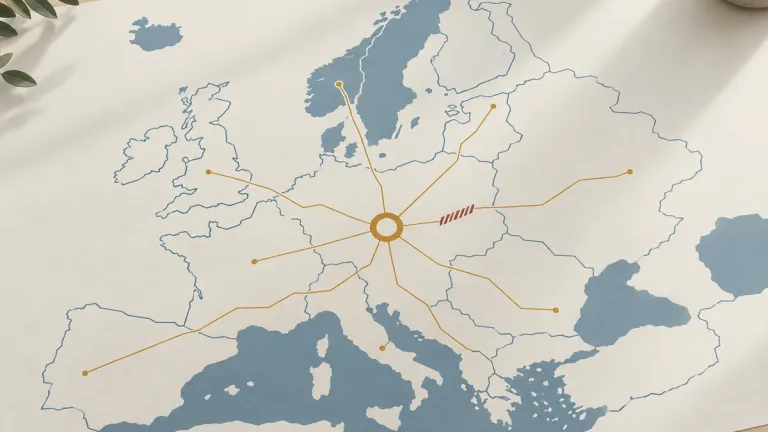
The framework is called Preparing for a wider Union. It offers candidate countries what the Commission calls gradual integration: access to EU programmes and parts of the single market before full membership. Voting rights and political power in the institutions stay off the table until a country actually joins, as the Ukrainian National News reported from the presentation.
The idea is not new. Reports of a draft plan offering candidate states benefits without a fast track to membership appeared in late June 2026. By the time Kos addressed the Parliament, the informal concept had become a formal package, with conditions attached to what happens after accession.
What the package contains
Three elements carry most of the weight. Candidate countries get earlier access to EU programmes and selected parts of the single market. Four frontrunners receive tailored accession roadmaps. And the EU keeps a lever over new members that can be used for years after they join.
Sensitive sectors are handled separately. Ukraine's agriculture is the clearest example, and it is treated as its own file rather than as part of the general market opening.
Four countries get their own roadmaps
The tailored roadmaps cover Montenegro, Albania, Moldova and Ukraine. These are the four candidates the Commission treats as advanced enough for a country-specific path. For them, the practical question is no longer whether the paperwork moves, but how much of the single market they can enter before accession.
The package also raises the possibility of deciding by qualified majority when opening negotiation clusters, instead of unanimity. That would remove a single member state's veto at that stage of the process. It would not remove unanimity from the accession decision itself.
The 15-year safeguard
The clearest number in the framework is 15 years. That is the maximum period after accession during which the EU could restrict a new member's voting rights or cut its financial support if it backslides on democracy, the rule of law or its core obligations.
For voters in the current 27 member states, this is the part that addresses the worry about money and standards. For governments in candidate countries, it means membership would come with a probation period written into the rules, not only into political statements.
The arithmetic of a bigger Union
Enlargement changes the institutions, and the framework puts numbers on that:
- 750 is the statutory ceiling on European Parliament seats, plus the President. Adding member states means redistributing seats among the existing ones.
- Two-thirds is the Treaty ratio for rotating European Commissioners relative to the number of member states. In a larger Union, not every country keeps a permanent commissioner.
- Nine member states is the minimum needed to launch enhanced cooperation, the mechanism that lets a group move ahead on a policy when the whole Union is stuck.
What is not in the package
There is no fast track. The framework does not promise candidate countries membership by a set date, and it does not give them votes before accession. Accession itself remains a decision for all member states, followed by ratification in each of them.
That distinction matters for how the plan is read in Kyiv, Chișinău, Tirana and Podgorica. Early market access is a real economic benefit. It is also not the same thing as a seat at the table where the rules are written. The Commission's own material is published through the European Commission.
What European digital rules still apply
None of this creates a regulatory gap for companies that sell into the EU. The GDPR applies when a business offers goods or services to people in the EU or monitors their behaviour, wherever that business is based. The AI Act applies to providers placing systems on the EU market, again regardless of where they are established. Consumer protection rules work the same way.
Those obligations follow from EU law and from market access, not from membership. A candidate country's status does not change them, and the enlargement plan does not replace them.
A company from a candidate country that wants early access to the single market will face the same documentation, data protection and transparency requirements as anyone else selling into it. Enlargement changes who sits in the room. It does not change what the room requires.
The limits written into the plan
The framework sets a 15-year maximum for the post-accession safeguard, names four countries for tailored roadmaps, and leaves the Parliament's 750-seat ceiling in place. Membership itself still needs the agreement of all member states and ratification in each of them.
Does the plan mean Ukraine or Moldova will join sooner?
It does not promise fast-track membership. The package offers benefits before accession, such as access to EU programmes and parts of the single market, while leaving the timing of membership open.
What happens if a new member backslides on the rule of law?
For up to 15 years after accession, the EU could restrict that country's voting rights or cut its financial support. The clause is written into the framework and has a maximum duration.
Does gradual integration mean companies can ignore EU digital rules?
No. The GDPR and the AI Act apply to businesses that target the EU market, wherever they are established. Candidate country status does not exempt anyone.