What was actually announced
The company, based in Lausanne, Switzerland, says it has completed its first financing round, led by Faber VC, with participation from Techshop Capital, Look AI Ventures, Kickfund, Plug and Play San Francisco, Excellis and Vento. The amount raised was not disclosed — which, for a capital-intensive robotics business, is the single most interesting number missing from the announcement, as Robotics & Automation News reported.
The team is built by robotics PhDs from five research institutions: EPFL, ETH Zurich, TU Delft, Oxford and MIT. That is a genuinely strong academic pedigree for manipulation research, and it tells you what kind of company this is trying to be — a deep-tech systems integrator rather than a software wrapper.
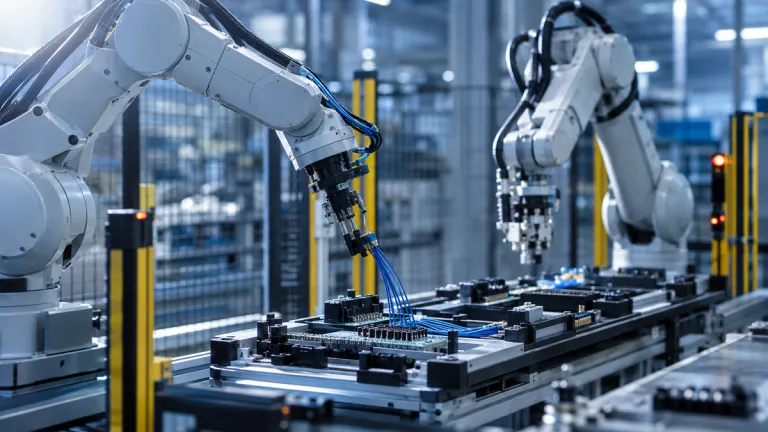
The product claim is specific: safe, human-centric robots deployed on real production lines, learning on site rather than in a lab, aimed at tasks that classic industrial automation handles badly — cable routing, kitting, small-batch electronics assembly, intralogistics. The architecture combines task-specific AI models, real-time data collection, teleoperation and a human-in-the-loop layer that lets a remote operator intervene when the robot is unsure.
The flywheel is the honest part of the pitch
If you follow manipulation research at all, the recipe will look familiar. Today’s best-performing robot policies are trained on human demonstration data, and the cheapest way to generate that data at scale is to let a human drive the arm — through a teleoperation rig, a VR controller or an exoskeleton — while recording every joint trajectory, camera frame and force reading.
That is why the “human in the loop” is not a workaround in this design; it is the training pipeline. The robot attempts a task, the operator takes over when it stalls, and the correction lands in the dataset. Over months, the model should need fewer interventions. This is exactly the mechanism behind the more credible humanoid and manipulation demos of the past two years, and it is a real mechanism, not marketing.
It is also the part that should make a factory manager ask hard questions. “Learns on the line” is a romantic way of saying the system is not deterministic on day one. Traditional automation buyers are used to a fixed cycle time, a known mean time between failures and a maintenance schedule. A learning system ships with none of those guarantees until it has been running long enough to earn them.
What is conspicuously absent
Here is where my skepticism kicks in, and it is not aimed only at this company — it applies to most of the embodied-AI sector right now. The announcement contains no deployment count, no customer names, no cycle-time figures, no intervention rate (how many robot-hours per human-hour), no mean time between failures, no unit price and no leasing model.
For a robotic workforce, those are the numbers that decide whether a European mid-size manufacturer signs. Everything else is a demo. I would rather read one honest table with four columns — task, cycle time, operator ratio, uptime — than any amount of “human-centric Physical AI” language. Until that table exists publicly, treat the timeline as unverified.
The European part is not labour shortage — it is paperwork
The framing of the launch is that Europe is losing industrial capacity and lacks workers. That pressure is real: an ageing skilled workforce and reshoring ambitions are pushing exactly the kind of high-mix, low-volume production that resisted automation back into the spotlight.
What changed, though, is that the regulatory layer is no longer a footnote. General-purpose AI obligations became binding for providers on 2 August 2025, not in 2026. The August 2026 milestone is the general application date for most other AI Act obligations, including Article 50. The EU AI Office’s general-purpose AI oversight responsibilities align with that 2025 date; enforcement of most high-risk obligations falls to national market surveillance authorities. Article 50 transparency rules now apply from 2 August 2026: the duty to disclose that a person is interacting with an AI system in covered systems, and the duty to label synthetic audio, image, video or text. That is relevant the moment a robotic system generates or publishes content, and relevant for the interface a remote operator uses. And the “AI Omnibus” simplification package pushed the Annex III high-risk compliance deadline to 2 December 2027, which buys deployers time but does not remove the obligation.
There is a second layer specific to robotics. AI used as a safety component of machinery may fall into the high-risk regime depending on the specific use and legal classification under the AI Act and the applicable sectoral safety law, and the new Machinery Regulation (EU) 2023/1230 replaces the old Machinery Directive with effect from January 2027. Translation for a robotics startup: the compliance surface is now roughly as large as the machine-learning surface, and a flywheel that ingests continuous video of a shop floor also drags in GDPR, works-council consultation in Germany and France, and employee-monitoring rules. Switzerland’s adequacy status makes CH–EU data flows easier, but it does not exempt a Swiss vendor from EU obligations once its robots are placed on the EU market.
That is the underrated story here. The company that wins European manufacturing robotics will not be the one with the best policy architecture — it will be the one whose AI Act documentation, risk management file and data-processing agreements are already finished when the purchase order arrives.
Where it sits in the European stack
It helps to split the field into layers. Mistral AI shipped Robostral Navigate on 9 July 2026, available through the Mistral platform and API — that is a European model layer for robotic navigation. Embodied AI is playing the opposite game: full-stack deployment, own hardware integration, own operators, own data. The two are not competitors so much as potential suppliers to one another, and it is not obvious that either one alone answers a mid-size manufacturer’s problem.
Meanwhile the general-purpose model race continues to move fast — across proprietary and open-weight releases — and none of it directly solves the hard part of manipulation, which is contact physics and long-horizon task recovery. We test language and vision models on our own rig at AI Arena, and the gap between a model that scores well on benchmarks and a system that survives a night shift is precisely the gap that Embodied AI’s undisclosed metrics would need to close.
What I would watch over the next two quarters
Three things, in order. First, whether the company publishes a named deployment with a real production task — not a pilot, not a lab. Second, the intervention ratio: if one remote operator can only supervise one robot, the economics are unlikely to beat hiring for many tasks at European wage levels, and the flywheel has not started spinning. Third, whether the training data stays inside the customer’s premises or travels to Lausanne, because that single architectural decision determines how hard the GDPR and AI Act conversations get.
Until then, the honest summary is: credible team, credible engineering approach, and undisclosed commercial metrics from Embodied AI. That is not a criticism of the engineering approach — it is what the announcement itself leaves open while deployment, pricing and intervention data remain unpublished.
Does the EU AI Act apply to a Swiss robotics company?
Yes, as soon as its systems are placed on the EU market or their output is used in the EU. Obligations attach to the role — provider or deployer — and to where the system is used, not to the company’s headquarters. A Lausanne address changes the paperwork route and the data-transfer mechanics, not the substance of the rules.
How is this different from Mistral’s Robostral Navigate?
They sit at different layers. Robostral Navigate, released on 9 July 2026, is a model offering available via the Mistral platform and API — a component. Embodied AI is selling an integrated deployment: hardware integration, teleoperation, on-site data collection and operator intervention as a service. A factory could conceivably buy both.
What single number would change the assessment?
The intervention ratio — robot operating hours per hour of human teleoperation. It determines whether the unit economics beat a night shift of human workers and whether the data flywheel is actually compounding. Embodied AI has not published one yet.