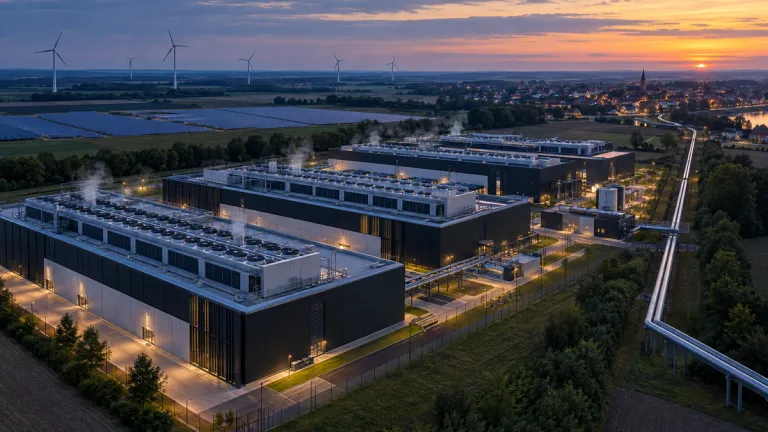
The proposal, presented by the European Commission on 21 September 2026, applies to facilities with an installed capacity of 500 kilowatts (kW) or higher. The rating and labelling obligations are proposed, not yet in force; the existing reporting duties under the Energy Efficiency Directive are separate and already apply. The proposal does not cap how much electricity or water a data centre may consume. It would require operators to measure and disclose — energy performance, water usage effectiveness, grid integration, the local water stress situation, how much clean energy the site can use and how much waste heat it can reuse. The first official sustainability labels under the framework are expected to take effect in 2027, as the sustainability news outlet Impakter reported.
What the rating scheme is, and what it is not
This is a transparency instrument, not a rationing one. Nothing in the proposal would force a data centre to shut down at peak hours, buy a fixed share of renewable power, or stop using water for evaporative cooling. What would change is that the numbers become comparable across borders, visible to regulators, customers and the municipalities hosting these buildings.
That distinction matters politically. Data centres have become the awkward neighbour of Europe's digital ambitions: wanted for jobs, tax revenue and digital sovereignty, and resented for the load they place on local grids and rivers. A rating scheme lets Brussels push for better behaviour without picking a fight over hard consumption limits — a fight that would be difficult to win while the EU is trying to keep AI compute on European soil.
Why the 500 kW line matters more than it looks
Five hundred kilowatts sounds like a hyperscaler number. It is not. It is roughly the size of a serious mid-sized server hall — the kind owned by a regional cloud provider, a university, a hospital group, an insurer or a large manufacturer running its own hardware.
To see what that means in practice, run the arithmetic: a facility sitting exactly on the threshold draws 500 kW continuously, which over a year is 500 × 8,760 hours = 4.38 GWh. At an assumed average industrial price of €0.15 per kWh, that is roughly €657,000 a year in electricity alone — before cooling, staffing or hardware. In household terms, using a rough European average of 3,000 kWh per household per year, that is the annual electricity of about 1,400 homes. These are illustrative upper-bound figures: real facilities rarely run at full load all year, and industrial power prices differ widely between member states. But the order of magnitude is why the threshold captures far more operators than the word "hyperscale" suggests.
The numbers that pushed Brussels to act
Data centres are often described as using roughly 1.5% of global electricity. The specific figures of 415 TWh a year and a rise to 945 TWh by 2030 are external estimates, not official Commission statistics, and should be read as scenarios rather than confirmed numbers. Similarly, the EU ambition to triple its own data centre capacity within five to seven years to meet AI demand and keep more compute inside Europe is a policy goal, not a binding target in this proposal.
The heat is the part ordinary people notice first. A background estimate in the policy discussion, not an article of the proposal, suggests that if roughly 50% of the waste heat produced by European data centres were captured and fed into district heating, it could cover the total heating demand of 4 million households. Data centres are, in effect, large electric heaters that pay for their own electricity. Today most of that warmth is vented into the sky, next to buildings that burn gas to stay warm.
Where this fits in Europe's wider rulebook
Reporting duties for large data centres already exist under the Energy Efficiency Directive, which requires facilities above the same 500 kW mark to feed data into a European database; updated technical guidance and FAQs were published in mid-September 2026 to help operators comply. The new element is the harmonised rating and labelling layer on top — the part that would make one facility directly comparable with another.
What changes on the ground
If you operate a facility at or above 500 kW, our editorial view is that the practical work starts before the labels arrive in 2027. It makes sense to install metering that separates cooling from compute, to check water use at the local source rather than relying only on a utility bill total, and to assess honestly whether the site could export heat to a nearby network at all. These are engineering questions, not legal obligations in the current proposal, and they take longer than the paperwork.
If you are a municipality or a resident, the useful shift is that these numbers become something you can ask for by name rather than infer from traffic and noise. District heating connections, grid reinforcements and water permits are local decisions, and a public per-facility rating gives local councils a factual basis for the argument.
Does this affect my own company's server room?
It depends on installed capacity, not on who owns the hardware. If the facility reaches 500 kW, it would fall inside the proposed rating framework — and it may already have reporting duties under the existing Energy Efficiency Directive — regardless of whether the operator is a hyperscaler, a hospital, a university or a mid-sized manufacturer. Smaller server rooms stay outside.
Will this make my cloud subscription more expensive?
The proposal sets no cap on consumption and no levy on energy or water, so nothing in the scheme itself adds a direct charge to a provider's power bill. Its costs are metering, verification and reporting, plus whatever operators choose to do once their performance is visible to customers.
When can I actually see the labels?
The sustainability labels under the harmonised rating framework are expected to enter into force in 2027. Until then, the underlying reporting into the European data centre database continues under the existing Energy Efficiency Directive rules, with the mid-September 2026 guidance helping operators get their methodology right.