Alpöge's claim covers two statements: the Riemann Hypothesis (RH) and its generalisation, the Generalized Riemann Hypothesis (GRH). Masullo's all-human draft claims a proof of the Generalized Riemann Hypothesis only. The Riemann Hypothesis has been open since 1859. It is a statement about the zeros of the zeta function: if every non-trivial zero lies on the line with real part one half, then the primes are distributed far more regularly than anyone has managed to prove. GRH extends the same claim to a wider family of functions. A proof would not break RSA and would not immediately change encryption. It would rearrange a large part of analytic number theory.
What Alpöge released
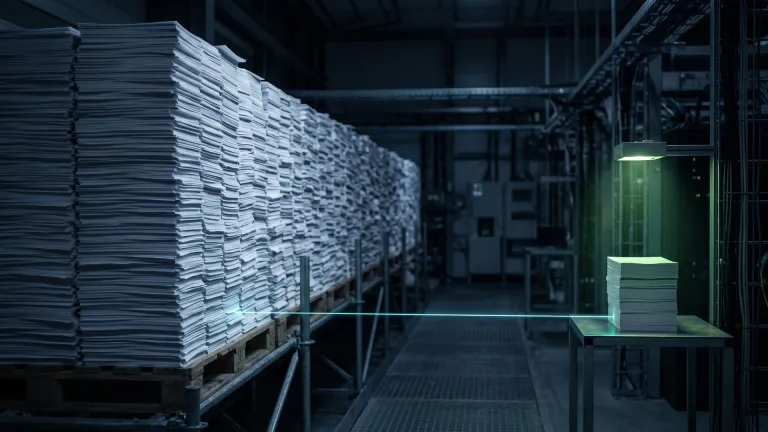
Alpöge released the proof itself as a formalisation in Lean, the open-source proof assistant, structured as 14 data packages. According to the reporting, the same argument written out as ordinary mathematics would run to an estimated 250,000 pages. Alpöge says he plans to write a human-readable version over the coming months.
That page count is the most checkable number in the story, because it can be set against public API price lists.
The cost of writing 250,000 pages
Take 500 words per page, a rough figure for mathematics dense with formulas, and 250,000 pages comes to about 125 million words. At roughly 1.33 tokens per word that is around 166 million output tokens. Anthropic lists Claude Fable 5.2 at $8 per million input tokens and $40 per million output tokens, list price. At the output price, the text alone would cost about $6,650, or roughly €6,000 depending on the day's rate. The table below records the list prices used for that estimate.
| Model | Input price per 1M tokens | Output price per 1M tokens | Cost for 166M output tokens | Public pricing page |
|---|---|---|---|---|
| Claude Fable 5.2 (Anthropic) | $8.00 | $40.00 | ~$6,650 | Anthropic pricing |
| Mistral Large 4 (Mistral AI) | $0.70 | $2.10 | ~$350 | Mistral AI pricing |
This is arithmetic on list prices, not an invoice. It ignores retries, agent scaffolding, tool calls and the whole input side of the context. No current model can hold 166 million tokens in one window, so the work would have been split across many sessions, and failed attempts would be paid for too. The gap between the two rows comes directly from those list prices, not from a measured production run.
You can also read the number the other way. A 250,000-page expansion of a proof is not a document anyone reads. It is a thing a machine checks.
Stanford's draft and eight hours of review
Vakil posted Masullo's draft on 20 November 2026, hours after the Anthropic claim went public. Reporting describes the draft as having had months of review from Stanford number theorist Brian Conrad; Masullo had expected to spend a year at Stanford refining it, but Anthropic's sudden announcement forced the researchers to release the current version. It runs to about 940 pages and carries no polish. About eight hours after his own announcement, Vakil updated his post to note that several people had contacted him to report apparent issues and omissions, identified with help from different AI models.
That turnaround is the part worth sitting with. A 940-page draft reviewed in an afternoon is not peer review, it is triage. The same tools that produced one document are now used to attack the other, and the criticism arrived faster than any journal process could have delivered it.
What a Lean proof can and cannot confirm
Lean is a proof assistant. A formal development states a theorem in a machine-readable language and derives it from definitions and earlier results, one step at a time. A checker walks the derivation and confirms that every step follows. If the formal statement is a faithful rendering of the claimed RH and GRH statements and the development rests only on accepted axioms, then a compiling proof is a proof.
If the statement drifted from the classical one, the compiler will not tell you. It checks the derivation, not the translation, and translation is where formalisation projects usually spend most of their effort. The 14 packages are public, and checking them is CPU work. Anyone with a workstation can run a checker. That is a completely different cost profile from generating the proof, and it is why formal releases are easier for an outsider to test than a PDF. On our own rig at AI Arena the GPU does the generation; here it does nothing.
The 2026 run-up
Three earlier events sit behind this weekend. In September 2026 a dispute broke out over Navier-Stokes work, when Tristan Buckmaster suggested that OpenAI had used prior work by him and Alpöge. In October 2026 OpenAI released progress on prime numbers, which Alpöge cited as the inspiration for his approach. In November 2026 Anthropic completed a major IPO on the Thursday before the proof went public on 20 November. The sequence is documented. What it says about how the result was produced is not, and the publication itself is the only thing the community can check.
European access and the rules that apply
Lean is open source and installs without an account, so a reader in the EU can pull the packages and run the checker on a normal machine. Anthropic's API pricing is quoted in dollars and applies to European customers in the same tiers. If a European team wanted to formalise something of its own on a budget, the French option is worth a look: Mistral Large 4 at $0.70 input and $2.10 output per million tokens, an open-weight model, with the licence linked from Mistral's site, so it can also run on your own hardware.
Regulation does not settle any of this. Article 50 transparency obligations under the EU AI Act have been mandatory since 2 August 2026, and they require synthetic content to be identifiable. A provenance label tells you where a document came from. It says nothing about whether a theorem is true. Formal verification is the part that travels across borders, and it is free.
As of writing, neither document has been certified as a complete solution. The Lean packages are public, the 940-page draft is public, and the checking continues on both.
Has either proof been verified yet?
No. The Lean development is still being checked by the formal proof community, and the human draft has drawn reports of apparent problems within hours of release. Neither has been certified as a complete solution.
Does a compiling Lean proof settle the Riemann Hypothesis and GRH?
Only if the formal statement matches the classical statements and the derivation uses no additional axioms beyond the accepted ones. The checker validates each inference step, not the faithfulness of the translation from informal mathematics.
Why publish an unfinished 940-page draft?
According to the reporting, Anthropic's sudden AI announcement forced the researchers to release their current version right away. The draft had been in progress for months and was released well ahead of any normal publication schedule.