The demo in two paragraphs, then the useful part
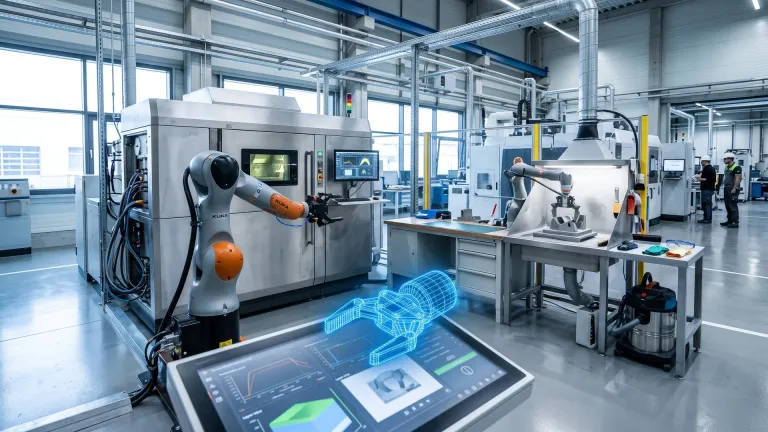
The chain Siemens put on the stand starts with a user describing a gripper for an AGIBOT humanoid robot in natural language. Software agents select a component, adjust the CAD model in Siemens' design software, run a virtual simulation in Siemens' simulation tooling, validate the robot interface and hand over a print file for slicing. According to Automation World's report from the fair, the agents coordinate through Model Context Protocol integrations rather than one monolithic assistant.
The cell is a joint build: EOS supplies powder-bed additive hardware, AM Solutions handles post-processing automation, Siemens contributes the software layer and the site — the Siemens Electronics Factory (Gerätewerk) in Erlangen, Bavaria. Industrial AI functions were folded into the AM I Navigator framework, which Siemens positions at customers still deciding where AI fits in their own additive workflows.
The bottleneck was never the printer
Additive manufacturing has spent a decade promising one-off parts at series prices, and the machine is rarely what breaks that promise. The engineering hours around it do: modelling, checking interfaces, simulating, slicing, depowdering, finishing. Siemens is attacking that ring of manual work with agents instead of with a faster laser, which is the more consequential half of the problem — and the reason the gripper is a modest showcase rather than the point.
A humanoid robot gripper is a compact part with tolerant geometry. Whether the same agent chain holds for a hydraulic manifold, a tooling insert with tight tolerances or a small batch of spare parts is a different question entirely. The demo answers the first question and not the second.
Four numbers a plant needs before it commits
None of these appear in the announcement, and each one moves a business case:
Price. No licence fee for the agentic layer, no hardware package, no integration estimate. For a mid-sized European manufacturer trying to budget a pilot, this is the first figure required and the first figure missing.
Cycle time. How long from prompt to validated print file, and how that compares with a skilled engineer working in the existing toolchain. An agent chain that takes longer than a human is a curiosity, not a saving.
Simulation failure rate. How often the agents produce a model that fails validation, and what happens when they do — does the loop retry, or does a person pick it up? This single ratio separates a robust pipeline from a trade-fair stand.
Supervision ratio. How many engineers the cell removes and how many it still needs to watch it. Nobody has said, and until Siemens or a customer publishes it, Erlangen demonstrates capability rather than production economics.
Post-processing is where the claim earns its keep
Most additive demos stop at the build job and quietly skip what follows: depowdering, support removal, surface finishing, part handling. AM Solutions' presence in the cell is therefore more interesting than it first looks. Finishing is the least digitised step in the chain and the one that most reliably destroys the economics of small batches. If agents genuinely reach into that stage, the cell is doing something new. If the chain ends at the slicer, it is a better CAD assistant.
The European compliance calendar
Germany is a sensible pilot location: a dense base of machine builders and automotive suppliers ordering exactly the low-volume custom parts additive manufacturing handles well. But anyone copying the Erlangen setup inherits a moving legal calendar, and machinery is squarely inside it.
| Obligation | Applies from | Who it concerns |
|---|---|---|
| Annex III high-risk AI systems | 2 December 2027 | Providers and deployers of listed high-risk systems |
| AI embedded in Annex I products, incl. machinery safety components | 2 August 2028 | Machine builders whose products carry AI |
| Article 50 transparency duties | 2 August 2026 | Anyone whose AI interacts with users or generates synthetic media |
| Fines regime for general-purpose AI models | Since 2 August 2026 | GPAI providers, up to €15 million or 3% of global turnover |
The dates above come from Regulation (EU) 2026/1744, the Digital Omnibus on AI, which moved the Annex III deadline to 2 December 2027 and the Annex I deadline to 2 August 2028. Machinery safety components fall into the second group. If an agentic system ends up making or validating decisions that affect machine safety, the later date governs; Siemens has not said whether this cell touches that category. Article 50 is already live: users must be told when they interact with an AI system, and synthetic media needs machine-readable labelling. Inside a factory that is largely an internal process question — until an AI-generated drawing or a customer-facing quoting tool leaves the building.
How to read the Erlangen cell
Take it as a working demonstration of orchestration across narrow agents, not as a purchasing decision. The MCP-based split — geometry, simulation, robot interface, slicing — is the reusable idea, because it lets a plant swap one step without rebuilding the chain. The rest is a pilot without a published bill of materials.
Does the demo mean a plant could cut CAD engineers?
Nothing published supports that. The chain still needs someone to define the part, judge whether a simulated result is acceptable and sign off the print file. The realistic near-term effect is fewer repetitive modelling and re-slicing hours per part, not fewer engineers.
Is Model Context Protocol an open standard a smaller software vendor can adopt?
MCP is an open protocol for exposing tool functions to a model in a predictable format, and the Siemens setup uses it to keep each agent narrow. Siemens has published no compatibility list for third-party machines, so what a smaller vendor can plug into is still unspecified.
Which step of the chain is hardest to automate?
Post-processing. Depowdering, support removal and surface finishing depend on part geometry and handling, which is why the presence of a dedicated post-processing partner in the cell matters more than the slicing step, where mature software already exists.