What AGIBOT and Chimelong actually turned on
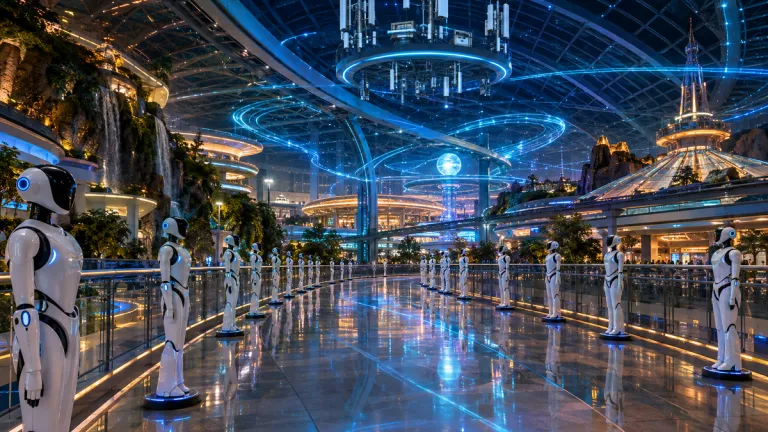
The two companies announced the first phase of a large-scale embodied AI deployment across the park and its hospitality facilities. More than 300 AGIBOT robots are integrated into daily operations, spread across more than 100 guest interaction points and seven core scenarios: entertainment and performances, education and study tours, tour guidance, retail service stations, intelligent tour companions, hotel services, and sports competitions.
The tasks are concrete rather than abstract: playing table tennis with guests, answering questions, demonstrating martial arts and tai chi, leading guided tours, welcoming hotel guests. Two features are pitched as world firsts — a large-scale human-robot joint dance performance and robot aerial acrobatics. The network underneath is 5G-Advanced, which the two firms describe as the first large-scale application of 5G-A-enabled embodied AI in cultural tourism.
The milestone that matters commercially is the handover of AGIBOT's 20,000th production humanoid, delivered directly to Chimelong. And this is not a bolt-on experiment: the strategic partnership was signed on 23 August 2026, when the two companies agreed to co-develop an embodied AI theme park and an industry laboratory. Five weeks later it is running in front of paying guests.
Three numbers worth doing arithmetic on
Roughly 475 robots a month. AGIBOT was founded in 2023, which makes it a young company. Twenty thousand units over about three and a half years works out to a cumulative average of roughly 475 units per month, or around 16 a day. That is a cumulative average, not a current run rate, and it says nothing about how many units are earning money versus sitting in demo halls. Still, it is a useful order of magnitude — very few humanoid makers publish a comparable line-output figure at all.
About three robots per interaction station. 300+ robots across 100+ interaction points averages to roughly three per point. That is the ratio a European operator would want to sanity-check, because it hints at the split between guest-facing units, spares, and machines pulled off the floor for maintenance.
Cost per interaction — unpublished. This is the number that decides whether the model scales, and nobody has put it on the table. A cloud chatbot fleet serving 100 concurrent users costs cents per hour. A humanoid fleet costs hardware amortisation, battery cycles, spare parts, technicians, storage, and floor space. Until someone attaches a euro or dollar figure to a single guest interaction, "300 robots" is a logistics feat, not yet a business case.
Live show, or production system?
Our instinct with any embodied AI announcement is to separate choreography from autonomy. A synchronised human-robot dance is impressive engineering, but it is also a scripted, bounded task in a controlled space — closer to an animatronic show than to a robot deciding on its own whether a guest needs help. The press material does not state, task by task, how much is autonomous, how much is teleoperated, and how much is pre-programmed motion.
The questions we would ask before calling this a production system are the boring ones: task success rate, intervention rate (how often a human has to take over), uptime hours per day, mean time between failures, and how the park handles a robot that stops mid-queue on a Saturday afternoon. Table tennis is a good stress test for perception and control latency, but cooperative rallies are not a competitive match.
Worth being honest about our own limits here: our benchmarking rig at AI Arena runs software models — an RTX 5060 Ti 16 GB with local LLMs through Ollama — so we can measure tokens per second and VRAM, not grip force or joint reliability. We have not tested these robots, and we are not going to invent numbers for them.
What a European version would have to clear
The launch announcement makes no claim about European sales, CE marking, or a service network, and we could not verify EU availability from the published material. That gap matters more than the robot count. A humanoid that breaks down on a Saturday needs a technician within driving distance, and a spare-parts pipeline with customs clearance behind it.
Beyond logistics, a European operator would face a regulatory stack that is no longer theoretical:
- GDPR. Robots with cameras and microphones circulating among families and children turn a theme park into a data-processing environment. Voice and face recognition would touch biometric data rules, and a deployment at this scale would require a proper data protection impact assessment, a legal basis, and clear signage. The EDPB has been consistent that "it was in public" is not a legal basis.
- AI Act transparency. GPAI obligations have been binding since August 2025, and the Article 50 transparency rules requiring machine-readable marking of AI-generated content apply since August 2026. If a robot generates speech, images, or synthetic avatars for a show, that is squarely in scope. The European Commission's regulatory framework page is the practical starting point.
- High-risk timing. Most theme-park entertainment robots are not Annex III high-risk systems. But note the shift: the Digital Omnibus on AI — Regulation (EU) 2026/1744 — postponed high-risk enforcement to 2 December 2027. That moves a deadline; it does not exempt anyone.
- Machinery safety. A robot moving among crowds is machinery. Regulation (EU) 2023/1230 becomes applicable in January 2027, and CE marking plus a documented risk assessment is the entry ticket.
What European operators can actually borrow from this
The transferable idea is not humanoids doing tai chi. It is the density of small, single-purpose interaction stations embedded inside a business that already has tickets, queues, and staff rotas. If you are building anything similar in Europe, three things are worth copying: keep each station narrow in scope, keep a remote human fallback for anything a guest might escalate, and start measuring intervention rate from day one. That metric — how often a human has to rescue the robot — is what determines whether a robot shift is genuinely cheaper than a human shift. Everything else is stagecraft.
Are the Chimelong robots fully autonomous?
The announcement does not break down autonomy by task. Performance segments such as the joint dance and aerial acrobatics are almost certainly scripted or pre-programmed, while guest-facing tasks such as answering questions rely on some combination of on-board perception, edge or cloud inference, and human supervision. Without published intervention-rate data, "autonomous" is a claim rather than a measurement.
Can a European theme park buy the same setup?
Nothing in the launch material describes EU distribution, certification, or service coverage, and we could not verify European availability. Buying hardware is the easy part — the practical blockers are CE conformity under EU machinery rules, a local maintenance and spare-parts chain, and liability insurance for machines operating in crowded public spaces.
Does the EU AI Act require approval before a park can deploy robots?
No. The AI Act is an obligation-based framework, not a licensing regime — there is no pre-deployment permit for entertainment robots. What applies in practice is transparency for AI-generated content, GDPR compliance for the cameras and microphones, and product-safety rules for the machines themselves. High-risk obligations for Annex III systems were postponed to 2 December 2027 by Regulation (EU) 2026/1744.