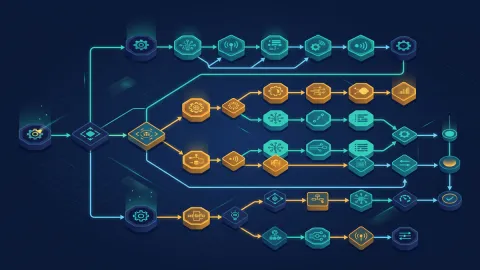
While most companies focus on what AI can do, experts from EY and Lenovo warn about what AI costs. Agentic AI systems don't work with just one query and one answer. These systems enter so-called "reasoning loops" (logical loops), where the model continuously analyzes its own steps, checks results, and corrects errors. Each of these steps consumes additional tokens, which at the scale of large organizations leads to costs that can quickly exceed the costs of training the models themselves.
Hidden costs: Why do agents "burn" money?
According to analyses brought by FutureCIO, there are three main areas where companies in agentic AI projects encounter unexpected expenses:
1. Data fragmentation and access rights
Many companies assume their data is ready for AI. The reality is often different. Data is fragmented across various systems (silos) and a unified access standard is missing. If an agent encounters inconsistent data or lacks proper database permissions, it begins "thinking" about solving a problem caused by poor infrastructure. Each such unsuccessful iteration is essentially money wasted on tokens.
2. Model selection: Speed vs. Accuracy
A strategic decision every CIO must make is: When to use a "brain" like GPT-4o or Claude 3.5 Sonnet and when a lighter model suffices? Using the most powerful model for every minor operation is economic suicide. Conversely, an overly weak model can lead to endless loops where the agent cannot solve the task and keeps repeating itself, further increasing costs.
3. Infrastructure and latency
Costs aren't just about the tokens themselves, but also about the infrastructure supporting these processes. As noted by Debdut Maiti from Lenovo, the decision between public cloud and on-premise solutions fundamentally affects the overall efficiency of agentic AI projects.
Gemini 3.5 Flash: An answer to the economic challenge?
In the context of rising costs, models designed specifically for optimizing these processes are emerging. One of the key players is Google Gemini 3.5 Flash. This model was developed with an emphasis on speed and efficiency, which are critical parameters for agentic AI systems.
According to reports from AI CERTs, Gemini 3.5 Flash shows significant advantages compared to previous versions and competing models:
- High throughput: Thanks to extreme generation speed, it reduces the time spent waiting for a response, which directly affects infrastructure costs.
- Large context window: With a capacity of up to 1 million input tokens, it enables agents to maintain long-term memory without the need for constant summarization, saving tokens with each subsequent step.
- Benchmarks: In Terminal-Bench-type tests, Gemini 3.5 Flash achieves a score of 76.2%, a significant improvement over the previous version 3.1 Pro (70.3%). This means higher first-attempt success rates and fewer unnecessary iterations.
Comparison for enterprise decision-making:
| Model | Main strength | Typical use |
|---|---|---|
| Gemini 3.5 Flash | Cost/Speed | Agent workflows, fast responses |
| GPT-4o / Claude 3.5 | Maximum intelligence | Complex analysis, creative writing |
Practical impact for Czech companies and the EU
For the Czech market and European businesses, this topic has two fundamental dimensions. The first is availability and localization. Google Cloud, through which Gemini is available (e.g. via Vertex AI), has strong infrastructure in Europe, which helps meet latency and data protection requirements. The Czech language is very well supported by the Gemini model family, enabling the implementation of agent systems into Czech administrative processes without the need for translation.
The second dimension is EU AI Act regulation. Agentic AI systems that can make autonomous decisions or influence processes fall under stricter regulatory categories. Companies must invest in "data lineage" (data traceability) and decision-making transparency. While this increases initial implementation costs, it is a necessary investment for legal operation within the EU. Inefficient agents that constantly generate incorrect decisions due to poor data can lead not only to financial losses but also to regulatory fines.
How to start with optimization?
- Data audit: Before launching agents, make sure your data is clean and accessible.
- Hybrid modeling: Use lightweight models (like Flash) for routine tasks and reserve "heavyweight" models only for final validation.
- Token monitoring: Implement dashboards that track token consumption in real time by individual agent tasks.
Does Agentic AI mean a higher price for each individual query?
Not necessarily. The individual query itself can be cheaper thanks to models like Gemini 3.5 Flash, but the total cost of a "session" is usually higher because the agent performs several internal steps and analyses within a single task, each of which consumes tokens.
Is Gemini 3.5 Flash available for the Czech market?
Yes, Google Cloud and the Vertex AI platform are fully available in the Czech Republic and support Czech localization, which is crucial for implementation into local business processes.
What is the difference between LLM and Agentic AI from a cost perspective?
A standard LLM works on the principle of "input -> processing -> output". Costs are linear. Agentic AI works in cycles ("input -> thinking -> action -> check -> output"), meaning that a single user query can generate dozens of internal model calls, thus surpassing the cost of regular chatting.