What the photos actually show
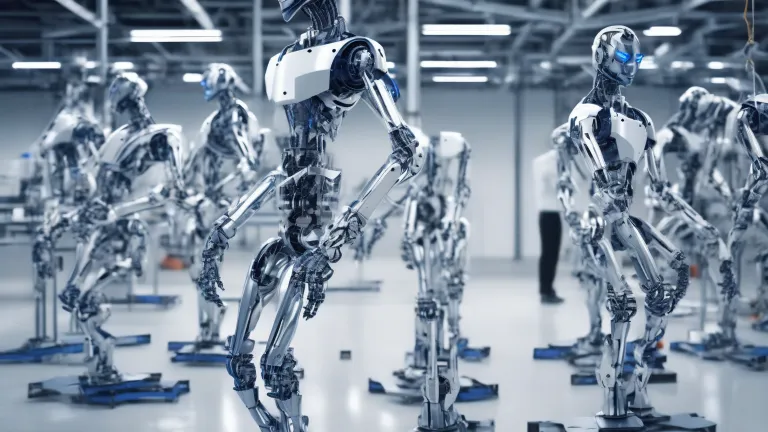
The images, published by Reuters on Thursday 23 July, were taken inside the Beijing Innovation Center of Humanoid Robotics — a major state-backed facility dedicated to general-purpose humanoid robot prototypes and, crucially, scaled manufacturing. Unlike the polished demo videos most robotics companies release, these photos show assembly lines, testing rigs, rows of humanoid frames in various stages of completion, and technicians working on dexterous hands.
The center is not a startup garage. It is part of a coordinated government push codified by the Chinese Communist Party's theoretical journal Qiushi, which in May identified "embodied-intelligence robots" as one of the sectors "opening up new trillion-yuan markets." This is industrial policy at full throttle, and the numbers behind it are hard to ignore.
The numbers that matter
China has been the world's largest industrial robot market for 13 consecutive years. In the humanoid segment specifically, Chinese manufacturers accounted for 90% of global shipments in 2025, with over 330 distinct models on the market and exports in Q1 2026 alone surging 210% year-on-year, according to data from the China Institute of Electronics. Revenue from major Chinese robot enterprises exceeded 90 billion yuan (roughly €11.4 billion / $13.3 billion) in the first five months of 2026, up 26.9% from the same period last year.
Price is the wedge. Some Chinese humanoid robots have dropped to 98,000 yuan (approximately €12,400 / $13,600), a price point that makes Western competitors look like luxury goods. Unitree's G1 — one of the few humanoids you can actually order online — sells for around $16,000 (€14,550) and the company shipped approximately 5,000 units in 2025 alone. Agibot, the Shanghai-based brand from Zhiyuan Robotics, lists its entry-level A2 Lite at $44,000 (€40,000), while its top-end Ultra variant reportedly reaches $190,000 (€173,000).
Pull the lens back and the story gets clearer: China's strength is not flashy demos — it is a full-chain manufacturing ecosystem that lets companies iterate faster and cut costs faster than anyone in Europe or the US.
What about Europe?
The European humanoid landscape is thin by comparison, but it is not empty. Norway's 1X Technologies has opened pre-orders for its Neo Gamma home humanoid at $20,000 (€18,200) or a $499/month (€454/month) lease, with shipping expected in 2026. Neo Gamma stands 167 cm tall, weighs just 30 kg, and is explicitly designed for domestic settings — softer materials, quieter motors, and an AI trained on household tasks. 1X ships to Europe, which matters.
In Paris, UMA — founded by Rémi Cadène, a former Tesla Optimus scientist — was announced in June 2026 as a European answer to the humanoid boom, though details on pricing and availability remain scarce. The UK's Engineered Arts sells its Ameca platform, known for lifelike facial expressions, but at £100,000–250,000 (€116,000–€290,000), it is a research purchase, not a commercial deployment tool.
The uncomfortable truth: as of mid-2026, if you want a cost-competitive general-purpose humanoid that ships today, you are almost certainly buying Chinese.
Humanoid robot price comparison (EUR)
| Model | Country | Price (USD) | Price (EUR, approx.) | EU availability |
|---|---|---|---|---|
| Unitree G1 | China | $16,000 | €14,550 | Online order, ships to EU |
| Agibot A2 Lite | China | $44,000 | €40,000 | Online, enterprise-focused |
| Agibot A2 Ultra | China | ~$190,000 | ~€173,000 | Enterprise only |
| 1X Neo Gamma | Norway 🇪🇺 | $20,000 | €18,200 | Pre-order, ships 2026 |
| Figure O3 | US | $20,000–30,000 | €18,200–27,300 | Enterprise partnership only |
| Digit | US | ~$250,000 | ~€227,500 | Enterprise, limited |
| Ameca | UK 🇪🇺 | £100,000–250,000 | €116,000–290,000 | Research/enterprise |
| Tesla Optimus Gen 3 | US | ~$30,000 (target) | ~€27,300 (target) | Not available yet |
Sources: Forbes, 1X Technologies, Global Times. EUR conversions at approximate mid-July 2026 rates. Prices are manufacturer-listed or reported and may vary by configuration.
The hand problem — and why China is racing to solve it first
The biggest unsolved problem in humanoid robotics is not walking — it is hands. Elon Musk has said hands represent the "majority of the engineering difficulty of the entire robot." A humanoid that walks but cannot pick up a cup, fold a shirt, or turn a valve is an expensive toy. A humanoid with dexterous hands becomes a programmable worker.
China's approach to this problem is characteristically industrial. The country now has more than one million registered robotics companies, and a sub-industry focused purely on dexterous hands has grown from 13 billion yuan in 2024 to over 50 billion yuan (€6.3 billion / $7.4 billion) in 2025, as reported by The Guardian. Beijing-based LinkerBot alone produces roughly 5,000 robotic hands per month and plans to double that.
Tesla's Optimus Gen 3 — which recently began retooling the Fremont Model S line for low-volume production — tackles the hand problem differently: 22 degrees of freedom, 25 actuators per forearm driving fingers through tendon cables rather than motors crammed into the hand itself. It is an elegant engineering solution, but the actuator count makes hitting Tesla's $30,000 target price exceptionally difficult. Musk himself conceded on the Q4 2025 earnings call that Optimus "is not in usage in our factories in a material way."
What the AI Act means for humanoid robots in Europe
Humanoid robots powered by embodied AI do not fit neatly into existing regulatory frameworks, but the EU AI Act will catch them. A robot that navigates a factory floor using computer vision and makes autonomous decisions about how to manipulate objects is, under the Act, likely a high-risk AI system — subject to conformity assessments, transparency obligations, and potentially CE marking requirements. If the robot interacts directly with consumers (think Neo Gamma in your kitchen), it could also fall under the General Product Safety Regulation and the Machinery Regulation.
For European companies deploying Chinese humanoid robots, this adds a compliance layer that does not exist in China's domestic market. Importers become responsible for ensuring the AI system meets EU requirements. That could slow adoption but also creates an opening for European manufacturers — 1X, UMA, and any others that emerge — to build compliance in from day one rather than retrofit it.
Why I am watching this closely
We run AI in production at ai-jarvis.eu — our article pipelines, image generation, AI Arena benchmarks. We test models on a local rig (RTX 5060 Ti with 16 GB VRAM) and we know what it takes to keep AI infrastructure reliable at scale. The humanoid robot wave intersects with everything we track: the same GPU supply chains, the same inference compute, the same geopolitical tensions over chips.
The Beijing photos matter not because they show something we did not already know — China leads in humanoid manufacturing — but because they make the scale tangible. This is not a lab. It is a factory, and it is state-funded. Europe has the regulatory framework and some bright spots in the startup landscape, but no equivalent industrial policy for embodied AI. If that does not change, the gap between Chinese supply and European demand will keep widening — and European buyers will have little choice but to import.
The hands race, not the arms race
For all the attention on walking robots and backflipping demos, the real competitive moat is dexterous manipulation. Whoever solves reliable, affordable robotic hands at scale wins the factory floor, the warehouse, and eventually the home. China is spending billions on that problem. The Beijing Innovation Center is where a chunk of that money is landing. The photos from Thursday are the receipt.
Can I buy a humanoid robot in the EU right now?
Yes — but your options are limited. Unitree's G1 ($16,000 / €14,550) can be ordered online and ships to the EU. 1X's Neo Gamma ($20,000 / €18,200 or €454/month lease) is available for pre-order with 2026 shipping from Norway. Most other models (Figure, Digit, Agibot's higher-end variants) are enterprise-only and require direct procurement negotiations.
What can a humanoid robot actually do today?
Realistically: walk on flat surfaces, pick up and move objects of known shapes, perform simple repetitive tasks in controlled environments (warehouse tote-moving, basic assembly). The gap between a slick demo video and reliable autonomous operation in an unstructured environment remains large. Dexterous manipulation — folding laundry, handling fragile objects, using tools — is the hardest unsolved problem and the focus of most current R&D spending.
Will the EU AI Act block Chinese humanoid robots from entering Europe?
No — but it will add compliance costs. Any humanoid with AI-powered perception and decision-making will likely be classified as high-risk under the AI Act, requiring conformity assessment and CE marking. The importer (not the Chinese manufacturer) bears legal responsibility. This creates both a barrier and a competitive advantage for European-built humanoids that design for compliance from the start.
As humanoids transition from laboratory demonstrations to factory floors in 2026, the global market will be defined by scale, price, and regulatory readiness. Whether European players can close the manufacturing gap or will instead establish niche expertise in high-compliance, specialized robotics remains the defining question for the continent's industrial AI strategy.