What the source reports
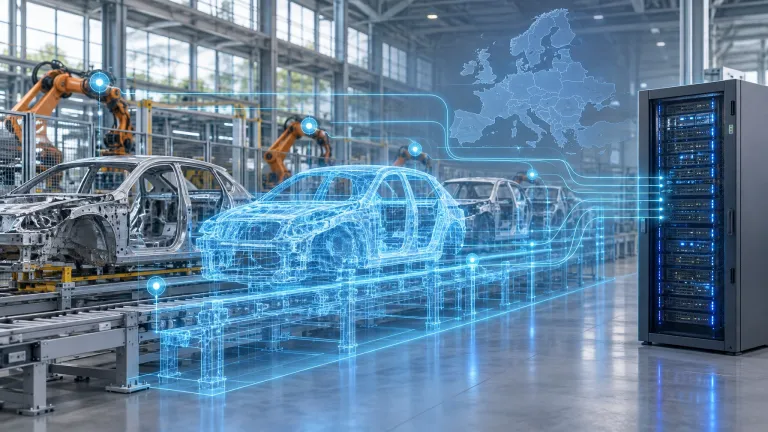
The article points to a broader move among European manufacturers: AI and digital twins are no longer confined to isolated trials. They are being used in engineering and production workflows. A digital twin is a software model of a physical asset, line or plant. It can simulate throughput, test changes before they touch metal, and track how a machine behaves over time.
AI adds a different layer. A language model can query maintenance logs, draft work instructions, summarise a simulation run, or turn sensor data into a checklist for an operator. It does not replace the physics model inside the twin. It sits beside it and handles text, code and pattern matching that would otherwise take engineering hours.
That combination is where European factories face a practical choice. The simulation software is often a long-term contract. The AI model can be swapped in weeks. The cost difference between model providers is large enough to change the business case for a pilot.
Where AI fits in a digital twin
In engineering, the useful work is often boring. A model reads a bill of materials, compares it with a previous project and flags missing parts. It turns a simulation report into a short note for a design review. It answers an operator question about an error code without sending someone to a PDF folder.
In production, the same model can sit behind a maintenance assistant. It takes a work order, a sensor trend and a maintenance history, then proposes a next step. The digital twin supplies the context: which machine, which line, which batch. The model supplies language and summarisation.
None of this requires a frontier model for every task. A smaller open model running on local hardware can handle document lookup and simple classification. A larger cloud model may be better for complex reasoning across multiple systems. The cost table below shows how wide that gap is.
API list prices for a digital-twin assistant
The calculation uses one common workload: 10 million input tokens and 2 million output tokens per month. That is a realistic size for a documentation and operator-query assistant in a single plant. The prices are vendor list prices in USD, not project quotes.
All figures are vendor list prices for standard-tier API access, checked in November 2026; they exclude VAT, committed-use discounts and batch rates.
| Model | Input $/1M tokens | Output $/1M tokens | Monthly cost for 10M input + 2M output |
|---|---|---|---|
| GPT-6.2 Astra | $8.00 | $40.00 | $160.00 |
| Meta Muse Spark | $1.25 | $4.25 | $21.00 |
| Grok 4.7 | $2.00 | $6.00 | $32.00 |
| GLM-5.3 | $1.40 | $4.40 | $22.80 |
On these verified list prices, GPT-6.2 Astra is the most expensive option in the table at $160 per month for this workload. Meta Muse Spark is $21, Grok 4.7 is $32 and GLM-5.3 is $22.80. The spread is wide enough to change the business case for a pilot. The Meta model also comes as open weights, which means a factory can run it on its own servers instead of paying per token.
A cached-input rate matters for real bills: GPT-6.2 Astra charges $0.40 per 1M cached input tokens. Meta Muse Spark also offers free self-hosted open weights, which changes the cost model from per-token billing to hardware and operations.
Vendors publish these API rates in USD. A European buyer adds VAT and any local reseller margin. The EUR amount on the invoice depends on the exchange rate and the contract, so I have kept the comparison in USD rather than invent a conversion.
European data and AI Act checks
Data location is not a side issue for a digital twin. Maintenance logs can contain personal data, and production data can reveal capacity, defects and supplier details. A cloud API sends prompts and outputs outside the plant. A self-hosted open model keeps them inside the factory network. Both options can be GDPR-compliant, but the paperwork is different.
The EU AI Act adds another layer. Mandatory, legally binding obligations for general-purpose AI models took full effect in August 2025, governed by the European AI Office and the GPAI Code of Practice. For industrial AI, the risk category depends on the use. A digital twin that simulates throughput is not automatically high-risk. If an AI output controls a safety function, the system can fall into the high-risk category under the AI Act, and the machinery file needs to match.
That distinction is worth checking before a pilot becomes a production line. A plant can start with a documentation assistant that has no safety role and a clear audit trail. It can test a local Mistral or Meta model on the shop floor. It can compare output quality against a cloud model without moving every query off-site.
What to test before scaling
Our own AI Arena rig exists for this test: a 16 GB RTX 5060 Ti running local models via Ollama and cloud APIs under the same prompts. A factory does not need the same hardware, but it needs the same discipline. Fix a prompt set from real engineering documents, then compare models on the tasks that matter.
- Measure time-to-first-token and tokens per second on the hardware you would deploy.
- Check the model licence for commercial use and for internal redistribution.
- Log prompts and outputs for audit, with retention rules that match GDPR.
- Price a full shift, not a demo. Ten million tokens can disappear in a week if every operator query hits the model.
- Test failure modes: missing sensor data, conflicting work orders, and a model that answers in the wrong language.
The digital twin is the expensive part of the project. The AI model is the part that can be changed. That makes the model choice a procurement decision as much as an engineering one.
Does every digital twin need a language model?
No. A digital twin can run simulation and sensor analytics without a language model. A language model is useful for documents, operator questions, code and summaries. It is an add-on, not a requirement.
Can a European factory keep AI data inside the EU?
Yes, if it uses self-hosted open weights or an EU cloud region with a data processing agreement. Mistral Large 4, Meta Muse Spark Open and DeepSeek-V4.1-Flash can be self-hosted. The hosted APIs have different data paths.
Does the AI Act make all industrial AI high-risk?
No. The risk category depends on the purpose. AI used as a safety component in machinery can be high-risk. A throughput simulation or a documentation assistant usually is not. The list prices above do not include simulation software, sensor storage, integration work, or human review.