What the programme actually offers
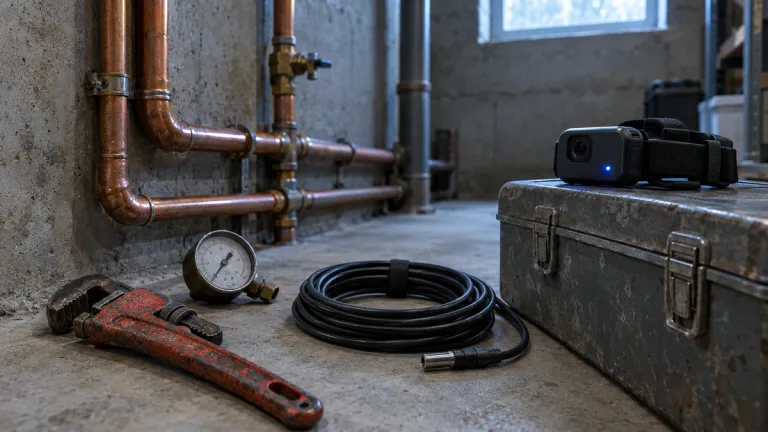
HUMXN, a US AI data and training company, announced the scheme on 6 October and it covers five categories: plumbing, HVAC, electrical work, air-duct cleaning and carpet cleaning. Qualifying homeowners pay nothing. The tradespeople are paid by HUMXN both for the repair and for wearing the capture kit.
The three cities were picked for different climates. Minneapolis brings brutal winters and frozen pipes, Miami brings humidity, corrosion and heat pumps running year round, Chicago sits somewhere in between with a large stock of older housing. That mix is deliberate. A dataset shot entirely in one climate teaches a robot very little about conditions it has not seen.
The repair is not the product. The record of the repair is. How a technician diagnoses a fault, which tool comes out of the bag first, how a hand turns a stiff valve in a cabinet too small to kneel in. That is the material that video-only robot learning is short of, because lab datasets are captured in tidy rooms with good light, no clutter, and no pipework installed in 1962.
In the EU, that footage is personal data
Video shot inside somebody's home is not anonymous. It captures faces, voices, documents on a kitchen table, family photographs on a wall, sometimes a neighbour walking past an open door. Under the GDPR a company doing this at scale needs a named legal basis, a defined retention period, and a data protection impact assessment if the processing is systematic and extensive. Article 5(1)(c) adds minimisation: you collect what the purpose requires and no more.
That is harder than it sounds for robot training. A model learning to grip a wrench benefits from context. A privacy officer reading the same frame sees a child's drawing and a bank statement. The two interests point in opposite directions, and the resolution usually ends up being on-device blurring, short retention windows and a documented purpose limitation. None of that is impossible, but it costs engineering time and money.
There is a second layer. The technicians are being recorded too, in the course of their work. In Germany, works councils have a statutory say over technology that can monitor employees. In the Czech Republic, the Office for Personal Data Protection has consistently treated workplace monitoring as processing that requires a strong justification, not a default. A US contractor model sidesteps much of this. A European one would not.
Paying with services is the awkward part
Article 7(4) of the GDPR says consent must be freely given, and when assessing that, account is taken of whether the service is conditional on consent to processing that is not necessary for performing the contract. HUMXN's model makes data capture part of the deal by design. A homeowner who wants the free repair cannot buy the same repair at full price instead, because there is no such tier.
A regulator would ask an obvious question: what does the resident actually get if they decline the recording and pay? If the answer is "nothing", the consent is thin. This is the part of the model most likely to need restructuring before any European launch, and there is no sign of one from the published details.
What the AI Act adds
The transparency duties in Article 50 of the AI Act apply from 2 August 2026 under Article 113, but they mostly target synthetic output: clear notices to users, deepfake labelling, machine-readable marking. Raw repair footage is not synthetic content, so that article does not bite here.
The enforcement side does. Binding oversight of general-purpose AI providers by the European AI Office also starts on 2 August 2026, with administrative fines reaching up to €15 million or 3% of global annual turnover. If HUMXN licenses its dataset to a model provider selling into Europe, obligations land on that provider inside the EU, not on a lab in Minneapolis.
Why the city list matters if you live in Prague or Munich
Minneapolis, Chicago, Miami. No European city is on the list. That is a technical limitation before it is a regulatory one. US homes run 120 V wiring, ducted forced-air systems and imperial pipe fittings. Czech and German flats run 230 V circuits, hydronic radiators, district heating in many blocks, and metric fittings throughout. Heat pump installation is a policy priority across the EU, and the hardware installed under those programmes is largely European, not American.
A manipulation model trained on this footage learns the fittings it sees. Transfer to a European boiler room is an open question, and nobody in the announced programme is collecting the data that would answer it. For European robotics teams, that gap is the actual story here: a US dataset that will not describe their buildings.
What the announcement does not answer
How many homes are enrolled. How long footage is stored. Whether faces are masked at capture or in post. Whether a resident can withdraw after the job and have the recording deleted. What happens when a session captures a third party who never agreed to anything. The source report describes the free-repair offer and the capture method; it does not describe the safeguards.
Those missing details are the ones a European data protection authority would request first. Until they exist in writing, the programme is a US pilot with an interesting price tag: $0 for the homeowner and an undisclosed cost per recorded hour that decides whether the whole thing scales.
Do participating homeowners get paid?
No. The service itself is free, and that is the entire compensation described. The technicians are the ones paid, both for the repair work and for capturing video and sensor data.
Could a company run this in the EU?
It is not ruled out, but it would need a valid legal basis, a data protection impact assessment for large-scale capture inside private homes, and a consent model that does not make the free repair the only option. None of those requirements is impossible to meet; they cost time and change the unit economics.
Can I sign up from Europe?
No. The programme is listed for Minneapolis, Chicago and Miami only.