TorqueAGI does not build robots. It builds the intelligence layer that goes inside other companies' machines, which puts it in a crowded slot of the stack. Nvidia wants that slot, the big model labs want it, and a long list of vision-language-action startups is already selling into it.
The interview, published by Robotics & Automation News on 2 November, is the fullest public statement so far of how TorqueAGI positions itself against the mainstream VLA approach. It is also a sales document, and it reads like one in places.
The critique: matching patterns instead of tracking objects
Vision-language-action models borrow the recipe that worked for chatbots and extend it with motor commands. A camera image plus an instruction goes in, joint positions come out. Trained on large collections of robot demonstrations, these models generalise well to tasks that resemble the training data.
Saxena argues that this amounts to pattern matching. In his account, a VLA model does not maintain an explicit representation of where the gripper sits relative to a box, or of what the box will do when the belt underneath it starts moving. It produces an action that looks right for inputs that look familiar.
That distinction matters most when the world shifts. A camera moved five centimetres, a different gripper, a pallet in the wrong place: situations where the visual statistics change and the learned correlation no longer points at the correct motor command.
A world-reasoning model built on graphs
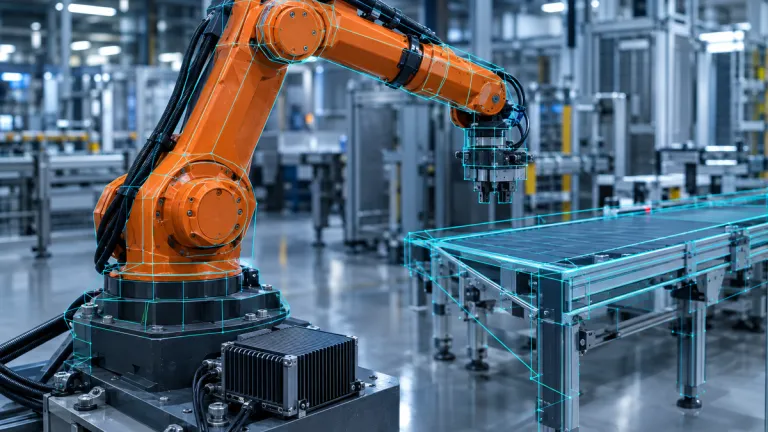
TorqueAGI's answer is a World-Reasoning Model, which the company describes as built on spatio-temporal graphs. Objects, their geometry and their relations to each other are represented as structure the model can reason over, rather than as pixels to be reinterpreted on every frame.
The concrete example from the interview is a conveyor belt that shifts by half a metre, or a gripper swapped for a different size on the same arm. TorqueAGI says its model adapts to those disruptions without retraining from scratch. That is a testable claim. It has not, so far, been tested in public.
According to Saxena, the model spent close to two years in development against heavy machinery and industrial robots. The commercial focus is warehousing, manufacturing and mobile robotics, sold as software to machine builders rather than as a finished product.
Why the on-device argument is the interesting part
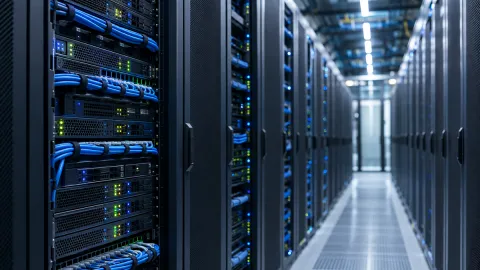
TorqueAGI calls its approach Sovereign Physical AI: the runtime sits on a GPU at the machine, and camera and sensor data stay on site.
The arithmetic explains the interest. A raw 1080p frame is about 5.9 MB. At 30 frames per second that is roughly 186 MB per second from a single camera, close to 1.5 Gbit/s before compression. Encoding cuts the bandwidth by an order of magnitude, and adds encode and decode time back into the control loop. At 30 fps a new frame arrives every 33 ms, so a cloud round trip longer than 33 ms means the controller reasons about a picture that is at least one frame old, before any queueing is counted.
What that costs in practice depends on the motion. A robot arm travelling at one metre per second covers 3.3 centimetres in 33 ms. For a slow pick-and-place cycle nobody will notice. For a fast bin-picking cell, or for a mobile robot sharing a floor with people, the margin gets thin quickly.
What EU rules say about a robot like this
Inside the EU, a robot arm carrying an AI safety component is covered by Annex I of the AI Act, which includes machinery. The compliance date moved. The Digital Omnibus on AI, Regulation (EU) 2026/1744, postponed Annex I obligations to 2 August 2028 and Annex III systems to 2 December 2027. The Article 50 transparency duties, including disclosure when a person interacts with an AI system and marking of synthetic content, have applied since 2 August 2026.
For a European integrator the practical consequence is documentation, not demos. High-risk status brings risk management, event logging and technical documentation that travel with the product. A vendor's video of an arm unloading a truck does not satisfy any of it.
On data, running inference at the machine removes a transfer of camera footage to a provider in a third country, which simplifies a GDPR assessment. It does not remove the need for a legal basis. A camera watching a loading bay records workers, and in Germany that conversation involves works council consultation before it involves a model.
Partners, awards and how much they prove
TorqueAGI was selected for John Deere's 2026 Startup Collaborator programme, is designated an Nvidia Perception Partner, and the interview names Dexterity among integrations, specifically autonomous truck unloading.
Read those as evidence of commercial traction, which they are, and not as validation of the technical thesis. A startup programme is a collaboration arrangement. Partner status with Nvidia is a tier in a partner programme. Neither compares a world-reasoning model against a VLA baseline on the same task.
What the interview leaves out
There are no latency figures, no success rates on a public manipulation benchmark and no comparison with open VLA checkpoints. TorqueAGI does not publish pricing, which is normal for industrial software and also means a European machine builder cannot estimate cost per robot cell from anything public.
This is the part I would want before believing any of it. On the AI Arena rig we run local models on a 16 GB RTX 5060 Ti, and the binding constraint there is memory footprint, not raw compute. A factory has the harder version of that problem: the model has to hold frame rate while leaving headroom for the safety PLC, on hardware that will be sold for a decade.
TorqueAGI's argument, stripped of the framing, is that a smaller model with the right structure beats a bigger model with the wrong one. It is a reasonable position. Saxena has the credentials and the customers to make it. The interview contains the architecture and the partner list, and not a single measured number.
Does TorqueAGI build robots?
No. It supplies the intelligence layer as software to robot and machine manufacturers. The hardware stays with the OEM, which is why the company talks about its runtime rather than about a product you can order.
If the model runs on the machine, is GDPR out of the picture?
No. On-device inference avoids sending footage to an external provider, which removes one transfer and one processor from the picture. You still need a legal basis for processing employee images, and monitoring rules in member states apply as before.
Could a mid-size integrator test this kind of model without a robot cell?
Partly. A world-reasoning model can be exercised on recorded sensor data and a simulator before it touches metal. What no simulation covers is the timing behaviour of the real control loop, and that is exactly where the edge-versus-cloud argument has to be decided.