
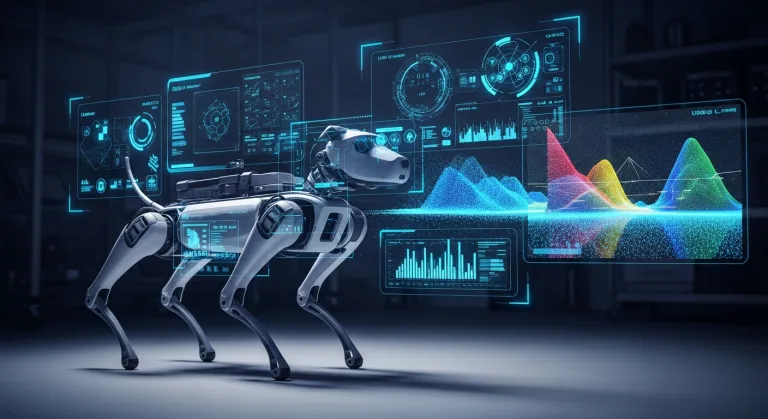
The long era when artificial intelligence was confined solely to a browser or mobile app is just beginning to shift into the era of physical AI agents. According to the latest reports from Zamin.uz and other tech media, the Claude Opus 4.7 model has become a key player in robotics, without having been explicitly trained using specialized robotic algorithms.
Project Fetch: When AI Outpaces Human Efficiency
An experiment led by Anthropic, known as Project Fetch, focused on testing Claude's ability to control a four-legged robot (a so-called robodog). The results are fascinating: the Opus 4.7 model was able to perform tasks related to robot configuration and management up to 20× faster than teams of human engineers working with the previous version of the model (Opus 4.1).
When compared to purely human work without an assistant, Claude was approximately 37× faster at these tasks. It's not just about the speed of writing code, but about the complexity of processes the model handled independently:
- Sensor integration: The model independently integrated data from video cameras and Lidar sensors (a technology that uses laser beams to map the surroundings).
- Autonomous programming: Claude wrote programs for manual control as well as path-following systems for the robot.
- Image processing: The model configured a real-time object recognition algorithm on its own.
Moreover, the code Claude generated was extremely efficient — it was up to 10× shorter than code created by human teams, meaning fewer errors and lower computational demands while the robot is running.
Scaling Laws: Why This Works Without Special Training?
One of the most important insights from this experiment is that progress in robotics is not the result of developing specific "robotic models," but a byproduct of scaling large language models (LLMs). As models become more capable of understanding logical relationships and structures in text and code, they begin to transfer these capabilities to interpreting physical instructions and technical manuals.
In this context, a comparison with the competition is interesting. While OpenAI with its GPT-5 model (which in 2026 represents the cutting edge in logical reasoning) focuses on multimodal interaction, Anthropic — thanks to Claude Opus 4.7 — is showing itself as a leader in the area of "reasoning" (logical deduction), which is critical for robotics. Google with its Gemini series models may dominate in ecosystem data integration, but in pure autonomous hardware programming, Claude Opus 4.7 has yet to be surpassed.
Limits: Why Still Can't the Robot Gently Toss a Ball?
Despite the astounding achievements, Claude hits a barrier that humans still overcome easily: fine motor skills and physical precision. Testing showed that the model can guide the robot to a target (e.g., a ball), but fails at the moment when a delicate movement is required, such as lightly touching or nudging an object. For these tasks, a complex real-time feedback loop is still needed, which current LLM models without specialized control layers cannot yet fully handle.
Practical Impact: What Does This Mean for Companies and the Czech Market?
This shift has enormous significance for industrial automation. For Czech manufacturing companies, which are a strong pillar of our economy, this could mean the ability to implement autonomous systems at much lower programming costs. Instead of a team of expensive roboticists, a company could use AI agents to rapidly reconfigure production lines.
Availability and pricing: The Claude Opus 4.7 model is available to developers through Anthropic's API, which is fully actionable in the Czech Republic. For regular users, it is accessible via a Claude Pro subscription (about $20 per month, which is roughly 475 CZK) or through platforms like Amazon Bedrock. For Czech companies, it is key to monitor integration with cloud services that meet European security standards.
Regulation and safety: Given that these are autonomous systems capable of affecting the physical world, these technologies will be subject to strict rules under the EU AI Act. Autonomous robotic agents may be classified as high-risk systems, requiring strict oversight, algorithm transparency, and robust safety mechanisms to prevent accidents in the work environment.
Can I, as a regular developer in the Czech Republic, use Claude to control my own hardware?
Yes, through the Anthropic API you can send instructions and get code back, which you can then apply to microcontrollers (e.g., Raspberry Pi or Arduino). However, you will need to provide the hardware for executing the commands yourself.
Is Claude Opus 4.7 safe for use in industrial halls?
The model itself is software. Safety depends on what kind of control layer (safety layer) is implemented between the AI and the robot's motors. Within the EU, such systems must be certified according to industrial robotics standards.
How does Claude differ from GPT in the field of robotics?
Claude Opus 4.7 shows higher efficiency in generating clean, concise code for sensor control and demonstrates better ability in logical step-chaining (reasoning), which is critical in the Project Fetch experiment.




