What Tempo actually announced
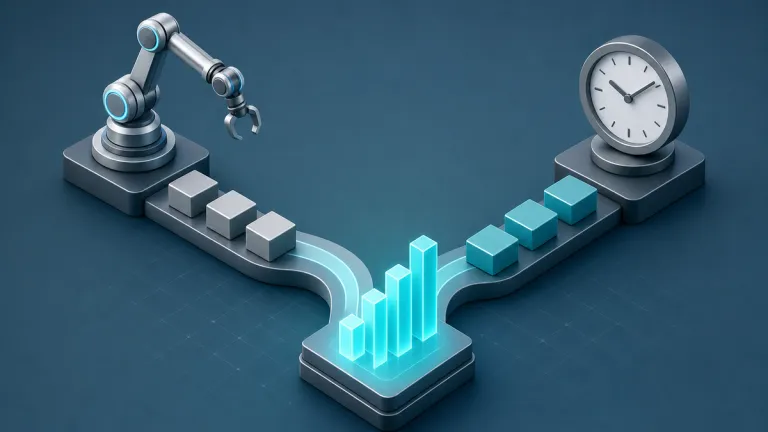
Tempo announced Workforce Intelligence, a product it calls the first attribution solution to align ROI for human and agentic productivity. Marketing phrasing aside, the problem is real: when humans and AI agents work the same tickets, write the same code and answer the same support conversations, nobody can currently say which share of the output — and which share of the cost — came from which side.
The announcement is light on details. No pricing, no EU-specific availability sheet, no methodology behind the attribution logic. What the positioning makes clear is that this is not another LLM observability dashboard. It is a business-level attribution layer: work data from project tools and AI activity logs could be combined to describe a task as, hypothetically, 60 % agent and 40 % human, and to attach a value to that mix. Tempo has not disclosed that specific attribution method.
Why attribution is the hard problem
Token metrics do not pay salaries. Tools like Langfuse, Helicone or LangSmith answer the question "how much API cost did this agent run up?" — which is useful, but it is not ROI. Traditional time tracking answers "how many hours did a human spend?", but not "how many of those hours were spent fixing what an agent produced."
That second question is the one European teams actually need answered. In our own production setup at ai-jarvis.eu, the boundary between human and AI work disappears daily: drafts from our article pipeline are edited, fact-checked and sometimes entirely rewritten by humans. A naive attribution model would credit the AI with the whole draft and the human only with "review" — and then conclude the human is the bottleneck. The honest measure of agent value is the rework ratio: how much human time was consumed correcting agent output. A tool that reveals that number is genuinely useful. A tool that only labels tasks "human/agent" is productivity theater.
We see the same split in our AI Arena benchmark rig: tokens per second, VRAM use and time-to-first-token tell us how fast a model runs, but nothing about whether the output was worth running at all. Workforce Intelligence sits at exactly that uncomfortable junction — between measurement and meaning.
The European angle: this is legally employee monitoring
In the EU, the moment a company uses AI to analyze how work gets done, the GDPR starts talking. Employee monitoring is not automatically a high-risk processing activity, and a DPIA is not always required. Systematic or extensive monitoring, profiling, or processing likely to create a high risk may require a data protection impact assessment (DPIA) under GDPR Article 35, depending on the actual scope and data involved. A team-level aggregate dashboard may fall below that threshold, while per-person productivity scoring or profiling may increase the likelihood that a DPIA is needed. Per-person attribution alone does not trigger Article 22: that provision concerns decisions based solely on automated processing that produce legal effects or similarly significant effects on a person. Employees also have the right to be informed in advance about the scope of monitoring — in many member states, including Czechia, labour law separately requires this, but the precise duty varies by country and sector.
Then there is the EU AI Act, whose general application date was 2 August 2026 — only weeks before this launch. The Annex III, point 4 employment provision does not apply just because a system combines work and agent data; it applies if the system is used to evaluate or make decisions about workers, for example by generating individual performance scores or supporting promotion, disciplinary or termination decisions. If Workforce Intelligence is used that way in the EU, high-risk obligations can apply. Providers carry duties such as risk management, data governance and technical documentation, while employers deploying it separately face obligations such as ensuring human oversight measures are in place and providing transparency to workers. Article 86 gives affected persons a right to an explanation in the specific circumstances set out by that provision, including where an AI-supported decision has a significant impact — it is not a general explanation right for every productivity attribution. Works councils in Germany and elsewhere may have co-determination rights depending on national law and the tool's actual use.
The practical consequence: a European company cannot quietly deploy an attribution tool, watch the dashboard and act on the results. The tool itself is not illegal — but uses involving worker evaluation or decisions may be subject to applicable GDPR, labour-law and AI Act safeguards, including transparency, appropriate human involvement and routes to challenge decisions where required. The exact obligations depend on the system's purpose, design and actual use.
Where it fits — and what's still missing
Tempo is not entering an empty field. Langfuse, Helicone and LangSmith track agent token spend; Microsoft tracks Copilot usage inside its own stack; Workday and Viva Insights measure human activity. What would make Tempo's "first" claim meaningful is the combination — one attribution model for humans and agents on shared work data, inside the Atlassian ecosystem where Tempo has spent two decades building trust.
The question European buyers should ask is simple: how are the attribution weights derived? If an agent generates 60 % of a document's text but the human spent an hour making it usable, how is that hour counted? If the agent created the mess the human then fixed, the ROI flips from positive to negative — and only the methodology, not the dashboard, can show that. Tempo has not published it, and for EU customers that methodology is not just an analytics preference, it is a compliance file.
What European teams should do before rolling this out
- Assess whether a DPIA is required first. Systematic or extensive monitoring, profiling, or processing likely to create a high risk may trigger GDPR Article 35; get legal involved before the pilot.
- Choose the unit of analysis. Team-level ROI is generally less sensitive than per-person attribution, but attribution at individual level does not by itself trigger GDPR Article 22. Article 22 may apply only where a decision based solely on automated processing has legal or similarly significant effects; separate GDPR Article 35 and AI Act assessments depend on the processing's likely risk and the system's purpose and use.
- Ask for the data sheet. Where is the data processed? What are the data location and transfer arrangements, and is there an EU data residency option? These are among the issues to assess; residency alone does not determine whether the deployment is permissible.
- Treat the dashboard as a measurement, not a verdict. GDPR transparency, human-review and contestation safeguards may apply depending on the processing and resulting decisions. Article 22 is relevant only to solely automated decisions with legal or similarly significant effects, while the AI Act may impose separate safeguards for applicable high-risk employment uses.
Can my employer deploy this in the EU without consulting the works council?
It depends on the country, sector, collective agreement and how the tool is actually used. In some member states, no — systematic monitoring or performance evaluation can trigger information and co-determination duties. Germany's BetrVG § 87 and Czech Labour Code § 316 are examples, not a universal EU rule. GDPR adds transparency obligations and, where the processing is likely to create a high risk, a possible DPIA under Article 35.
Is Workforce Intelligence a replacement for Tempo Timesheets?
Nothing in the announcement suggests that. Timesheets captures human time; Workforce Intelligence aims to attribute output to humans and agents on top of shared work data. The two are far more likely to complement each other — agentic productivity without human time context would be easy to game.
Does it only work with Jira?
Tempo has not published the integration list. Given the company's history in the Atlassian Marketplace, a Jira-first data model is the reasonable expectation, but treat "works with everything" as unverified until integrations are documented.
This article is general information, not legal advice.