
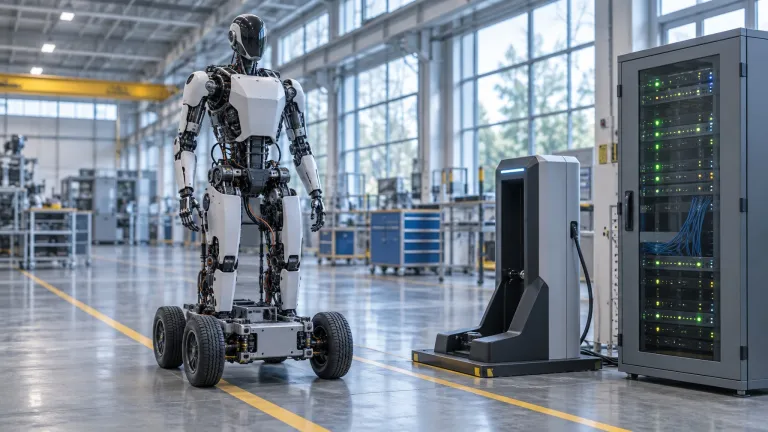
Telekom Malaysia, usually shortened to TM, is the country's incumbent fixed-line and mobile operator. AGIBOT is a Shanghai-based builder of embodied AI systems and humanoid robots. Swancor Advanced Materials is a Shanghai-listed materials company best known for corrosion-resistant resins and carbon-fibre composites used in wind blades and industrial parts. According to The Star, the three agreed to work together on getting more robots into Malaysian factories and service operations.
That is roughly what the public record contains. No disclosed contract value, no fleet size, no deployment sites, no timetable. Anyone who tells you otherwise is extrapolating.
What a telco brings to a robot fleet
A robot on a shop floor is a connected device before it is a mechanical one. It needs firmware updates, telemetry, synchronised sensor data and, for supervised or teleoperated units, a video uplink with latency low enough to steer by. Billing all of that as a managed service fits an operator's business model better than shipping boxes. It also puts the operator between the factory and the robot vendor, which changes who the customer calls when something stops moving.
Malaysia has spent several years building out 5G coverage and edge capacity, and industrial automation is one of the use cases operators there have been chasing. Whether this partnership produces signed deployments or a demonstration line is not yet known.
AGIBOT and Swancor
AGIBOT, formally Shanghai Zhiyuan Innovation Technology, is among the more visible Chinese embodied-AI companies. Its line-up includes the Expedition A2, a bipedal humanoid that completed a continuous 106 km walk from Suzhou to Shanghai, a Guinness record. The smaller bipedal Lingxi X1 sits below it. The company has shown its machines operating in Chinese electronics and automotive plants. Competition at home is crowded, with Unitree, UBTech and a long tail of smaller builders all after the same factory buyers.
Swancor's role is easier to read once ownership is included. According to reporting, AGIBOT acquired a majority stake in Shanghai-listed Swancor Advanced Materials in July 2025, and AGIBOT has started an IPO process in Hong Kong. That makes the materials partner a company AGIBOT already controls, which explains why it sits in the agreement. Swancor supplies composites and specialty chemicals; lightweight structures are the obvious overlap with robotics, and the partnership gives AGIBOT a materials supplier inside its own group rather than a name on a press release.
The EU rules already in force, and the deferred high-risk file
This is where a European deployment differs from a Malaysian pilot. Since 2 August 2026, the transparency duties in Article 50 of the EU AI Act are enforceable rather than advisory. A system that interacts with people has to say so. Synthetic content has to be marked. Emotion recognition has to be disclosed to the people exposed to it, and in workplaces and schools it is banned outright under Article 5.
Robots that act as safety components of machinery sit in a heavier category. Under Regulation (EU) 2026/1744, the AI Act's high-risk timetable has been deferred: Annex III high-risk obligations now apply from 2 December 2027, while Annex I product-safety obligations — including safety components of machinery — apply from 2 August 2028. The Machinery Regulation (EU) 2023/1230 still replaces the old Machinery Directive from 20 January 2027. Technical documentation, risk management, logging, human oversight and a conformity assessment come with the high-risk file. A provider established outside the EU also has to name an authorised representative inside the Union.
None of this stops a Chinese or Malaysian robot from being sold in Europe. It does mean the vendor needs a compliance file written against EU law, and the buyer needs to see it before the purchase order, not after commissioning.
Where the camera data goes
Robot fleets generate video, audio and location traces. When a worker walks through the frame, that footage is personal data under the GDPR. The European Commission has not adopted an adequacy decision for China, so a cloud back end there needs standard contractual clauses and a transfer impact assessment on top.
Keeping inference on site removes most of that problem. Detection and navigation models are small. Our AI Arena rig runs quantised vision models on a single 16 GB consumer card, and that class of hardware is enough to hold a camera feed and a detector inside the building. The expensive part of such a setup is integration, not compute.
European competitors
Europe's robotics base rests on industrial arms and safety engineering rather than low-cost humanoids. Neura Robotics in Metzingen, PAL Robotics in Barcelona, and Munich's Agile Robots, which now owns Franka Robotics, are the names that turn up in EU procurement. Their pitch leans on CE-ready documentation, service networks and data handling that stays inside the single market. That pitch gets easier to make as AI Act enforcement matures.
A buyer's checklist
For a European company evaluating a humanoid or mobile robot from any vendor, six questions cover most of the ground:
- Is there a CE declaration of conformity, and which directives or regulations does it cover?
- Does the vendor have an EU authorised representative, and is it named in the contract?
- Which parts of the control stack run in the cloud, and in which jurisdiction?
- Can inference run on-premise, and what hardware does that require?
- Does the system log actions for later audit, and who holds those logs?
- Is any emotion recognition or biometric identification included, even as an optional module?
As reported, the Malaysian partnership has no published unit count, no site list and no start date.
Does a humanoid robot need a CE mark to be sold in the EU?
Usually yes, though not because of the AI Act alone. Most industrial robots fall under the Machinery Regulation, and many also under electromagnetic compatibility or radio equipment rules. The AI Act adds a separate assessment when the AI is a safety component or otherwise classified as high-risk.
Can an EU company run a pilot with a non-EU robot vendor?
Yes. Deployer duties still apply inside the EU: human oversight, monitoring, keeping logs where the system is high-risk, and informing affected workers. Running a pilot does not suspend those obligations.
Is emotion recognition in a factory allowed?
No. Article 5 of the AI Act prohibits AI systems that infer emotions in the workplace and in education, with a narrow exception for medical or safety reasons. A robot with a camera and a mood-detection feature would need that feature removed or disabled for EU deployment.