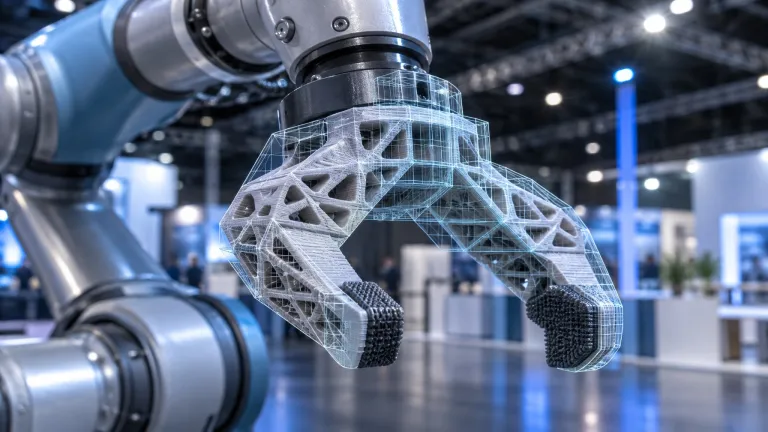
From a sentence to a build file
The workflow ran at Formnext 2026 in Frankfurt, Hall 12.1, booth 119D. A person describes what the robot has to pick up. The agent selects a gripper concept, opens the part in Siemens Designcenter, changes the geometry, executes simulations, validates that the gripper fits the robot's mounting and handling interfaces, and exports files for the printer.
Siemens built it with AGIBOT, a robotics company working on humanoid machines. The gripper is the component that touches the world, and it is the one that changes most often. A new object to grasp usually means new fingers, new dimensions and another round of CAD work.
The agent operates CAD over MCP
The connection to Siemens' engineering software runs through the Model Context Protocol, the tool-calling standard Anthropic published in late 2024. MCP gives a model a fixed way to list the tools it can reach and to call them. That is the difference between an assistant describing which button to press and an agent pressing it.
Humans stay in the loop for oversight, according to Siemens. The wording matters. Tool-calling agents fail in unglamorous ways: a wrong parameter, a stale file, a simulation run against the wrong mesh. We run tool-calling models in our own article and transcription pipelines, and the rule there is the same one that applies to engineering software: a call that returns a machine-checkable result can be verified, a call that returns prose cannot. The same logic sits behind the local tool-calling tests we publish in AI Arena.
How far the weeks-to-a-day claim goes
Siemens' additive manufacturing leadership says custom gripper design went from weeks to a single day. The company has not published the baseline. Three working weeks is fifteen working days; one day is one. On that reading the agent removes roughly 90 percent of the calendar time inside the geometry-and-simulation loop.
What the claim does not cover is everything downstream. Print time, post-processing, physical testing and sign-off are not part of the quoted figure. Neither is the engineering judgement that decides whether a simulated grip actually holds a real object.
Grippers happen to be a good candidate for this kind of automation. The problem is bounded, the interfaces are documented, and the failure mode is a dropped part rather than an injured person. That is not true of most mechanical design.
Printing cell in Erlangen
Design files still need a printer. Siemens is developing an adaptive production cell in Erlangen with EOS, the German industrial 3D printing vendor based in Krailling, and AM Solutions, the post-processing arm of the Rösler Group. The cell is meant to automate printing and the finishing steps that usually eat manual hours. It is in development, not on sale.
AM I Navigator and the wider portfolio
Siemens also added an Industrial AI layer to its AM I Navigator framework, which industrial customers use to assess and prioritise AI use cases in additive manufacturing. The gripper demo and the navigator update were shown together at the Frankfurt fair.
The pattern across Siemens' recent announcements is consistent. Late October brought agentic rollouts for EDA and 3D IC design. November brings agentic CAD and physical production. In each case the agent sits inside an existing engineering tool rather than beside it as a chatbot, which is also where the commercial value is: the software licence is already there.
Why this one lands in Europe first
Siemens is Munich-based, the production cell is in Erlangen, the printing partner is in Bavaria, and the showcase is at Formnext in Frankfurt. For European manufacturers this is closer to a domestic roadmap than a lab video from California. The likely early users are German and Italian machine builders and contract manufacturers with existing Siemens seats.
Regulation is the second European thread. The new Machinery Regulation (EU) 2023/1230 applies from 20 January 2027 and covers the safety of machinery, including functions driven by AI. Under the AI Act, the high-risk deadline for Annex III systems moved to 2 December 2027 after the Digital Omnibus. A CAD assistant that generates gripper geometry is not an Annex III system. The compliance question for a factory stays where it was: the finished machine and its risk assessment, not the model that sketched a finger.
No price, no release date
Siemens has published no standalone licence fee and no commercial terms for the workflow. It runs as an industrial technology demonstration and pilot. That leaves the usual gap between a trade-fair demo and a line item in a procurement spreadsheet: nobody outside the pilot can yet say what a seat costs, whether it runs on customer premises or in Siemens' cloud, or which data leaves the factory when the agent calls a hosted model.
For a European plant the last point is not academic. A gripper geometry is not personal data, but the task description next to it can describe a production process, and that is exactly the kind of text companies prefer to keep inside the EU. Siemens has not said how the inference is hosted for the Erlangen setup.
Can I use this workflow with my own 3D printer today?
No. Siemens presented it as a demonstration and pilot with AGIBOT. There is no published product, no price and no customer availability date. The Erlangen production cell with EOS and AM Solutions is still in development.
Does the agent work with CAD software from other vendors?
MCP itself is vendor-neutral and has been adopted across the industry, but Siemens has only described an integration with its own Designcenter environment. No support list for third-party CAD tools has been published.
Is a generated gripper design automatically safe to use?
No. Siemens keeps humans in the loop for oversight, and simulation results are not a substitute for physical testing. Under the EU Machinery Regulation, responsibility for the safety of the finished machine stays with the manufacturer placing it on the market.
Siemens has not named the customers in the pilot, and the Erlangen cell has no announced date for leaving development.