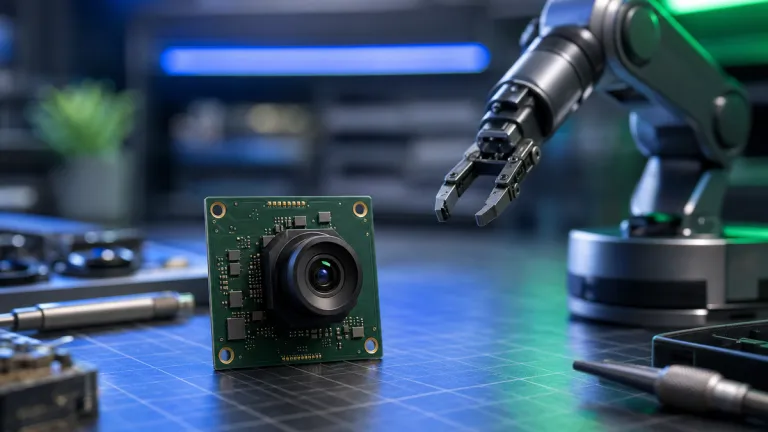
Seeing Machines is not a robotics company, and it does not pretend to be one. The Australian firm, founded in 2000 as a spin-off from the Australian National University, made its name in automotive vision: small cameras and dedicated chips that watch the driver instead of the road. So when it announces a Physical AI Platform for humanoid robots, the obvious question is: what does a driver-monitoring company think it can teach a robot?
The answer, according to the company, is perception on a budget. A humanoid robot that needs to react to people in real time does not just need a bigger AI model. It needs fast, reliable, low-power vision that runs on the robot itself — no cloud round-trip, no data-centre GPU in its chest. Seeing Machines argues that this is precisely the engineering problem it has been solving inside cars for decades, but the announcement does not yet show a deployed robot using the platform in the field.
What the Physical AI Platform actually is
"Physical AI" is the industry term, popularised by NVIDIA, for AI that operates in the real world: robots, automated vehicles, machines that move and act. Seeing Machines is borrowing the label deliberately. According to the launch announcement, the platform is built around the FOVIO chip and the company’s perception software, which tracks faces, eyes, gaze and body position. The announcement presents the platform as intended for humanoid-robot manufacturers, but does not provide deployment evidence or customer names.
In a car, that stack has to decide whether the driver is eyes-on-road or eyes-on-phone, drowsy or attentive — within milliseconds. In a humanoid robot, the company proposes using the same stack to tell the machine where people are, what they are doing, and whether they are about to step into its path. Different product, same problem — by Seeing Machines’ account.
Why a car company is credible here
Driver monitoring sounds simple until you list the conditions: changing light, sunglasses, masks, reflections, a driver turning their head, a bump shaking the camera. Production systems still have to make a safety-relevant decision in real time, every single time. That experience is exactly what roboticists mean when they complain that perception is hard.
There is also a European regulatory reason this company got the chance to build that experience. The EU General Safety Regulation includes requirements for driver drowsiness and distraction warning systems on certain new vehicle types; these requirements have applied to all new vehicle registrations from 7 July 2024. That shift created a broader market for driver-monitoring systems, but it does not mandate Seeing Machines’ particular FOVIO system in every vehicle. Seeing Machines describes Magna as one of the automotive suppliers through which its technology reaches production vehicles.
The European angle: GDPR, the AI Act and home-grown robots
For European robotics companies, the interesting part is what automotive history brings with it: documentation, testing processes and a design philosophy in which failure is not an option. That is the language of the EU AI Act. Under the Act, whether a robot perception system is high-risk depends on the robot’s intended use and on whether the AI is a regulated safety component or falls within an Annex III use case. Not every humanoid-robot perception system is automatically high-risk, but perception is likely to be among the first things an auditor will ask about for use cases that are covered.
On-device processing can reduce transmission and storage risks if a robot’s vision stack never sends video outside the machine. But that does not settle the data question: GDPR obligations such as lawful basis, transparency, retention, security and possible biometric-data rules still apply to the data that is collected and processed locally.
Europe is not the centre of the humanoid hype, but it has real programs: Norway’s 1X with its NEO humanoid, Germany’s Neura Robotics, Spain’s PAL Robotics. These companies are examples of the kind of European humanoid programs that could benefit from a licensed automotive-grade vision stack; the launch announcement does not identify them as Seeing Machines customers. A licensing play that brings automotive-grade vision to European robot makers is a plausible match — if the technical claims hold up.
How it compares to the big robot-AI platforms
The field Seeing Machines is entering has heavyweight names. NVIDIA is pushing Isaac and the GR00T foundation models for general robot intelligence. Google DeepMind is working on Gemini Robotics. Figure is building its own stack from the ground up, and Tesla’s Optimus is the poster child of vertical integration.
Seeing Machines’ entry point is different: a dedicated, low-power chip rather than a general-purpose GPU. That matters in a machine that has to carry its own battery and reserve most of its power budget for motors. We see the same trade every week in our AI Arena, where we benchmark local LLMs on an RTX 5060 Ti with 16 GB of VRAM. A general-purpose GPU is a poor fit for always-on tasks — even a mid-range card like the one in our rig draws around 180 watts and needs active cooling. A robot that burns that much power on vision alone will spend most of its life at the charger.
But there is a flip side. NVIDIA’s GR00T and DeepMind’s Gemini Robotics bring something the automotive world does not: general intelligence wrapped around perception. A chip that detects people and predicts movement is one layer of a humanoid robot. The planning, reasoning, manipulation and safety architectures still have to come from somewhere else.
What we still do not know
The launch announcement names no humanoid customer and publishes no benchmark numbers, no power figures and no pricing. Typical for a B2B platform launch, but it also means the story is still just a story until a robot maker ships a product with FOVIO inside.
The honest read: this is a component play, not a finished robot company. The business model mirrors the automotive one — license the chip and software to hardware makers that do not want to spend five years reinventing perception. Whether that is enough to matter in robotics will be decided not by the press release, but by the first real robot that uses it.
Is the Physical AI Platform available to European companies?
It is a B2B platform, so there is no consumer pricing or self-serve access. Seeing Machines is an Australian company with substantial UK operations and a global automotive footprint, so European robotics firms can engage directly. Commercial terms were not disclosed in the announcement.
Will this chip end up in consumer robots?
Nothing in the announcement addresses consumer robots. The stated target is humanoid-robot manufacturers, which today build industrial machines rather than home appliances. Consumer robots usually run on far cheaper, simpler vision modules.
Is Seeing Machines becoming a robot maker?
No. The announcement describes a platform, not robot hardware. The strategy is to license the perception stack to hardware makers — the same model Seeing Machines uses in the automotive market. Building a humanoid body would put it in direct competition with its own customers.