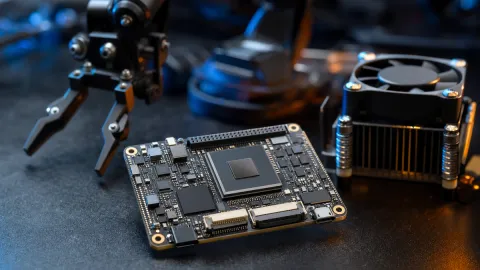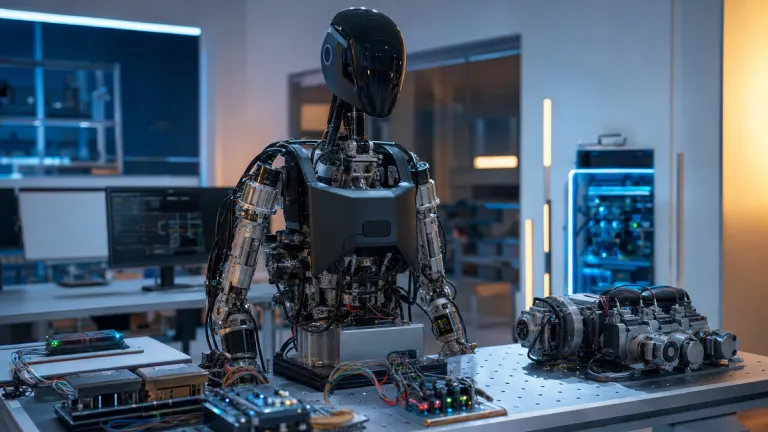
Renesas, the Japanese semiconductor giant, has turned its physical AI ambitions into a physical address. On August 27, the company inaugurated the Physical AI & Robotics Lab in Beijing. Renesas says the facility is designed for customers to test, validate and co-develop next-generation robotic systems, with humanoid robots as the primary target. According to Renesas, the lab bundles embedded processing, motion control, power management, sensing, software, AI modeling and system-level verification under one roof, as Renesas announced in the August 27, 2026, press release “Renesas Opens Physical AI & Robotics Lab in Beijing”.
Renesas positions this as an engineering lab, not a demo stage. The company says customers can walk in with a robot concept — or a half-assembled humanoid — and leave with something that has been tested against real workloads: motor drivers talking to microcontrollers, power rails holding under load, and AI models running fast enough for closed-loop control.
What "physical AI" actually means in silicon
The term gets used loosely. For Renesas, physical AI means AI that acts in the physical world — robots, drones, autonomous machines — where a model's output has to drive a motor or respond to a sensor within milliseconds. That is a fundamentally different engineering problem from generating text. The Beijing lab is where Renesas proves its chips can handle that under realistic, repeatable conditions.
The timing is telling. Renesas has made physical AI a distinct commercial priority, and the Beijing lab gives that strategy a customer-facing physical presence. The company is clearly treating humanoids as a near-term commercial sector, not a research curiosity.
The 30% to 70% BOM math, decoded
According to Renesas, it already addresses approximately 30% of a humanoid robot's bill of materials (BOM) and aims to expand that to up to 70% using its control, power, sensing, AI and software portfolio. This is a vendor estimate from Renesas, not an independently audited share of a robot's total value; the exact percentage depends on the robot design and how Renesas counts bill-of-materials components. What does that coverage actually look like inside the robot?
A humanoid is, electrically speaking, a distributed network of actuators. Every joint — shoulder, elbow, wrist, hip, knee, ankle — needs a motor driver, current and position sensing, and a local controller. The battery pack needs power management and protection. The "brain" needs embedded compute, and every sensor needs signal conditioning. These are the components Renesas has sold into cars and industrial machines for decades: microcontrollers, microprocessors, motor driver ICs, power management chips and sensor interfaces.
The jump from 30% to 70% depends on how much of the compute and software stack Renesas can own. The remaining BOM includes AI accelerators and GPUs from companies like NVIDIA and Qualcomm, plus mechanical parts, batteries and actuators. Renesas does not need to build GPUs — it needs its controllers, power stages and software to become the default nervous system around whoever's GPU is doing the thinking.
Why Beijing — and what it signals for Europe
The location is deliberate. China has one of the densest ecosystems of humanoid robot developers anywhere — Unitree, Fourier, UBTech and a long tail of startups. The US has Tesla's Optimus; Europe has its own smaller set of players, including Norway's 1X Technologies and Spain's PAL Robotics. By putting a full validation lab in Beijing, Renesas is positioning itself close to where a large share of early humanoid design work appears concentrated.
For European companies, this is a double signal. Renesas is a global merchant supplier, so the same chips, reference designs and validation expertise are generally available through its EMEA organization; however, Renesas has not explicitly confirmed that European teams can access the Beijing lab itself through EMEA, and specific access conditions should be confirmed. The lab also underlines that early high-volume humanoid design work appears concentrated in Asia. European chipmakers Infineon, NXP and STMicroelectronics are strong in automotive power and microcontrollers; whether they will build similar customer-facing robotics validation hubs in Europe is an open competitive question. That gap is worth watching — as a competitive risk, and possibly as an opportunity for European consortia. For broader context on how EU regulation is shaping this market, see our magazine archive.
The EU AI Act is no longer a future risk
The Beijing lab opened just as the EU AI Act entered a new enforcement phase. The Chapter V general-purpose AI obligations began applying on August 2, 2025; supervision and enforcement powers may have had an adjustment period before full enforcement. Those rules require providers to draw up technical documentation, make certain information available to downstream providers, publish a sufficiently detailed summary of training content, and put in place a copyright compliance policy; providers of GPAI with systemic risk also face model evaluation, risk assessment, incident reporting and cybersecurity obligations. These GPAI duties attach primarily to model providers. Robot makers and integrators may be pulled in through documentation and supply-chain responsibilities, not as blanket direct duties for every robot builder.
Article 50's transparency requirements have applied since August 2, 2026 where their scope is met. For AI systems intended to interact directly with people, providers may need to design the system to disclose AI; synthetic media has labeling and machine-readable metadata rules. However, this does not mean every humanoid with a conversational interface automatically has identical duties. Whether a specific humanoid triggers Article 50 depends on the AI system it uses, how it is deployed and the context of use.
For humanoid robotics, the practical meaning is twofold. First, a humanoid sold in the EU that includes an interactive AI interface and falls within Article 50's scope must provide transparency in the manner specified for that use case. Second, the European Commission's proposed Digital Omnibus, which as of August 28, 2026 had not been finally adopted, would postpone the high-risk compliance deadline: Annex III systems (biometrics, recruitment, critical infrastructure) would have until December 2, 2027, and Annex I regulated products until August 2, 2028. Those later dates are conditional on adoption; they are not currently law, and the AI Act's existing high-risk dates remain the legal baseline unless the Omnibus is adopted. If adopted, they would give European robot makers a planning horizon — roughly 15 months to build the documentation, testing and validation evidence the AI Act will demand. The proposed postponement, if adopted, would be a reprieve, not a cancellation.
What European developers and companies should do now
- Map your silicon dependencies now. If your humanoid design uses Renesas controllers and drivers, the Beijing lab is the kind of customer-facing facility Renesas positions for validation of power and motion architectures. Renesas has not explicitly confirmed access arrangements for the Beijing lab through its EMEA channel, so European teams should clarify access and scheduling directly with Renesas.
- Treat December 2, 2027 as a planning milestone, not a universal hard deadline. If the proposed Digital Omnibus postponement is adopted, high-risk obligations for Annex III use cases would become applicable then. Whether a specific humanoid triggers those obligations depends on its use case and risk classification; Annex I regulated products would follow a later date under the proposal.
- Watch the geopolitical layer. The EU AI Act and the US–China export-control environment make supply-chain diversification a compliance issue, not just a procurement preference.
Renesas has done something unusual: it opened a physical building for a silicon-and-software race. European teams can ignore it only at their own risk — not because Beijing matters more than European labs, but because humanoid supply-chain choices are being made now and the EU AI Act will demand proof of what actually works.
Is the Beijing lab reserved for Chinese customers?
Renesas has not explicitly confirmed the Beijing lab's access arrangements for European customers. The company positioned the lab as customer-facing and sells globally, but European teams should not assume they can access the Beijing facility through EMEA without confirmation from Renesas. The EMEA organization can clarify chip, reference-design and support availability, while specific validation-slot access in Beijing should be confirmed directly with Renesas.
Which components does Renesas actually contribute to a humanoid robot?
The bulk of the 30% BOM coverage sits in embedded control and power: microcontrollers and microprocessors for joint control, motor drivers, power management ICs and sensor signal conditioning, plus supporting software and AI tooling. Reaching 70% implies expanding the software stack, system integration and more of the sensing chain — while the central AI accelerator, typically a GPU, remains outside Renesas' core scope.
Does the EU AI Act directly regulate robots like humanoids?
Partly. A humanoid with an interactive AI front end may trigger Article 50 transparency duties — depending on the AI system and use case, not automatically for every humanoid; those transparency provisions have applied since August 2, 2026 where their scope is met. Many robotics use cases also fall under Annex III high-risk categories, which under the proposed Digital Omnibus — still pending as of August 28, 2026 — would need to be fully compliant by December 2, 2027 if adopted; Annex I products would have until August 2, 2028 under the proposal. GPAI obligations that began applying on August 2, 2025 apply primarily to model providers and can flow downstream to system integrators through documentation duties.