The claim as reported
The Quantum Zeitgeist article describes a vision model with quantum layers reaching 80.7% accuracy on spatial reasoning tasks. There are no weights, no API and no price list attached. It is a research result, and we have not reproduced it.
That gap is ordinary for work this fresh. It is also why the headline figure needs reading slowly. Accuracy on one benchmark says what a model did on that benchmark. It says nothing about inference cost, behaviour on images outside the test set, or whether a fatter classical network would have landed in the same place. Those are the questions a product team asks before committing engineering time.
What a quantum layer actually computes
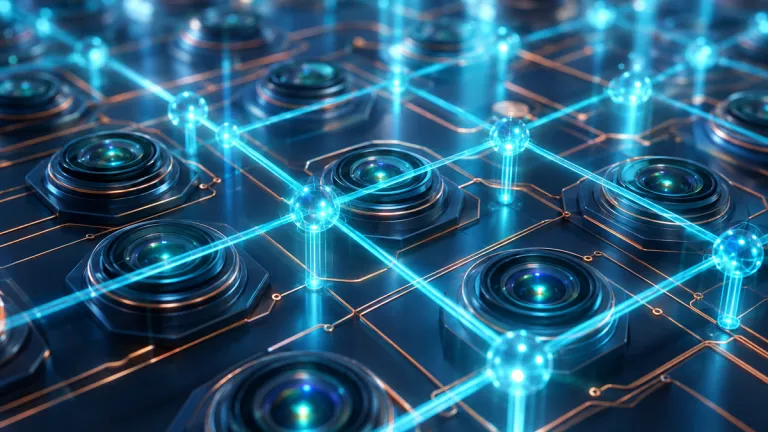
Classical layers in a vision model do matrix multiplications with learned weights. A quantum layer does something different in the middle of that stack. It encodes a feature vector into qubit rotations, applies a parameterised sequence of gates, then measures the circuit and returns expectation values as ordinary numbers to the next classical layer.
Training runs end to end. Gradients through the circuit come from parameter-shift rules or adjoint differentiation, and the classical optimiser updates both classical and quantum parameters together. The quantum part is small: published hybrids tend to use anything from four to a few dozen qubits, because that is what current hardware and simulators can carry.
The memory ceiling on a 16 GB card
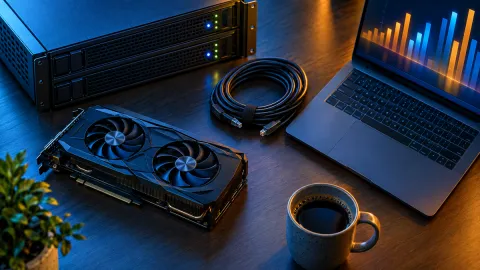
This is where the arithmetic gets useful. Our own AI Arena rig runs an NVIDIA RTX 5060 Ti with 16 GB of VRAM, and a noiseless statevector simulation of a quantum circuit is a memory problem before it is anything else. An n-qubit statevector holds 2n complex amplitudes. With complex128 precision that is 16 bytes per amplitude.
The numbers land quickly. Twenty-eight qubits need 4 GiB. Twenty-nine qubits need 8 GiB. Thirty qubits need 16 GiB exactly, which fills the card with no room left for the classical network's weights, activations or the images themselves. In practice a desktop simulation tops out around 29 qubits, and anything layered on top of a real vision backbone pushes that ceiling down further.
So when a paper describes a quantum layer improving a vision model, the quantum contribution is operating on a small register while the convolutional or transformer part does most of the work. That is not a flaw in the research. It is the current shape of the field, and it changes how the 80.7% should be read.
Spatial reasoning tests relations, not objects
Spatial reasoning benchmarks are built so that recognising objects gets you nothing. The questions are about relations: what is left of what, which shape is behind which, how many items sit above a line, whether two objects touch. A model with perfect object detection and no sense of arrangement will fail most of them.
Which is why the baseline matters more than the score. Eighty percent on a task where a trivial guess scores fifty percent is a different result from eighty percent on a task where the previous best was seventy-eight. The report's 80.7% only becomes a signal once the dataset, the split and the comparison model are on the table.
What a developer can call today
If you need spatial reasoning in a product this month, you buy tokens. The current general-purpose options are well documented, priced in US dollars and billed with EU VAT added on top.
- GPT-6 Astra – $10.00 per million input tokens, $50.00 per million output tokens.
- Gemini 4 Argon – $2.00 input and $10.00 output per million tokens, with cached input discounted by 95%. That is a promotional rate: from 1 December 2026 the same model is listed at $4.00 input and $20.00 output per million tokens, so budget for double.
A hybrid quantum vision model has no equivalent line item. Until someone publishes latency and cost per image, the honest comparison is accuracy against dollars, and only one side of that table exists.
The European rules that apply either way
None of this sits outside regulation. Under the EU AI Act, Article 50 transparency obligations have applied since 2 August 2026: synthetic images, audio, video and text must carry machine-readable marking, and users must be told when they are interacting with an AI system. A quantum layer inside the pipeline changes none of that. The output still needs marking.
The high-risk obligations for Annex III systems slipped to 2 December 2027 after the Digital Omnibus on AI was adopted in mid-2026, following standardisation delays at CEN and CENELEC. For providers of general-purpose models placed on the European market, the duties are already active: systemic risk assessments, full training data copyright documentation and architecture disclosure. The European Commission's AI Act pages hold the current text.
Practical consequence for a European team: if you build a quantum-enhanced vision component into a product, you inherit the documentation duties of whatever you replaced. The novelty of the layer is not an exemption, and "we do not know what the circuit learned" will not pass as a technical description.
Five things to check before trusting the number
- Dataset and split. Name, size, whether the test set was touched during development.
- Classical baseline. Same parameter count, same training budget, same augmentation.
- Qubit count and circuit depth. A depth-50 circuit on 8 qubits is a very different claim from depth-400 on 20.
- Hardware or simulator. Noisy hardware results and noiseless simulation results are not comparable.
- Cost per inference. Milliseconds and euros, not just accuracy.
Two of those five can be tested on a desktop card today with PennyLane or Qiskit on top of a small vision backbone, which is roughly what our Arena rig is for. The classical baseline is the part most teams skip, and it is the part that decides whether a quantum layer earns its place.
Do you need a quantum computer to run a quantum layer?
Not necessarily. Parameterised circuits with a few dozen qubits can be evaluated on a classical statevector simulator, which is how most experiments at this scale are checked. Whether a given result used real hardware or simulation matters, because noise, calibration and queue time all change the cost and the accuracy.
Is this available in the EU?
Not as a product. The report describes a research result with no released weights, API or pricing, so there is nothing to buy in Europe or anywhere else. Any future deployment would fall under the standard EU rules, including Article 50 marking of synthetic output and the documentation duties for general-purpose model providers.
Until the dataset, the classical baseline and the qubit count are public and reproducible, 80.7% remains a figure from one report about one benchmark.