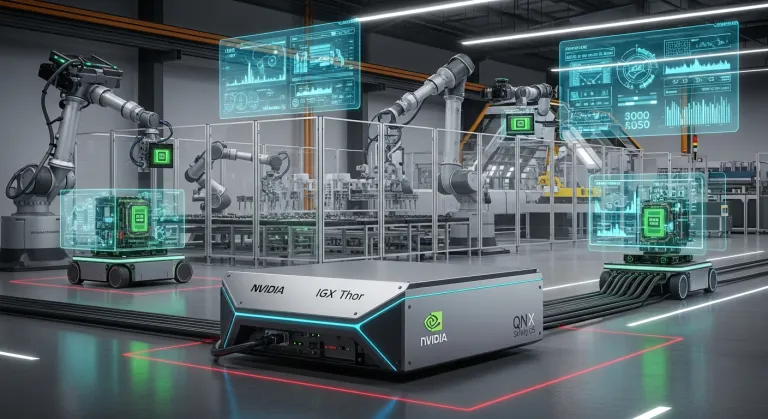
What is QNX and why it matters
QNX is an operating system with over forty years of history, now under the wings of the Canadian company BlackBerry. Unlike Linux distributions, QNX is a so-called **microkernel RTOS** (Real-Time Operating System) — an operating system for real-time work, where individual components are strictly separated from each other. If one part fails, the rest of the system continues to run. This is precisely the feature you need in a hospital robot or an industrial machine where operational interruption is unacceptable.
Today, QNX technology powers devices from **nine out of ten of the world's largest medical device manufacturers**. You'll also find it in the automotive industry, aerospace, and critical infrastructure. Safety certifications like IEC 61508 or ISO 26262, which QNX meets, are mandatory in these industries, not an optional extra.
NVIDIA IGX Thor: Computational Power for the Industrial Edge
**NVIDIA IGX Thor** is a next-generation industrial edge AI platform, built on the Blackwell architecture — the same one that powers the most modern data centers. Compared to consumer electronics, IGX Thor offers **industrial durability**, a 10-year lifecycle with support, and functional safety features. It is designed for deployment directly at the machine or robot, i.e., where it is not possible to wait for a response from the cloud.
The platform belongs to the NVIDIA IGX family (its predecessor was IGX Orin), which combines a powerful GPU accelerator with industrial interfaces and the NVIDIA software ecosystem. The new Thor model brings significantly higher performance for AI model inference — crucial for tasks such as visual perception, trajectory planning, or real-time decision-making.
What the QNX + IGX Thor Integration Brings
At the core of the announcement is the combination of **QNX OS for Safety 8.0** with **NVIDIA Halos Safety Stack** on a unified IGX Thor hardware platform. Technically, this is a so-called *mixed-criticality* approach: deterministic real-time control (under QNX) and computationally intensive AI tasks (under NVIDIA CUDA) run simultaneously on a single chip. These parts are strictly isolated from each other, so a failure or error in the AI model will not jeopardize the safety-critical functions of the system.
Practical impact? Engineers don't have to put together two separate systems — a safety control unit and an AI accelerator — and deal with their communication. Everything runs on one hardware, in one ecosystem, with clear safety guarantees. John Wall, President of QNX, summarized it clearly: *“safety and determinism cannot be an afterthought”* in the development of autonomous systems.
Where it will be actually deployed
The integration targets specific and rapidly growing industries:
- Autonomous Mobile Robots (AMR) — warehouses, logistics centers, production halls. Robots that move among people need guaranteed reaction safety.
- Humanoid Robots — a new generation of robots working in environments designed for humans. Safety guarantees are an existential necessity here.
- Surgical Robotics — operating systems like Da Vinci or their successors require a certified real-time OS. QNX is an established choice in this segment.
- Medical Imaging Technology — CT, MRI, and AI-assisted diagnostics, where real-time image processing combines GPU performance with safety requirements.
- Industrial Automation — production lines with AI quality inspection, predictive maintenance, collaborative robots (cobots).
Hannover Messe 2026: Where Industrial AI is Made
The announcement was made at Hannover Messe 2026, the world's largest industrial trade fair, where manufacturers, integrators, and technology giants gather annually to showcase what the next generation of industry will look like. The choice of this fair is not accidental — QNX and NVIDIA clearly signal that their target market is industrial customers, not typical software developers in the IT sector.
Those interested in testing can register for the **Early Access program** for the NVIDIA IGX Thor Developer Kit with QNX. Specific prices or the general availability date have not yet been announced.
What this means for the Czech Republic and Europe
The Czech and Central European industry is strongly focused on manufacturing and automotive — precisely where autonomous robots and AI systems are deployed in safety-critical environments. Domestic manufacturers and integrators such as Škoda Auto, robotic divisions of industrial companies, or suppliers for the German automotive chain will likely work with these platforms within two to three years.
The regulatory context is also important. The **EU AI Act**, which came into force in 2024 and whose obligations are gradually being activated, classifies AI in medical devices and industrial safety as *high-risk* systems — meaning those subject to the strictest requirements for documentation, testing, and safety guarantees. The integration of a certified OS like QNX directly into an AI computing platform can significantly ease manufacturers' path to compliance with these requirements.
Neither QNX nor NVIDIA have yet specified certifications for particular applications — these depend on the final product and its regulatory context. However, the platform provides a **basis for certification processes**, which is a fundamental difference for industrial customers compared to building their own solution from scratch.
Technical Challenge: AI and Safety on a Single Chip
The key technical challenge that this integration addresses is **deterministic behavior**. AI models — especially neural networks — are inherently statistical: their response can vary slightly, and their computation time is not always precisely predictable. Safety control systems, on the other hand, require absolute guarantees: if I issue a "stop" command, the robot must stop within a precisely defined time.
The QNX microkernel architecture ensures this isolation at the OS level — AI inference runs in a separate space, while the safety loop always has guaranteed priority. The NVIDIA Halos Safety Stack then adds a layer that monitors the behavior of AI components and allows for their safe shutdown or switching to a backup mode.
Is QNX available in Czech or with support for the Czech market?
QNX is an industrial operating system without a language interface for end-users — therefore, localization into Czech is not relevant. For Czech companies, availability through industrial distributors and system integrators in the CEE region is important. NVIDIA and BlackBerry have sales offices in Europe; access to the IGX Thor platform is through a partner program.
How does this platform differ from standard industrial PCs with Linux and GPU?
The key difference lies in safety certifications and deterministic behavior. While Linux offers real-time extensions (PREEMPT_RT), its microkernel isolation and certification records for medical or industrial standards (IEC 61508, ISO 26262) are significantly weaker than those of QNX. For products that must undergo regulatory approval in the EU or USA, a certified foundation like QNX is practically a necessity.
When will the platform be available and how much will it cost?
In April 2026, an Early Access program for the NVIDIA IGX Thor Developer Kit with QNX was launched for selected customers. General availability and prices have not yet been officially announced. Industrial platforms of this type typically range in the thousands of dollars per unit; the final price depends on configuration and order volume.