Photons instead of electrons: what makes PsiQuantum different
While Google and IBM have bet on superconducting qubits made of aluminum and Intel is trying electron-based qubits, PsiQuantum is taking a third path. Its fundamental building block is photons — particles of light. And this very choice may be the key to why the company believes it will be the first to build a quantum computer capable of solving practical problems.
"Photons have many advantages," says co-founder Terry Rudolph. They can maintain a quantum state for an extraordinarily long time — photons in the cosmic microwave background have held it for billions of years. Moreover, they are resistant to heat and electromagnetic interference, which means there is no need to cool the entire system to temperatures near absolute zero. Only the detectors that measure the final state of the photons at the end of the calculation need to be cooled.
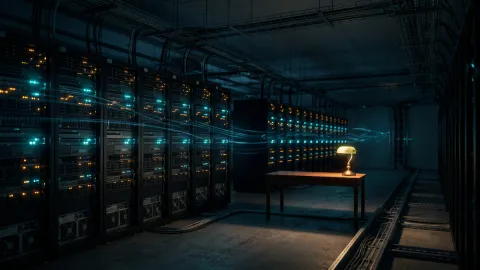
That is a fundamental difference from the competition. While superconducting quantum computers must run at temperatures around −273 °C and most of the operating costs are consumed by cooling alone, PsiQuantum's photonic approach is significantly more economical in this regard. Inside stainless steel cabinets — resembling a cross between a data center and an ice cream factory — thousands of photons flow through a maze of optical switches and beam splitters.
The grandson of Schrödinger and three academics from Britain
The company was founded by four physicists from British universities, who created the firm in 2016. The most interesting figure is Terry Rudolph — an unassuming, shaggy-haired scientist who only learned after completing his first physics degree that he was the grandson of Erwin Schrödinger, one of the fathers of quantum mechanics. He even wrote a 150-page book explaining quantum computers for teenagers.
The quartet divided the tasks: Rudolph works on theory, Mark Thompson on engineering, Pete Shadbolt on scaling the technology, and Jeremy O'Brien — until recently the CEO — raised investors. Since February 2026, the company has been led by Victor Peng, a semiconductor industry veteran, signaling that PsiQuantum is moving from the research phase into industrial production.
A billion dollars, the Pentagon, and its own crystal factory
PsiQuantum's ambitions don't come cheap. Last year, the company raised one billion dollars in an investment round and has another 100 million dollars pledged from the U.S. CHIPS Act. The Pentagon's research agency DARPA has placed PsiQuantum in the third phase of its evaluation program — as one of only two companies (alongside Microsoft) to make it that far.
"I'm more optimistic than I've been at any point in the last ten years," said Joe Altepeter, former head of DARPA's quantum program. His successor Micah Stoutimore added: "It seems likely that someone will build a useful quantum computer by 2033."
PsiQuantum isn't waiting. In the city of Moreton Bay in Queensland, Australia, construction was ceremonially launched this June, and a second campus is being built in the Illinois Quantum & Microelectronics Park near Chicago. The chips are manufactured at the GlobalFoundries factory in New York state — leveraging the existing semiconductor infrastructure into which the world has invested trillions of dollars.
The crystal that will change the game
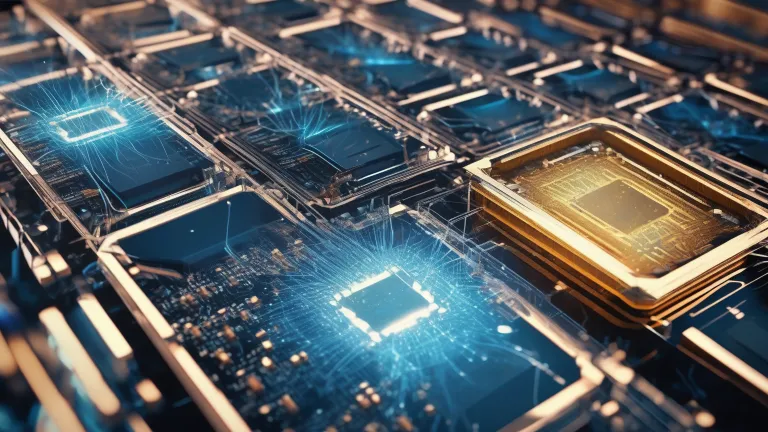
A key component of the technology is a material called barium titanate. This bluish crystal can quickly and reliably route light particles with minimal electrical input, so the fragile photons remain undisturbed during their journey through the circuit. But producing it is a nightmare — the crystal structure is difficult to grow, and the material was not available on the market at the required scale.
PsiQuantum therefore decided — painfully, according to Rudolph — to produce barium titanate in-house. In a lab in San Jose, technicians use equipment resembling a giant pressure cooker to heat the basic elements until they crystallize into a thin layer on a silicon wafer. Each disc used to take 12 hours to produce; today, the company makes several per day.
From enzymes to batteries: what it's all for
What practical problems should a light-based quantum computer solve? PsiQuantum has a clear vision. In collaboration with the pharmaceutical industry, it aims to simulate cytochrome P450 enzymes, which break down drugs in the body. When pharmaceutical companies precisely understand their behavior, they can design more effective drugs faster. Today, estimating this for a specific drug takes over ten years — PsiQuantum promises four minutes.
Among the first customers are Lockheed Martin (materials design), Mercedes (battery design), and Airbus (aerodynamics). The company has also launched a software platform called Construct, which it made freely available to all developers. It enables the design of quantum algorithms even before the hardware they will run on exists.
What it means for AI and why the Czech Republic should care
For readers interested in artificial intelligence, the key connection is this: quantum computers could dramatically accelerate AI model training, neural network optimization, and the solving of combinatorial problems that today's LLMs struggle with. While GPT-5.5 or Claude Fable 5 consume megawatts of electricity in giant data centers, quantum calculations could theoretically do the same work with a fraction of the energy.
For Europe and the Czech Republic, the development of quantum technologies is of strategic importance. The European Union is investing over one billion euros in quantum research through the Quantum Flagship initiative, and the Czech AI Factory is already operating in Ostrava as part of the European supercomputing network. Quantum computers could become the next tier of this infrastructure. Several Czech research groups — for example at CTU, Palacký University in Olomouc, or CEITEC in Brno — are actively working on quantum technologies.
Will light make it to the end of the tunnel?
PsiQuantum claims that its Australian facility will be "operational" by the end of 2027. That doesn't mean a finished quantum computer will be running there — it means the cooling systems and infrastructure for hardware installation will be ready. Exactly when the hundred stainless steel cabinets will start churning out answers to questions that today's computers can't solve remains an open question.
Scott Aaronson, a theoretical computer scientist at the University of Texas, warns that evaluating PsiQuantum from the outside is exceptionally difficult. Unlike Google or Quantinuum, which regularly publish incremental results and gradually unveil larger and larger chips, PsiQuantum is more of a black box. It's betting everything on a single card — building an outright million-qubit machine, which researchers estimate is what it takes to deliver practically useful results.
Whether it works out or not, one thing is certain: the race for the first useful quantum computer is transforming from an academic curiosity into an industrial showdown with billion-dollar stakes. And PsiQuantum is definitely not an underdog in it.
What is a quantum computer good for if it's not meant to replace a regular laptop?
A quantum computer is not a replacement for a classical PC. It is a specialized machine for solving narrowly defined problems — mainly simulating chemical reactions, optimizing complex systems, or factoring large numbers. Everyday tasks like email or web browsing won't run on it.
Why does PsiQuantum use light when the competition bets on superconductivity?
Photons don't interact with heat or electromagnetic interference, so extreme cooling of the entire system isn't necessary. Moreover, they can be interconnected with optical fibers that are already commonly used in data centers. This significantly simplifies scaling to larger numbers of qubits.
Could a quantum computer threaten bitcoin or internet security?
Theoretically, yes — Shor's algorithm allows a quantum computer to break RSA encryption, on which a large part of internet security relies. Fortunately, new encryption standards resistant to quantum attacks are already being developed, and PsiQuantum itself is investigating how long it would take its system to run Shor's algorithm. There is no need to panic yet.