Classrooms without screens
Several metro school districts started the 2026–2027 academic year with bell-to-bell bans on personal electronic devices — phones, smartwatches and earbuds alike. The policy is straightforward: from the first bell to the last, devices stay off and out of sight. Pupils who need one for medical reasons get an exemption; everybody else learns to live without the urge to check notifications between classes.
The rules extend beyond the school gate. Kansas now fines drivers $60 (about €55) for holding a phone in active school and construction zones, a law timed to take effect as students returned. Police will hand out only warnings until July 2027, but the signal is clear: the school day is now officially a screen-free zone.
At the same time, districts published updated guidelines on how students and teachers may use AI in class. The same week that artificial intelligence was welcomed as a learning tool, it was banned as a pocket distraction. That contrast is telling.
The camera that detects the weapon
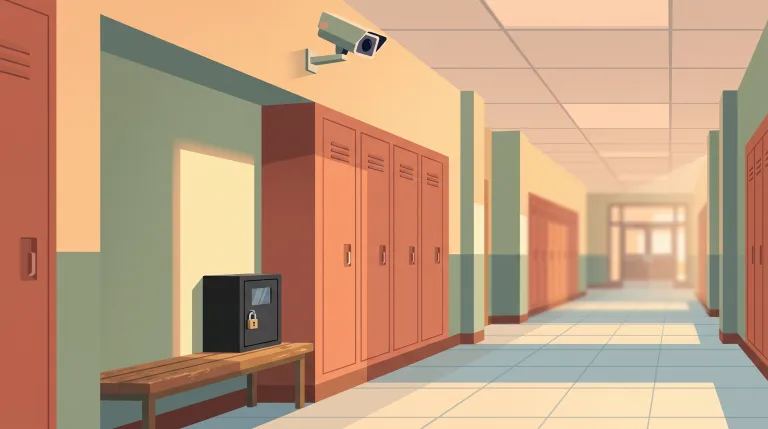
The more consequential change is less visible. The Bonner Springs-Edwardsville school district has switched on ZeroEyes, an AI security system integrated into existing campus cameras. According to local reporting cited by KCTV, the software can detect an unconcealed firearm in three to five seconds and alert authorities. The Kansas Attorney General's office is funding such deployments across the state with a $10 million grant.
ZeroEyes was founded by former Navy SEALs after the 2018 shooting at Marjory Stoneman Douglas High School in Parkland, Florida. The technology scans feeds that schools already record, so districts get a weapon-detection layer without installing new hardware. As with any detection system, accuracy is everything: a false alarm that sends police racing to a school is not harmless. The company runs a staffed operations centre that reviews detections before law enforcement is contacted.
Why the same software would travel badly across the Atlantic
Here is where the story splits for European readers. The EU AI Act, which reached full enforcement this August — the very month Kansas students returned — treats school security AI as a high-stakes system. It requires mandatory risk management, technical documentation and human oversight for high-risk applications. Critically, the obligations apply not only to European developers but to any provider placing such a system on the EU market.
GDPR adds a second layer. Continuously analysing video of school corridors is a textbook case for a data protection impact assessment; children's data enjoys special protection under EU law, and a school would have to prove that constant monitoring is proportionate to the threat. The EU rulebook does not ban this kind of software outright, but it turns deployment from a purchase into a process. Violations can cost up to €35 million or 7% of worldwide turnover for the most serious breaches.
Two continents, same instinct, different paperwork
Europe is not foreign to the anti-phone mood. France banned classroom phones back in 2018; the Netherlands restricts devices in secondary schools. But when the topic moves from pocket distraction to AI surveillance, Brussels and individual member states become visibly more cautious. A European district considering AI security cameras would buy compliance paperwork along with the licence: legal opinions, staff consultation, audit trails.
That is slower and more expensive, and it is a large part of why no direct European equivalent of Kansas's $10 million grant story exists. Our ongoing coverage of AI in education shows the same pattern across the continent: schools adopt AI where it is transparent and limited, and hesitate where it watches people.
As a parent, I admit the Kansas approach has a certain appeal. Someone watching the camera feed who can send help within seconds — what is not to like? But the EU framework forces a question worth answering before, not after, the cameras go live: who decides what the software may look for, and who verifies that it works as promised? Kansas is about to find out, because its schools are already running the experiment. Europe gets to watch, and to decide later — with the benefit of data that did not exist when the EU AI Act was written.
How does the AI tell a real gun from a water pistol?
ZeroEyes is trained to recognise unconcealed firearms in existing camera feeds. No detection system is perfect, so alerts go to a staffed operations centre where a human reviews the footage before police are contacted.
Could a European school simply switch on similar software on its current CCTV?
Not quickly. GDPR requires a data protection impact assessment for systematic monitoring, and the AI Act adds high-risk duties: risk management, documentation and human oversight. Realistically, that means months of legal and staff consultation — which is why most EU districts have not rushed.
Why ban smartwatches along with phones?
Because a watch can text, browse and record audio, and would otherwise become the loophole a phone-in-a-bag leaves open. Kansas's $60 traffic fine applies separately to drivers holding a phone in school and construction zones.