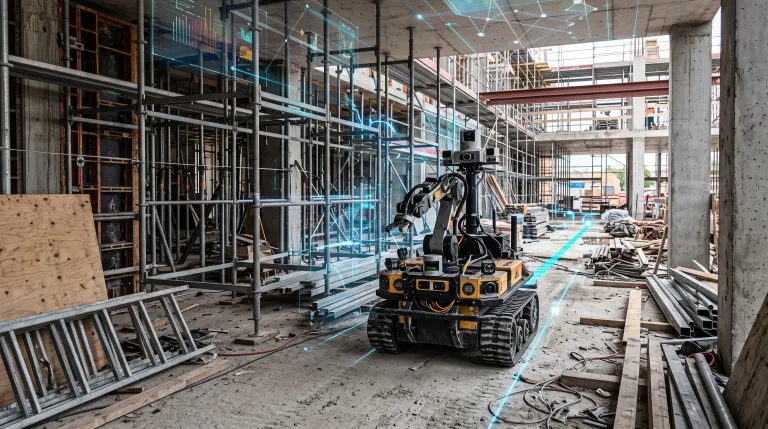
What Nextera Robotics actually does
Nextera Robotics, founded in Boston, produces the Didge™ platform — a system of autonomous mobile robots equipped with 360-degree cameras and AI-powered analytics software. The robots navigate construction sites daily, capturing high-resolution images of every room, floor, and corner. The AI then processes this visual data to provide four core functions:
- Safety monitoring — detecting fall hazards, missing PPE, trip hazards, and unsafe worker behaviors in near real time
- Quality control — comparing installed work against design models, flagging deviations, code violations, and missing installations
- Progress tracking — automatically calculating work-in-place percentages per trade and detecting schedule slippage before it escalates
- Digital documentation — generating automated reports, interactive dashboards, and integrating with tools like Procore, Autodesk, and Oracle
The platform is already deployed on active job sites, including a well-documented 31-story residential tower in Seattle built by Skanska, where it was covered by NPR's KUOW affiliate. The project's senior engineer told KUOW the robot "wasn't very thrilling" as a replacement for the soul-crushing daily routine of photographing hundreds of rooms by hand — and that was exactly the point. The Didge robots freed the engineering team from an estimated dozens of hours per week of manual photo documentation, letting them focus on actual problem-solving.
More recently, Nextera has expanded into hyperscale data center construction, with deployments on fast-paced, multi-crew builds across the United States, according to Nextera's project updates. Data center builders — operating under brutal timelines where every day of delay costs seven figures — are emerging as some of the most aggressive adopters of construction AI.
Why Oshkosh wrote the check
The investment is not a random diversification play. Oshkosh Corporation owns JLG Industries, the world's largest manufacturer of mobile elevating work platforms (MEWPs) and telehandlers. JLG's ClearSky Smart Fleet™ platform already provides telematics and fleet management for connected equipment. Adding Nextera's job site intelligence layer — real-time visual monitoring, AI-powered progress analytics, safety alerts — turns a fleet management dashboard into something closer to a digital twin of the entire job site.
Jay Iyengar, Oshkosh's CTO, framed it clearly in the press release: "The future of construction isn't defined by connected equipment alone; it's defined by connected job sites, where intelligent machines, autonomous robotics and AI-powered insights work together to improve safety, productivity and project execution."
Oshkosh also confirmed it will showcase its growing robotics and automation portfolio at CES 2027. That's a revealing choice — CES has become the auto industry's second auto show, and increasingly the venue where industrial companies telegraph their tech ambitions to investors rather than just end-customers.
What we know, what we don't
Oshkosh did not disclose the investment amount. The language is "strategic equity investment," which typically means a minority stake — enough to get board observer rights or a seat, but not an acquisition. Given Nextera's size (a Boston startup with real deployments but not yet a household name in construction tech), the investment is likely in the tens of millions, not hundreds. For context, Oshkosh reported $183.2 million in net income in Q2 2026 alone, so this is a strategic bet, not a bet-the-company move.
The press release also uses careful language about scope: "While this investment is initially focused on the job site of the future, we believe these capabilities have the potential to create value across the Oshkosh portfolio over time." That's a hint that Nextera's AI could eventually find its way into Oshkosh Defense, Pierce fire apparatus, or airport equipment — all verticals where autonomous monitoring and AI-powered situational awareness have obvious applications.
European angle: where this matters for the EU
Oshkosh products reach more than 150 countries, and JLG has a substantial European footprint — including manufacturing facilities in Maasmechelen, Belgium and Tonneins, France, plus distribution and service centers across the continent. When Oshkosh integrates Didge-level AI into its European equipment ecosystem, the implications ripple through the EU's construction sector, which employs roughly 18 million people and generates about 9% of EU GDP.
Three things European readers should watch:
1. AI Act classification. Autonomous mobile robots operating on active construction sites — where they navigate around human workers, heavy machinery, and changing environments — almost certainly fall under the EU AI Act's high-risk category (Annex III, safety components). That means Didge-like systems deployed in the EU will need conformity assessments, human oversight mechanisms, and technical documentation. Nextera (or Oshkosh) will need to navigate this before any European deployment. No public timeline exists for that yet.
2. Construction labor crisis. The EU construction sector faces an acute labor shortage. Eurostat data shows the EU construction workforce has been shrinking since the 2008 financial crisis, with some member states reporting vacancy rates above 4% in construction. AI-powered tools that multiply the productivity of remaining workers — a robot doing the photo walks so engineers can spend their time on higher-value tasks — address a genuine structural problem, not a manufactured use case.
3. European competition is thin. While Europe has notable construction-tech startups (Denmark's ROBOTLAB, Germany's KEWAZO for scaffolding logistics, Switzerland's ANYbotics for industrial inspection), the market for AI-driven, full-coverage construction site intelligence platforms is largely dominated by North American players. Nextera's closest European analogue might be Doxel (US-based but with international deployments) or Buildots (Israel/UK, using hardhat-mounted cameras rather than autonomous robots).
The bigger picture: construction's AI moment
Construction has historically been among the least-digitised sectors — McKinsey regularly ranks it second-to-last, ahead of only agriculture. But the combination of labor shortages, margin pressure, and now functional AI is changing the calculus fast.
A few data points: The global construction robotics market was estimated at roughly $50–60 million in 2024 and is projected to grow at 15–20% annually through 2030. The ROI math on Didge is straightforward — if a robot costs less than the labor hours it replaces plus the rework it prevents, the purchase makes sense. On the Seattle Skanska project, the robot was described as paying for itself by preventing a single major rework incident.
Oshkosh's move also fits a pattern. Larger industrial companies are increasingly buying — rather than building — their AI capabilities. Caterpillar invested in SafeAI for autonomous mining trucks. Komatsu acquired MineWare for data analytics. John Deere bought Blue River Technology for computer-vision-based precision agriculture. The construction equipment sector is following the same playbook: acquire the AI layer rather than trying to build it from scratch.
For Nextera, the Oshkosh partnership means distribution at a scale that a Boston startup could never achieve on its own. JLG's global dealer network and existing relationships with major contractors give Didge a direct path into commercial deployment that would otherwise take years of enterprise sales grinding.
Can Didge robots be used on European construction sites today?
Technically, yes — Nextera's robots are hardware-agnostic autonomous platforms and could operate on any construction site with appropriate floor surfaces. Regulation is the bottleneck. Didge would need to comply with EU machinery safety directives, GDPR (it collects visual data of workers), and likely the EU AI Act's high-risk category requirements. Oshkosh/JLG's existing European presence and regulatory infrastructure — they already sell CE-marked equipment in the EU — gives them a pathway that a standalone startup would struggle to navigate.
What's the difference between Didge and a drone inspection?
Drones are useful for exterior and roof-level surveys, but they cannot operate indoors across multiple floors, navigate around workers and temporary structures, or capture the consistent, room-by-room perspective needed for quality control and progress tracking. Didge's ground-based robots operate inside buildings, on unfinished floor surfaces, and in spaces where drones are impractical or illegal. Some projects use both — drones for the exterior, Didge for the interior — but the capabilities are complementary, not competitive.
Is this actually AI, or just a camera on wheels?
The robot is the data-collection layer. The AI component — which Nextera describes as vision-based and analytics-driven — processes thousands of daily images to detect deviations from design models, identify safety hazards, track installation progress across trades, and generate automated reports. The claim that it "spots quality issues early and prevents expensive rework" is the AI value proposition, and it's verifiable: on the Seattle Skanska project, Didge was reported to flag ductwork and sprinkler installation errors that didn't match the building's BIM model. That kind of cross-referencing at scale isn't practical without machine learning.