Today's announcement, brought by the CNBC portal, represents a significant shift in how the largest players in the field of artificial intelligence are trying to secure computing capacity for training and operating their models. The Stargate project, which is intended to serve as a pillar for future generations of AI, is now undergoing reconfiguration, in which Microsoft plays a primary role.
End of direct cooperation with Nscale
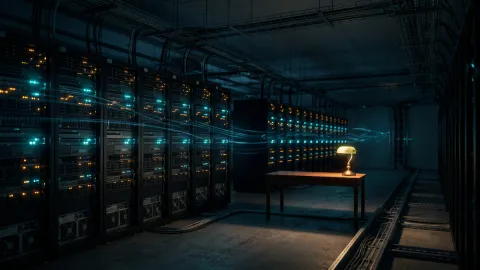
The original plan was based on OpenAI directly utilizing the capacity of data centers operated by the British company Nscale in Norway. Nscale specializes in providing cloud services optimized for AI, which includes massive clusters of graphics processing units (GPUs) that are essential for computations demanding the training of large language models (LLMs).
However, OpenAI's decision to withdraw from this partnership does not mean that the infrastructure in Norway will not be utilized. On the contrary, the remaining capacity that OpenAI originally planned to occupy will be taken over by Microsoft. According to available information, OpenAI and Microsoft are in active negotiations regarding OpenAI renting this capacity directly from Microsoft, rather than through third parties. This step simplifies the supply chain but also increases OpenAI's dependence on its largest investor.
Why is Norway key?
The selection of Norway for these massive data centers was not accidental. Two factors are critical for AI infrastructure: energy and cooling. Norway offers:
- Cheap and sustainable energy: Thanks to massive hydroelectric production, Norway has a stable and relatively cheap energy source, which is economically and ecologically sustainable for operating thousands of GPUs.
- Natural cooling: The cold climatic conditions in the northern latitudes significantly reduce the costs of cooling servers, which is a crucial technological challenge for high-power-density data centers.
Technical impact: What is "compute capacity"?
For laypeople, the term compute capacity may sound abstract. In the context of AI, it refers to the sum of the power of all processors (especially GPUs, such as NVIDIA H100 or newer models) capable of performing billions of mathematical operations per second. The higher this capacity, the faster more complex models can be trained and the lower the latency (response time) will be when generating answers for the end user.
In comparison with the competition, OpenAI models (e.g., GPT-4o) still show top results in the MMLU (Massive Multitask Language Understanding) benchmark, although competitors like Claude 3.5 Sonnet from Anthropic or Gemini 1.5 Pro from Google are starting to catch up in some specific tasks, such as programming or logical reasoning. Securing stable and massive capacity through the Stargate project is key for OpenAI to maintain its technological lead.
Impact on the European and Czech market
Although discussions about data centers take place within a global strategy, for the European environment, this has specific consequences. The first is digital sovereignty. If the AI infrastructure in Europe (in this case in Norway) is primarily controlled by American corporations, the region's dependence on their decisions increases.
From a regulatory perspective, the EU AI Act is key here. The European Union places great emphasis on safety, transparency, and data protection. For Czech companies that integrate AI into their processes, this means they must monitor where data is processed and how it is secured in accordance with GDPR. The selection of Norwegian infrastructure, which is part of the European Economic Area, may be an advantage for compliance with European standards.
What does this mean for the average user in the Czech Republic?
For you, a ChatGPT user in the Czech Republic, this change in the background will not directly manifest as a change in the interface or functionality. However, it may affect the stability and speed of services. If Microsoft effectively integrates the Stargate capacity, we can expect faster model responses and smoother availability even during peak times. OpenAI services are fully available in the Czech Republic, including Czech localization, and prices remain the same:
- ChatGPT Free: Free (limited access to the latest models).
- ChatGPT Plus: 20 USD per month (approx. 460 CZK) – full access to the latest models and priority availability.
- ChatGPT Team/Enterprise: Individual pricing for companies, focused on higher data security.
Conclusion: Consolidation of power
This shift in the Stargate project shows that the era of fragmented cloud services for AI may be closing for the largest players. OpenAI has decided on vertical integration with Microsoft, creating a closed ecosystem with enormous computing power. For the market, this means that the barrier to entry for new players who do not have access to similarly massive infrastructure will continue to rise.
Will this decision change the availability of ChatGPT in Czech?
No, this decision only concerns the background infrastructure (hardware and data centers). Functionality, language support, and application availability for users in the Czech Republic remain unchanged.
Why didn't OpenAI want to work directly with Nscale?
Although Nscale offers quality services, OpenAI likely decided on the strategic advantage of collaborating with Microsoft. Microsoft offers not only capacity but also the entire Azure platform, which allows OpenAI to better integrate their models into existing cloud infrastructure.
Does this project affect the privacy of my data within the EU?
The use of Norwegian infrastructure is in accordance with European standards. The key factor for privacy remains how OpenAI (or Microsoft) manages your data within its privacy policies and in accordance with GDPR and EU AI Act regulations.