Summit in India and the viral moment of refusal
It was February 19, 2026, in New Delhi, at the AI Impact Summit. Indian Prime Minister Narendra Modi stood in the middle of a group of the world's most influential tech leaders, trying to arrange a group photo as a symbol of unity. Sam Altman of OpenAI and Dario Amodei of Anthropic stood side-by-side — and refused to hold hands with each other.
While Sundar Pichai of Google and other leaders joined without hesitation, Altman and Amodei instead raised closed fists into the air. The video immediately spread across social media. Commentators called it a "cringe masterpiece" and a perfect visual metaphor for the state of the AI industry. Altman later tried to downplay the situation: "Modi grabbed my hand and raised it — I just wasn't sure what exactly was expected of me."
But the context was too clear for such an apology to be convincing. Just weeks before, one of the sharpest public skirmishes in the history of both companies had taken place.
Super Bowl and the ad war
At Super Bowl 2026, Anthropic launched an advertising campaign called "A Time and a Place" — four ads, each opening with a loaded word: "betrayal," "deception," "treachery," "violation." The scenario was always the same: an AI assistant helps a user with an important task, only to be interrupted by an unsolicited advertisement. The conclusion was explicit: "Ads are coming to AI. But not to Claude."
A direct jab at OpenAI, which was testing ads in ChatGPT at the time. Altman reacted publicly and angrily — calling Anthropic "clearly dishonest" and the campaign "doublespeak." Amodei remained silent. The tension was palpable.
Rivalry has deep roots
To be clear: this rivalry didn't emerge overnight. Dario Amodei worked at OpenAI from 2016 to 2020 as Vice President of Research. According to Wikipedia and publicly available information, he participated in the development of GPT-2 and GPT-3 — models that laid the foundations for today's ChatGPT. In 2021, he left OpenAI along with dozens of other researchers due to disagreements over the company's safety philosophy and direction, and co-founded Anthropic.
Ironically, Anthropic today employs over 2,500 people and has raised funding exceeding 30 billion dollars. The company, which started as an alternative to OpenAI, has become its biggest competitor. And their models — Claude on one side, GPT on the other — are fighting for every percentage point in benchmarks.
On SWE-Bench Verified (testing real software tasks), Claude Opus 4.6 scores 80.8% compared to 77.2% for GPT-5.4. On other benchmarks, GPT leads. The rivalry is real — and technically substantiated.
But their models got a different script
And here comes the truly interesting part. While company heads wage marketing battles and refuse to shake hands at top diplomatic meetings, experimenters across the internet are doing something different: they're letting models from both companies talk to each other.
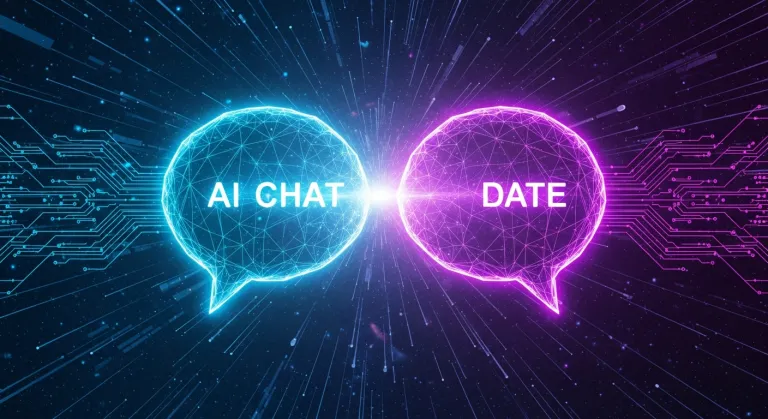
A viral Reddit post titled "OpenAI & Anthropic's CEOs Wouldn't Hold Hands, but Their Models Fell in Love In An LLM Dating Show" captured this paradox perfectly. In a "dating show" format experiment — where various AI models are put into conversation and compete for affection — GPT and Claude did not act like rivals. They cooperated, acknowledged each other's strengths, and complemented each other.
This is not an isolated case. The platform MultipleChat allows exactly this: putting different LLM models into one conversation where they respond to each other and build a common answer. Research from 2025 published in the scientific journal Cognitive Science analyzed dialogues between GPT-4 and Claude — and found that the models in conversation achieve surprisingly coherent and constructive discourse, far more natural than a battle.
Similarly, the dataset CounseLLMe showed that GPT and Claude can collaboratively simulate therapeutic conversations — and the result was in many ways better than from each model individually.
What does this say about the nature of AI models?
Here we get to a more philosophical level. AI models like GPT or Claude do not have rivalry hardcoded. They don't know they are products of rival companies. They have no ego, ambitions, or investors to whom they must prove market dominance. Their "personality" is the result of training on texts — and a large part of these texts is full of cooperation, dialogue, mutual respect.
Research from the Johnson Lee lab from February 2026, which examined the behavior of models in debates, showed that more powerful models (Claude, GPT, Gemini) tend to find common ground and avoid unnecessary confrontation — while humans escalate under similar conditions.
The paradox is thus sharp: the people who created the models behave belligerently. The models themselves behave diplomatically.
What does this mean for users in the Czech Republic?
For ordinary users, this debate is interesting from a practical point of view. Both models are available in Czech — ChatGPT via chat.openai.com (free tier with GPT-4o, paid Plus for approximately 20 USD/month), Claude via claude.ai (free tier with Claude 3.5 Sonnet, Pro plan for 20 USD/month). Both have Czech localization, both respond to Czech queries comparably well.
The rivalry between companies should not have a big impact on model selection — what matters more is what you need a specific model for. Claude traditionally excels in long texts and analytical thinking, GPT in multimedia tasks and broader tool integration. The most sensible approach? Work with both — exactly as in the experiments where they cooperated.
Rivalry is a business strategy, not a technical necessity
The story from India and the viral LLM dating show reveal an important distinction: the rivalry between OpenAI and Anthropic is a human, corporate, market phenomenon. The models themselves carry no rivalry — and when we let them "talk to each other," the results are surprisingly harmonious.
Of course, this "harmony" of models is largely an artifact of their design — they are trained to be helpful and cooperative. But it is still an interesting signal: while company heads fight for market share, their creations may be showing a different way to exist in a space shared by competitors.
And what will happen next time Modi raises his hand for a group photo? That remains an open question.
Why did Dario Amodei leave OpenAI and found Anthropic?
Amodei worked at OpenAI as Vice President of Research from 2016–2020 and participated in the development of GPT-2 and GPT-3. He left due to disagreements over the company's safety philosophy and direction — a number of other researchers left with him. In 2021, he co-founded Anthropic as a company with a stronger emphasis on AI safety.
Can GPT and Claude be used together or allowed to "talk to each other"?
Yes. Platforms like MultipleChat (multiple.chat) allow multiple AI models to be involved in one conversation at once. Each model responds to the query separately, and the results can be compared or merged. Research shows that models cooperate surprisingly constructively in such a setup.
Which model is better for Czech users — GPT or Claude?
Both models support Czech and both are available for free in their basic versions. Claude traditionally handles long documents and analytical tasks better, while GPT excels in multimedia capabilities and broader tool integration. For most users, the best strategy is to try both and use the one that proves better for a given purpose for different tasks.