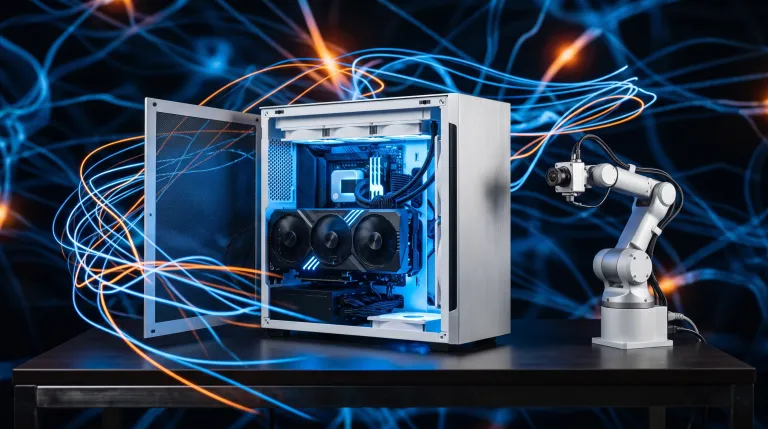
The NVIDIA community showcase announcement is straightforward: throughout August 2026, NVIDIA and its open-source partners are presenting models, libraries and tools for building and running intelligent agents locally. No mandatory cloud round-trip, no per-token invoice — just a GPU, open weights and enough unified memory to hold the model.
That is a bigger deal than it sounds. For most of this decade, "local AI" meant small chat models that were fun but not particularly useful. The new generation is built for multi-step execution: writing and fixing code, generating video with synchronized audio, planning robot movement, and holding a million tokens of context while doing it.
Five models, one theme: agents without the cloud
The showcase covers everything from embedded robotics to data-center serving. Here is the map:
| Model | Size | Active params | Context | Target hardware | Purpose |
|---|---|---|---|---|---|
| Cosmos 3 Edge | 4B | 4B | — | DGX Spark, Jetson | Robotics & vision world model |
| MiniMax-H3 | 33B | — | — | Local GPU via ComfyUI | Video + synchronized stereo audio |
| Laguna S 2.1 (Poolside) | 118B | — | — | 1× DGX Spark (NVFP4) | Coding agent |
| DeepSeek-V4-Flash | 284B MoE | 13B | 1M tokens | DGX Spark-class | General-purpose agent |
| Nemotron 3.5 Lightning | 30B MoE | 3B | 1M tokens | Mid-range GPU | Hybrid SLM / edge agent |
| Nemotron 3 Super | 120B | 12B | — | Data center | High-throughput serving |
Cosmos 3 Edge: a world model inside the robot
At 4 billion parameters, Cosmos 3 Edge is one-quarter the size of Cosmos 3 Nano and is designed to run on DGX Spark and Jetson directly in the machine. For European robotics and manufacturing SMEs, that is the difference between a system that works on the factory floor and one that depends on a reliable link to a cloud. Running camera data through an on-device world model also keeps the sensor stream on-site — a property that simplifies GDPR handling even if NVIDIA does not market it that way.
MiniMax-H3: local video that is not silent
MiniMax-H3 packs 33B parameters and generates video with synchronized stereo audio, runnable through ComfyUI. Video generation has been the most cloud-locked category in generative AI; a 33B model doing audio-visual work on your own GPU makes content pipelines rethink their infrastructure entirely. It also lands squarely in EU AI Act territory — synthetic video is synthetic video, wherever it was rendered.
Laguna S 2.1: a 118B coding agent on one desk
Poolside's Laguna S 2.1 is the showcase's "is that even possible?" moment: 118B parameters running on a single DGX Spark using NVFP4 4-bit quantization. The arithmetic is quick: at 4 bits, 118B parameters weigh roughly 59 GB — comfortably inside DGX Spark-class unified memory, and impossibly far from a 16 GB gaming card. So "runs locally" is real, with the honest caveat that "local" now includes a serious desktop appliance.
DeepSeek-V4-Flash: the 1M-context workhorse
The refreshed DeepSeek-V4-Flash is a 284B Mixture-of-Experts model with only 13B active parameters, a 1-million-token context window, and free open weights. Quantized to 4-bit, the full model file is roughly 140 GB, so this is not a consumer-card model. But because each token touches only 13B parameters, a model this size is actually usable without a data center. For EU enterprises, the 1M context is the practical hook: entire contract frameworks, technical documentation, or a year of support tickets in a single window.
Nemotron 3.5 Lightning and Super: hybrid-state efficiency
Nemotron 3.5 Lightning uses a hybrid Mamba-2 + Transformer MoE design with 30B total and 3B active parameters, plus a 1M context. At 4-bit, that is about 15 GB — borderline territory for the 16 GB RTX 5060 Ti in our AI Arena benchmark rig, and we would want to measure real tokens/sec before promising anyone a smooth ride. Still, a 30B model with a million-token context is the most realistic "prosumer" agent candidate in the lineup.
Nemotron 3 Super (120B total, 12B active) is the data-center sibling. NVIDIA claims up to 5× higher throughput than previous models — a serving metric, but it shows where the architecture is heading: more agents per GPU, not bigger GPUs for one agent.
Why this hits differently in Europe
Since August 2, 2026, the EU AI Office holds binding enforcement powers over general-purpose AI. Under Article 50 of the AI Act, deepfakes need machine-readable watermarking, interactive chatbots must disclose that users are talking to AI, and GPAI providers carry compliance documentation duties. The AI Office can run model evaluations, demand information, order risk mitigations, recall models, and impose fines.
For a European company, the practical effect is that every prompt sent to a foreign API becomes part of someone else's processing chain — a GDPR consideration that the new AI Office powers sharpen considerably. Running open-weight models on your own hardware changes the equation: data stays local, the DPIA is simpler, and the compliance conversation shifts from auditing a vendor to labelling your own outputs.
Two caveats. First, "local" is not "exempt": if you deploy an interactive chatbot for the public, the AI-disclosure duty applies no matter where the model runs. If your MiniMax-H3 pipeline produces synthetic video for clients, that output needs the watermark. Second, the EU Digital Omnibus pushed high-risk system obligations to late 2027, so the immediate pressure is on GPAI and Article 50 duties — which is exactly the part these local agents touch.
What to do with this wave
- Developers with a 16 GB GPU: the realistic entry point is the 30B class. Nemotron 3.5 Lightning's ~15 GB footprint at 4-bit is the one that might fit; 100B+ models need DGX Spark-class memory, no way around it.
- Companies: two extremes from the showcase map directly to production. Laguna S 2.1 keeps code generation entirely on-premises; Cosmos 3 Edge puts world modeling inside the robot. Both shrink the data-residency surface compared to API-based alternatives.
- Media teams: local video-plus-audio generation is here. Budget for the labelling workflow, not just the GPU, because Article 50 applies to synthetic media regardless of where it was rendered.
None of this is magic. It is open weights plus NVFP4 quantization plus a lot of clever architecture — and unlike most vendor showcases, it is verifiable on your own hardware. That is the part we like most: in a field full of impressive demos, this one actually lets you check the claims. We intend to.
Which of these models can I actually run on a gaming PC?
The honest starting point is the 30B class. Nemotron 3.5 Lightning has 30B total parameters — at 4-bit quantization that is roughly 15 GB plus context overhead, so a 16 GB card is borderline and a 24 GB card is comfortable. The 118B Laguna S 2.1 needs around 59 GB, which is why NVIDIA demonstrates it on a single DGX Spark. The 284B DeepSeek-V4-Flash weighs roughly 140 GB quantized, despite only 13B active parameters per token.
Do EU AI Act rules apply if I download an open-weight model myself?
Yes, in part. The GPAI provider obligations (documentation, risk mitigation, recall) sit with whoever places the model on the EU market. But as a deployer you still carry Article 50 duties: an interactive chatbot must tell users they are talking to AI, and generated deepfakes must carry machine-readable watermarks. Since August 2, 2026, the EU AI Office can investigate and sanction for non-compliance.
Where do I get these models?
Most are open-weight releases distributed through NVIDIA's ecosystem and community channels; DeepSeek-V4-Flash is explicitly free with open weights. Check each project's license before commercial use — open-weight does not always mean permissive. The practical cost is no longer per-token API fees; it is GPUs and electricity, which is the trade-off local AI always asks you to make.